Security Information and Event Management (SIEM) and Regulated Industries

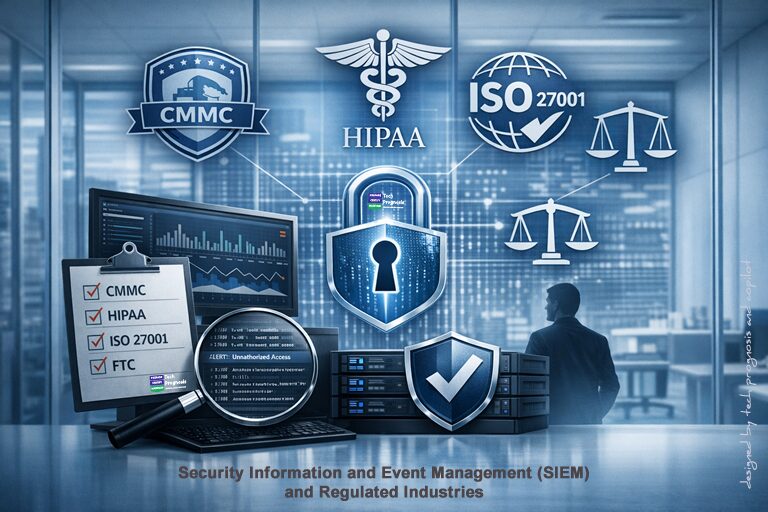
A digital illustration showing cybersecurity, Security Information and Event Management (SIEM) and compliance concepts, including a glowing lock at the center, surrounded by icons for CMMC, HIPAA, ISO 27001, and FTC related compliance, with dashboards, servers, checklists, and security symbols representing monitoring, auditing, and regulatory alignment.

Understanding SIEM in 2026: Limitations—and How to Build a Compliant, Outcome‑Driven Detection Program

Executive summary. Security Information and Event Management (SIEM) remains central to modern detection and response, but the playing field has evolved: cloud‑first estates, identity‑centric attacks, and new or strengthened rules (CMMC, HIPAA Security Rule enforcement practices, FTC Safeguards updates, ISO/IEC 27001:2022, and NIST CSF 2.0) raise the bar for logging, monitoring, and evidence. SIEM alone isn’t enough; you’ll need smart log source prioritization, detection engineering mapped to frameworks like MITRE ATT&CK, and automation you can trust (SOAR), all tuned to produce defensible evidence for audits and assessments.


What is Security Information and Event Management (SIEM) today (and what it isn’t)

A SIEM centrally collects and analyzes logs and events across systems, networks, applications, identities, and cloud services to help analysts detect, investigate, and report incidents. It’s often paired with Security Orchestration, Automation, and Response or SOAR to orchestrate and automate response actions.

SOAR (security orchestration, automation, and response) provides playbooks and automation for triage and remediation; it does not replace analytic rigor or governance.

Governments and industry recently published pragmatic guidance for implementing SIEM/SOAR, highlighting benefits (visibility, faster response) and pitfalls (data normalization, coverage, resource intensity).

Where SIEM fits in frameworks: NIST CSF 2.0 explicitly expects continuous monitoring and event logging outcomes (e.g., PR.PS‑04 requires that log records are generated and made available for continuous monitoring)—functions typically enabled by SIEM + SOAR.

Read more

Share

Data Flow Mapping for CMMC Level 2 and Your Entire Compliance Strategy

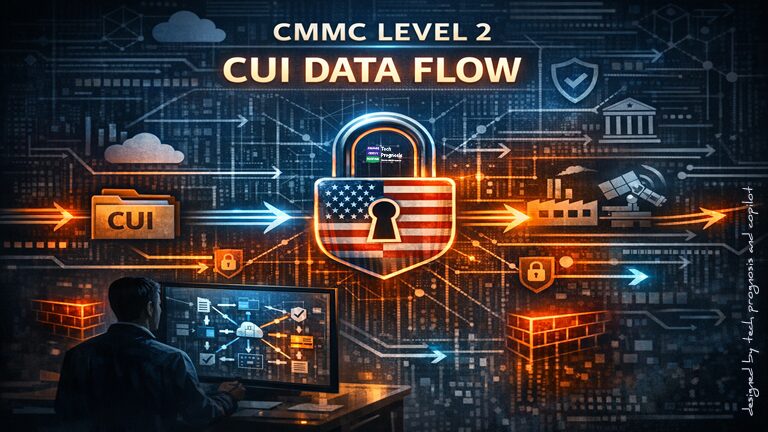
A digital illustration showing a secure CUI data flow concept for CMMC Level 2. A central padlock with a U.S. flag design is surrounded by directional arrows connecting icons representing cloud storage, government systems, industry, and firewalls. A person sits at a workstation viewing a data flow diagram.

Data Flow Mapping for CMMC Level 2: Why Mapping CUI Flow Determines Your Entire Compliance Strategy

If you can’t see where Federal Contract Information (FCI) and Controlled Unclassified Information (CUI) travel in your workflows, you can’t scope your obligations—period. This data flow mapping guide gives you a clear, repeatable way to map data flows, define system boundaries, and stop misclassification before it derails your contract.

Executive Summary

  • Controlling how CUI flows inside and outside your environment determines scope, architecture, tooling, and cost.
  • Design a focused CUI enclave so requirements only follow where CUI actually goes, reducing complexity and spend.
  • Document, enforce, and evidence approved flow paths to satisfy AC.L2-3.1.3 and pass a CMMC Level 2 assessment.

1. Introduction: Data Flow—the Most Underestimated Requirement

Organizations that pass CMMC Level 2 know exactly where CUI is allowed to go and can prove it never goes anywhere else. Information flow control is not just another checkbox—it shapes your boundary, controls, and cost.

2. What “Data Flow Control” Means in CMMC (AC.L2-3.1.3)

Control the flow of CUI in accordance with approved authorizations. Assessors expect to see:

  • Defined information flow control policies;
  • Defined enforcement mechanisms;
  • Designated sources and destinations for CUI;
  • Defined authorizations for CUI flow;
  • Consistent enforcement of those authorizations.

Read more

Share

CMMC Certification in Texas: 2026 Compliance Guide for DoD Contractors

Minimalist illustration representing CMMC cybersecurity for Texas DoD contractors, featuring a CMMC shield with a lock over a Texas outline, simplified defense icons, and U.S. and Texas flags

CMMC Certification for Texas DoD Contractors: The 2026 Comprehensive Guide

Defense contractors in Texas face a rapidly changing compliance landscape as the Department of Defense (DoD) fully implements the Cybersecurity Maturity Model Certification (CMMC) 2.0 program. With the final CMMC rule published on September 10, 2025, and enforcement already underway across new DoD solicitations, organizations that process Federal Contract Information (FCI) or Controlled Unclassified Information (CUI) must act quickly and decisively to ensure eligibility for future defense contracts.
[business.defense.gov]

This updated guide breaks down what CMMC is, what has changed, why Texas defense contractors must take action now, and how to prepare strategically.

What Is CMMC?

The Cybersecurity Maturity Model Certification (CMMC) is the DoD’s unified cybersecurity standard designed to ensure that all contractors within the Defense Industrial Base (DIB) implement adequate safeguards to protect sensitive information. The standard integrates requirements from:

  • FAR 52.204‑21 (for handling FCI)
  • NIST SP 800‑171 Rev. 2 (for protecting CUI)
  • NIST SP 800‑172 (for advanced protection required under Level 3)

CMMC was created in response to persistent compromises of defense information across contractor systems.

Read more

Share

Modern Recovery Planning: A Central Texas Business Guide

Business professional walking through flooded Central Texas street during severe storm, holding umbrella and briefcase. A case for why modern recovery planning is essential.

When Disaster Strikes: A Central Texas Business Guide to Modern Recovery Planning

How Round Rock, Austin, and Central Texas Businesses Can Plan Modern Recovery by Building Resilience Using the NIST Cybersecurity Framework and Cloud Technologies


Executive Summary

Central Texas businesses face frequent disruptions—from severe winter storms and flash floods to cyber incidents. A modern recovery strategy combines Business Continuity Planning (BCP) and Disaster Recovery Planning (DRP) within the NIST Cybersecurity Framework’s Recover function to minimize downtime and protect revenue. Cloud approaches (e.g., “pilot light” on AWS/Azure) now deliver near–enterprise‑grade recovery at a fraction of the traditional cost.

Quick next step:
Schedule your free 15‑minute discovery call to discuss your recovery objectives (RTO/RPO) and build a right‑sized cloud‑enabled plan for your Round Rock, Austin, or broader Central Texas operations.

Read more

Share

Defense Supply Chain and CMMC: Practical Steps for Vendor Security

Illustration of secure defense supply chain with shield and interconnected boxes representing vendors

CMMC 2.0 and Defense Supply Chain Attacks: Practical Steps to Build Resilience Across Your Vendor Ecosystem

Supply chain attacks keep rising because attackers go where trust and access already exist—third-party vendors, managed service providers, and software suppliers. If you handle Federal Contract Information (FCI) or Controlled Unclassified Information (CUI), your security posture is only as strong as your partners’. CMMC 2.0 responds to this reality by placing verifiable expectations on every tier that touches sensitive DoD data. In this post, we’ll break down the threat, connect it to CMMC’s objectives, and share a practical roadmap you can start using today—grounded in inclusive, plain language and real-world scenarios.

Why the Defense Supply Chain Is a Prime Target

  • The attack surface is huge. Organizations share data with hundreds of vendors, yet few have mature processes to evaluate and improve vendor cybersecurity posture. In 2023, 15% of breaches involved a defense supply chain compromise, and 98% of companies had at least one vendor that experienced a breach. This is a perfect storm of exposure and limited oversight.
  • High-profile cases illustrate the risk. The SolarWinds Orion compromise showed how malicious code in a trusted update can ripple across government and commercial networks. Likewise, the 2023 third-party breach linked to Infosys McCamish Systems affected more than 57,000 Bank of America-related entities, underscoring how downstream vendors can become a gateway for attackers.

Inclusive takeaway: regardless of your organization’s size, role, or location within the Defense Industrial Base (DIB), defense supply chain risk touches everyone who processes, stores, or transmits FCI/CUI.

Read more

Share

Cloud Technology: Understanding the Invisible Backbone of Modern Life

Cloud technology isometric showing icons of a cloud, datacenters and a laptop, with text of best practices for managing cloud dependence responsibly.

Cloud Technology Is Like Air: Understanding the Invisible Backbone of Modern Life

Introduction: The Air We Breathe, the Cloud We Use

We rarely think about the air around us until something disrupts it — a smoky day, a strong gust, or a breathless moment. The same goes for cloud technology. It’s always there, powering everything from our mobile apps and streaming platforms to business-critical systems and secure backups. Yet, unless there’s a service outage or data breach, many people don’t give it a second thought.

But in today’s digital-first world, understanding cloud technology is as essential as understanding electricity or plumbing. This blog explores the analogy of cloud computing as air, revealing just how pervasive and vital the cloud has become in both personal and professional contexts.

Read more

Share
Share
Share