
Overengineering Solutions: A Call for Practicality in MSP Services

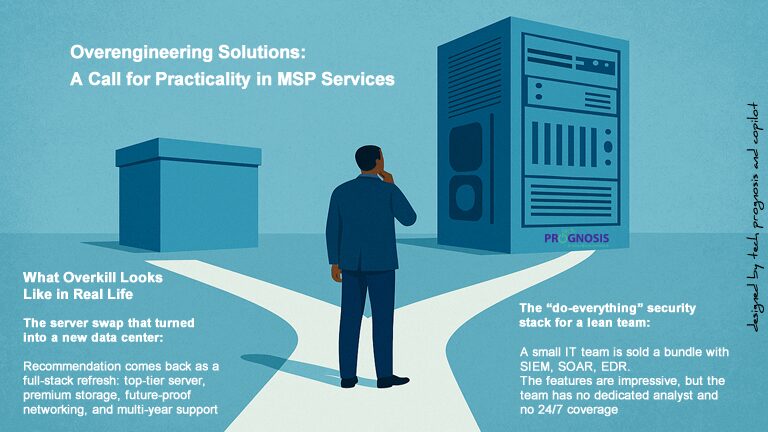
Illustration of a business professional standing at a crossroads, deciding between a simple box and a large server tower, symbolizing overengineering versus practical solutions.

Too many managed service providers (MSPs) still prescribe solutions that are bigger, pricier, and more complex than what clients actually need. Overengineering solutions not only wastes budget—it also slows teams down, erodes trust, and makes day‑to‑day operations harder. The fix is simple, but it takes discipline: start with the business problem, apply a risk‑based lens, right‑size the solution, and co‑design with the people who will live with it.

This post shares real‑world examples, root causes, and a practical framework you can use today.

Why This Question on Overengineering Solutions Still Matters

In a world of nonstop product launches, aggressive vendor marketing, and a constant drumbeat of “more features, more protection,” it’s easy to equate complexity with quality. But for many organizations—especially small and mid‑size businesses—large, layered solutions can be the wrong fit. They can consume scarce budgets, demand skills that the team doesn’t have, and introduce new points of failure.

Right‑sizing solutions is not about cutting corners. It’s about delivering outcomes that match the organization’s goals, resources, and risk tolerance. It’s about respect: the kind that honors each client’s constraints and aspirations. And it’s about trust—because teams remember when you take care to recommend what works, not simply what sells.

Read more

Share

Virtualization and the Small Business Owner (2026 Edition)

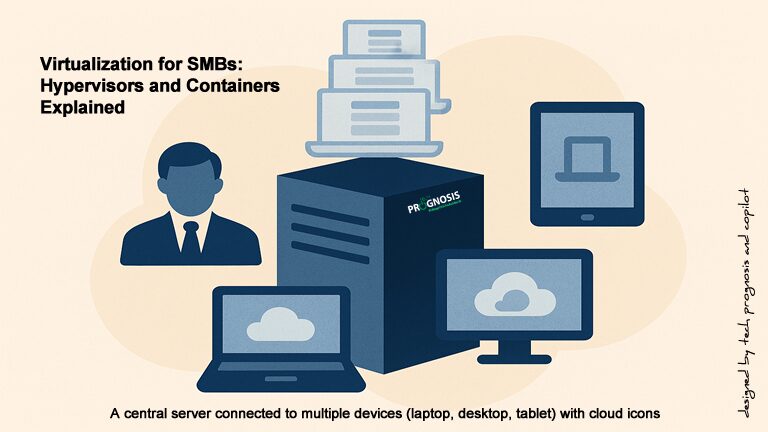
Illustration of a central server connected to multiple devices (laptop, desktop, tablet) with cloud icons, symbolizing virtualization and hybrid cloud integration for small businesses.

How Small Businesses Can Use Virtualization in 2026

Virtualization has moved from “promising” to practical and pervasive. In 2009, running six servers on 8 GB of RAM felt remarkable. Today, consolidation, hybrid cloud, containerization, and Desktop‑as‑a‑Service (DaaS) make modern small‑business IT more scalable, secure, and cost‑aware than ever. This guide shows how to choose—and succeed with—the right mix of virtual machines (VMs), containers, and cloud desktops for your business.

1) What “Virtualization” Means Today

Virtual machines (VMs) still anchor most business workloads. A hypervisor (like Hyper‑V, KVM, or VMware by Broadcom’s vSphere) runs multiple guest operating systems on one physical host, isolating workloads while boosting utilization. Linux’s KVM is built into the kernel, delivering near‑native performance for many workloads and supporting both x86 and Arm hosts. [kernel.org]

Read more

Share

True Cost of Neglecting IT (Information Technology) and Support

Illustration of essential IT investments concept with technology symbols and text of collaboration and communication, cloud computing and storage, cybersecurity, and secure remote work solutions as a remedy for organizations and businesses neglecting IT (Information Technology) and Support

Neglecting IT (Information Technology) and Support : The Make-Or-Break Factor Business Owners Overlook—Until It’s Too Late

A CIO’s Perspective on IT as a Growth Driver, Not Just a Cost

As the vCIO of a couple of businesses and organizations, I have seen firsthand how technology can be either a strategic enabler or a major roadblock. Too often, business owners focus on growth, sales, and customer experience while leaving IT decisions on the back burner—until something goes wrong.

For many business owners, IT is seen as a necessary expense rather than a strategic asset. But the reality is that your technology infrastructure directly impacts efficiency, security, and growth. Slow computer systems, dropped phone calls impacting sales, outdated software, or weak cybersecurity measures that leave an organization’s data vulnerable don’t just cause occasional frustration—they can create significant vulnerabilities that cost your business time, money, and reputation.

Here’s the hard truth: neglecting IT and support can cost your business more than you think—in lost productivity, security risks, and missed opportunities. The right technology isn’t just an operational necessity; it is a competitive advantage.

So, let me ask you: Is your IT helping your business grow, or is it quietly holding you back?

Read more

Share

IT Preparedness: Six Risk-Based Questions Every Nonprofit Leader Must Ask


Circular diagram infographic showing text of six risk-based questions non-profit leaders must ask about information technology or IT preparedness before their IT expert leaves the organization.

Six Risk-Based Questions Every Nonprofit Leader Must Ask About IT Preparedness Before Their IT Expert Leaves

Nonprofit organizations rely heavily on their in-house IT experts to keep operations running smoothly. But have you ever thought about what happens if that expert suddenly quits? It’s not just an inconvenience—it could be a disaster. Here are six critical questions to help you identify your IT preparedness, identify potential risks and protect your nonprofit.

When your nonprofit’s in-house IT expert suddenly leaves, the organization might face serious challenges—from downtime to security risks. To avoid disruption, leaders must take a proactive approach to understanding and documenting their IT environment. These six questions can help nonprofits of any size safeguard their operations.

Read more

Share

Shared Responsibility and The Importance of Email Backup for Microsoft Office 365

Image showing the concept of the shared responsibility model for Microsoft 365 Office, and depicting the responsibility of Microsoft and that of the consumers of its cloud services.

Protecting Your Business Data: The Importance of Shared Responsibility and Third-Party Email Backup Solutions for Microsoft Office 365

Businesses rely heavily on cloud-based solutions like Microsoft Office 365 for their day-to-day operations. With its suite of productivity tools and collaborative features, Office 365 has become a cornerstone for many organizations, enabling seamless communication, document sharing, and project management. However, amidst the convenience and efficiency it offers, there lies a critical aspect that business owners often overlook: shared responsibility for data protection.

Understanding Shared Responsibility

When it comes to cloud services like Office 365, there’s a common misconception that data protection is solely the responsibility of the service provider. While Microsoft does implement robust security measures to safeguard your data against external threats, such as encryption, threat detection, and compliance certifications, the responsibility for certain aspects of data protection falls on the shoulders of the user – that’s you, the business owner.

Read more

Share

7 Common Technology Challenges Small Business Owners Face (And How to Overcome Them)

Image of maze game with space theme depicting the 7 common technology challenges small business owners face.

7 Common Technology Challenges Small Business Owners Face (And How to Overcome Them)

Technology is now a cornerstone for small businesses, empowering them to compete in a dynamic market. It plays a vital role in the success of small businesses. However, with the rapid advancements and ever-evolving landscape, small business owners often find themselves facing a myriad of challenges. From cybersecurity threats to outdated systems, these obstacles can hinder productivity and growth.

In this article, we’ll explore seven common technology problems faced by small business owners and provide practical solutions to overcome them.

Read more

Share
Share
Share