
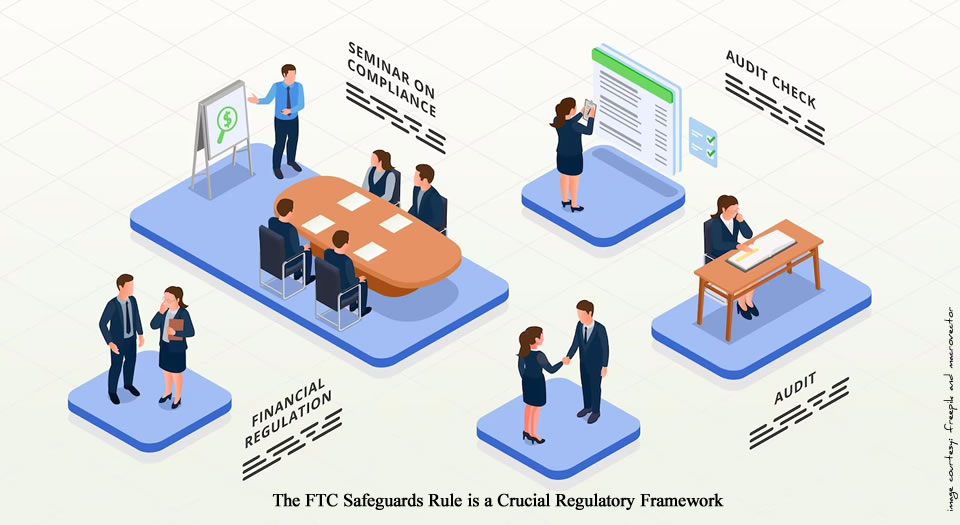
In today’s digital age, data security is paramount. With cyber threats on the rise, protecting sensitive information has become a top priority for businesses of all sizes. The Federal Trade Commission’s FTC Safeguards Rule is a crucial regulatory framework designed to ensure the security and confidentiality of customer information. In this article, we’ll break down what businesses need to know about the FTC Safeguards Rule.
Understanding the FTC Safeguards Rule
The FTC Safeguards Rule is a set of regulations developed under the Gramm-Leach-Bliley Act (GLBA) to safeguard consumer information held by financial institutions and certain other businesses. Its primary goal is to protect the privacy and security of customer data, preventing unauthorized access, and ensuring that businesses have robust security measures in place.
Who Does the Rule Apply To?
The Safeguards Rule primarily applies to financial institutions such as banks, credit unions, and mortgage lenders. However, it also extends to a broader range of businesses known as “financial institutions under the GLBA.” These include businesses that are significantly engaged in financial activities, such as:
- Tax Preparers: Businesses involved in tax preparation and filing services.
- Check Cashers and Payday Lenders: Entities that provide check-cashing services or short-term loans.
- Credit Reporting Agencies: Companies that collect and maintain credit information on individuals.
- ATM Operators: Businesses that operate automated teller machines.
Key Requirements of the FTC Safeguards Rule
1. Develop a Written Information Security Program (WISP)
One of the core requirements of the Safeguards Rule is the development and maintenance of a Written Information Security Program (WISP). This document outlines how a business plans to protect customer information. It should include:
- Risk Assessment: Identifying potential risks to customer data.
- Safeguards: Implementing security measures to address those risks.
- Oversight: Assigning responsibility for the program to specific individuals.
- Regular Updates: Continuously reviewing and updating the program to adapt to changing threats.
2. Employee Training
Employees play a crucial role in data security. The Safeguards Rule mandates training programs to educate employees about their responsibilities in safeguarding customer information. Regular training helps reduce the likelihood of human error leading to data breaches.
3. Access Control Measures
Controlling access to customer information is vital. Businesses should implement strong authentication measures, such as passwords and multi-factor authentication, to ensure only authorized personnel can access sensitive data.
4. Incident Response Plan
Despite best efforts, data breaches can still occur. Having a well-defined incident response plan is essential. It should outline steps to take in the event of a data breach, including notifying affected parties and regulatory authorities as required by law.
Penalties for Non-Compliance with the FTC Safeguards Rule
Non-compliance with the FTC Safeguards Rule can result in severe consequences for businesses. The FTC has the authority to enforce the rule and impose penalties, including fines. Additionally, businesses found negligent in protecting customer information may suffer significant reputational damage.
Practical Steps for Compliance with the FTC Safeguards Rule
Achieving compliance with the Safeguards Rule requires a proactive approach:
- Identify Applicable Regulations: Determine whether your business falls under the scope of the GLBA and, if so, the Safeguards Rule.
- Create a WISP: Develop a comprehensive Written Information Security Program tailored to your organization’s needs and risks.
- Employee Training: Provide regular training to your staff to ensure they understand their roles in data protection.
- Access Control: Implement strong access control measures to restrict unauthorized access to customer information.
- Incident Response: Develop a clear incident response plan to minimize the impact of data breaches.
- Regular Audits: Periodically review and update your security measures to stay ahead of evolving threats.
Conclusion
In an era where data breaches and cyber threats are a constant concern, businesses must take the FTC Safeguards Rule seriously. Understanding the requirements and taking proactive steps to protect customer information not only ensures compliance but also fosters trust among customers. By adhering to these guidelines, businesses can secure sensitive data and demonstrate their commitment to safeguarding customer privacy. Remember, in today’s digital landscape, data security is not just a legal requirement but a fundamental aspect of good business practice.
If you need assistance with a risk assessment to discover compliance lapses in your environment, contact us schedule a visit, or call us at 512-814-8044.
