
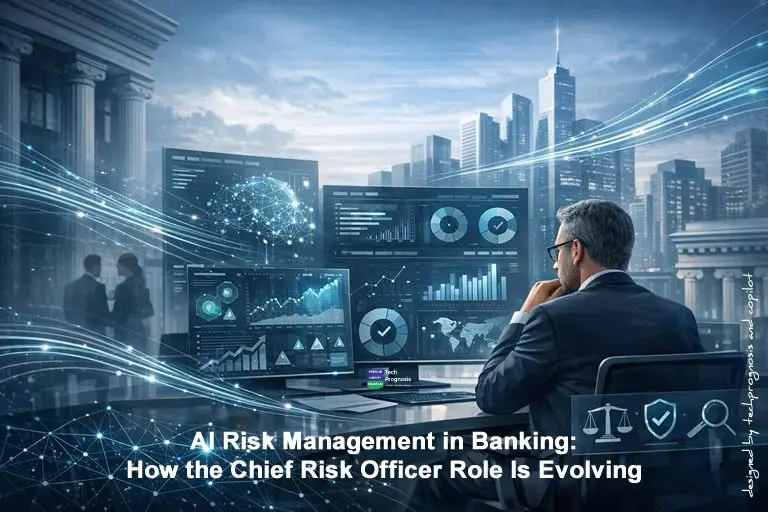
AI risk management is becoming a defining priority for banks and other financial institutions. As artificial intelligence moves from experimentation to operational use across financial services, the Chief Risk Officer is being asked to do more than monitor exposures and enforce controls. The role now sits at the center of AI governance, model risk management, regulatory discipline, and customer trust.
Over the next several years, AI in banking will reshape how institutions identify emerging threats, assess customer and portfolio risk, detect anomalies, and respond to changing market conditions. For Chief Risk Officers, the shift is not simply technological. It is strategic. The role is evolving from oversight alone to active partnership in enterprise transformation, responsible AI adoption, and predictive risk management.
AI Risk Intelligence
Leading institutions are building AI-enabled risk operations that bring together transaction data, market signals, internal controls, and external indicators into a more unified view of exposure. The goal is not to create a futuristic control room for its own sake. It is to shorten the time between signal detection, analysis, and action.
In practice, these capabilities can help risk teams detect unusual transaction patterns earlier, monitor concentrations across portfolios, and surface relationships among operational, market, credit, and compliance risks that might otherwise remain fragmented across systems. Used well, AI can improve the speed and consistency of analysis, especially in environments where risk teams must process large volumes of data in near real time.
But AI-enabled risk intelligence is only as strong as the underlying data, controls, and governance. Without clear ownership, validation, monitoring, and escalation pathways, faster insights can just as easily accelerate poor decisions. That is why the CRO remains central: AI expands the range of what the risk function can see, but leadership determines how those insights are interpreted and acted upon.
Personalized Risk Models
Another major shift is the move away from broad, segment-based risk assessment toward more granular modeling. AI makes it possible to evaluate a wider range of signals, identify nonlinear relationships, and tailor decisions more closely to individual customers, counterparties, transactions, or scenarios.
In lending and customer risk assessment, that can translate into more precise differentiation between applicants who appear similar under traditional scoring approaches. In fraud and financial crime programs, it can improve the prioritization of alerts and reduce unnecessary manual review. In treasury and market risk contexts, it can support more dynamic scenario analysis and stress testing.
The opportunity is significant, but so is the responsibility. More personalized models raise important questions about explainability, fairness, privacy, and adverse-action transparency. In highly regulated environments, better prediction alone is not enough; institutions must also be able to defend how decisions are made and whether those decisions remain aligned with legal and ethical expectations.
How the Chief Risk Officer Role Is Changing
These technological advances are transforming the CRO role in several fundamental ways:
Predictive Leadership
Traditional risk programs often emphasized retrospective control: investigate what happened, document the lesson, and strengthen the framework. AI expands that model by helping institutions anticipate what may happen next. It enables earlier detection of weak signals, faster scenario analysis, and more continuous monitoring of changing conditions.
That changes the Chief Risk Officer’s job. The modern risk leader must be able to evaluate forward-looking signals without treating model output as certainty. Effective CROs will combine data-driven insight with judgment, challenge, and escalation discipline. Predictive tools are most valuable when they strengthen decision quality, not when they replace accountability.
Innovation Enabler
AI also changes the posture of the risk function inside the enterprise. When risk teams have stronger analytical capability, they are better positioned to support product design, market expansion, underwriting strategy, and operational resilience. That allows the Chief Risk Officer to move beyond being seen as a gatekeeper and toward being recognized as a strategic enabler of responsible growth.
This is especially important when institutions are evaluating new customer segments, new geographies, or new products. Better risk intelligence can help leaders distinguish between uncertainty that should be priced, monitored, or mitigated and uncertainty that should stop an initiative entirely. In that sense, AI can make risk management more commercially relevant without making it less disciplined.
Strategic Partner
AI adoption also pushes the CRO closer to technology, data, compliance, legal, and frontline business leaders. That is a healthy development. AI risk cannot be managed in a silo, because the underlying issues span model design, data sourcing, customer outcomes, regulatory obligations, cybersecurity, and operational execution.
As a result, the CRO increasingly becomes a translator across functions: helping technologists understand risk expectations, helping executives understand model limitations, and helping boards understand where AI creates both opportunity and exposure. Institutions that do this well are more likely to build governance into AI programs early rather than retrofit controls after problems emerge.
AI Roadmap for Chief Risk Officers
For CROs preparing for this shift, the most effective approach is usually phased rather than dramatic: build the foundations first, scale what works, and strengthen controls as the use of AI becomes more material to core risk decisions.
Year 1: Foundation Building
Build AI Literacy
Start with AI literacy. Risk professionals do not need to become machine learning engineers, but they do need enough fluency to ask the right questions about data quality, model design, drift, explainability, and control effectiveness. Without that baseline, meaningful challenge becomes difficult.
That capability matters because AI governance is not only a technical exercise. It depends on whether the risk function can challenge assumptions, understand where performance may degrade, and recognize when a model’s outputs should not drive a business decision without additional review.
Set AI Governance
Next, establish governance that is clear enough to support innovation and strong enough to withstand scrutiny. Public frameworks already point in this direction. NIST’s AI Risk Management Framework provides a practical structure for governing, mapping, measuring, and managing AI risk, while recent U.S. banking guidance reinforces that model risk management should be risk-based, tailored, and supported by effective governance and controls.
- Clear ownership for model development, validation, monitoring, and override decisions
- Testing for performance, bias, explainability, resilience, and data quality
- Defined escalation paths when outputs conflict with policy, regulation, or human judgment
Run Pilot Projects
Early pilot projects should be targeted and measurable. The best candidates are often use cases with clear business value, available data, manageable regulatory exposure, and reversible outcomes. Well-chosen pilots help institutions learn where AI adds value, where controls need strengthening, and where adoption should proceed more cautiously.
Year 2-3: Scaling and Integration
Build Infrastructure
As adoption expands, institutions need infrastructure that supports reliable AI use across functions. That includes integrated data architecture, consistent definitions, lineage, access controls, and monitoring environments that allow teams to evaluate performance over time rather than at a single point of deployment.
This work is often less visible than model development, but it is usually more important. Institutions that struggle with fragmented data, inconsistent taxonomies, and unclear ownership rarely achieve scalable AI risk programs, no matter how sophisticated the models appear in isolation.
Hybrid Workflows
The strongest operating model is usually hybrid. AI can process signals, rank alerts, identify outliers, and generate recommendations at scale. Humans remain essential for context, escalation, exceptions, and decisions that carry legal, reputational, or strategic weight.
That balance is especially important in credit, fraud, compliance, and trading environments, where decisions may need to be both fast and explainable. Human oversight should not be a symbolic control. It should be built into workflow design, authority structures, and documentation standards.
Continuous Learning
Institutions should also build feedback loops into operations. Models need monitoring for drift, shifts in customer behavior, changes in the external environment, and patterns in overrides or escalations. Continuous learning is not just about improving model accuracy; it is about improving governance and decision quality over time.
Year 4-5: Advanced Capabilities
Real-Time Risk
In more mature environments, the ambition shifts from periodic review to continuous intelligence. Instead of assessing risk on a monthly or quarterly cadence, institutions can monitor key indicators in near real time and adapt controls, thresholds, or escalation processes more quickly as conditions change.
Achieving that state requires more than better models. It requires operational readiness: clear playbooks, defined response authorities, resilient systems, and disciplined governance so that faster alerts translate into better action rather than more noise.
Tailored Risk Models
More mature institutions may also move toward increasingly tailored risk models that incorporate richer behavioral, transactional, and contextual signals. Where these models affect customers directly, however, institutions should ensure they remain explainable, tested for unintended bias, and appropriate for the regulatory context in which they operate.
External Data
External data can expand visibility, but it also introduces added complexity around provenance, quality, consent, vendor oversight, and regulatory defensibility. CROs should treat third-party data and external models as governance questions, not just technical inputs.
Critical Success Factors
Several factors consistently distinguish institutions that make meaningful progress from those that remain stuck in fragmented experimentation:
Executive sponsorship: AI-enabled risk transformation requires sustained leadership support. Without alignment among the CRO, CIO or CTO, legal, compliance, and business leadership, initiatives often stall between proof of concept and enterprise adoption.
Cultural change: Institutions need a culture that values challenge, documentation, and learning. AI programs struggle when teams treat model output as infallible or, at the other extreme, reject it outright because it is unfamiliar.
Talent strategy: The most effective teams blend domain expertise, data science, model risk management, compliance, and product understanding. Hiring alone is not enough; institutions also need to upskill experienced risk professionals so they can challenge and guide AI adoption.
Regulatory engagement: Governance expectations are continuing to evolve. In the United States, institutions can already draw on public resources such as NIST’s AI Risk Management Framework, the U.S. Treasury’s financial-services-oriented AI risk framework, and updated interagency banking guidance emphasizing risk-based governance and controls.
The Path Forward
AI will not eliminate the need for judgment in risk management. If anything, it raises the premium on disciplined leadership. The institutions that benefit most will be those that combine stronger analytics with strong governance, clear accountability, and a realistic understanding of where models help and where humans must decide.
For CROs, the opportunity is clear: use AI to make the risk function faster, more connected, and more strategic, while ensuring that trust, transparency, and control remain non-negotiable. That is what publication-ready leadership on AI and risk should look like.
Getting Started
If your organization is evaluating how to strengthen AI governance, modernize model risk management, or build a practical roadmap for responsible adoption, a short discovery conversation can help clarify priorities and next steps.
- Assess your readiness
- Identify quick wins
- Plan your implementation roadmap
References
- National Institute of Standards and Technology. Artificial Intelligence Risk Management Framework (AI RMF 1.0).
- National Institute of Standards and Technology. AI Risk Management Framework: Generative AI Profile.
- S. Department of the Treasury. Treasury Releases Two New Resources to Guide AI Use in the Financial Sector. February 19, 2026.
- S. Department of the Treasury. Managing Artificial Intelligence-Specific Cybersecurity Risks in the Financial Services Sector. March 2024.
- Board of Governors of the Federal Reserve System and Office of the Comptroller of the Currency. Supervisory Guidance on Model Risk Management (SR 11-7). April 4, 2011.
- Office of the Comptroller of the Currency, Board of Governors of the Federal Reserve System, and Federal Deposit Insurance Corporation. Model Risk Management: Revised Guidance. April 17, 2026.
- Consumer Financial Protection Bureau. Consumer Financial Protection Circular 2022-03: Adverse action notification requirements in connection with credit decisions based on complex algorithms.
- Consumer Financial Protection Bureau. CFPB Issues Guidance on Credit Denials by Lenders Using Artificial Intelligence. September 19, 2023.
- Federal banking agencies. Interagency Guidance on Third-Party Relationships: Risk Management. June 2023.
About the Author: Daniel Ihonvbere is a Risk Management and GRC expert with 15+ years of experience helping organizations and businesses navigate technological transformation and complex regulatory guidelines and frameworks.
