Security Information and Event Management (SIEM) and Regulated Industries

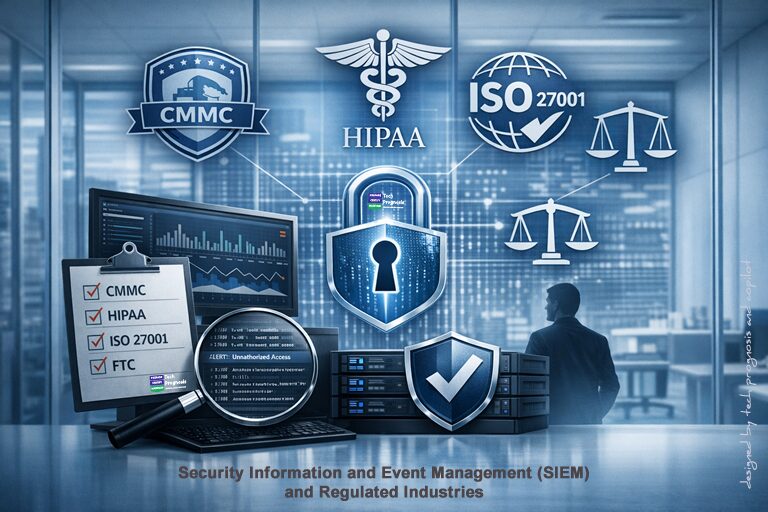
A digital illustration showing cybersecurity, Security Information and Event Management (SIEM) and compliance concepts, including a glowing lock at the center, surrounded by icons for CMMC, HIPAA, ISO 27001, and FTC related compliance, with dashboards, servers, checklists, and security symbols representing monitoring, auditing, and regulatory alignment.

Understanding SIEM in 2026: Limitations—and How to Build a Compliant, Outcome‑Driven Detection Program

Executive summary. Security Information and Event Management (SIEM) remains central to modern detection and response, but the playing field has evolved: cloud‑first estates, identity‑centric attacks, and new or strengthened rules (CMMC, HIPAA Security Rule enforcement practices, FTC Safeguards updates, ISO/IEC 27001:2022, and NIST CSF 2.0) raise the bar for logging, monitoring, and evidence. SIEM alone isn’t enough; you’ll need smart log source prioritization, detection engineering mapped to frameworks like MITRE ATT&CK, and automation you can trust (SOAR), all tuned to produce defensible evidence for audits and assessments.


What is Security Information and Event Management (SIEM) today (and what it isn’t)

A SIEM centrally collects and analyzes logs and events across systems, networks, applications, identities, and cloud services to help analysts detect, investigate, and report incidents. It’s often paired with Security Orchestration, Automation, and Response or SOAR to orchestrate and automate response actions.

SOAR (security orchestration, automation, and response) provides playbooks and automation for triage and remediation; it does not replace analytic rigor or governance.

Governments and industry recently published pragmatic guidance for implementing SIEM/SOAR, highlighting benefits (visibility, faster response) and pitfalls (data normalization, coverage, resource intensity).

Where SIEM fits in frameworks: NIST CSF 2.0 explicitly expects continuous monitoring and event logging outcomes (e.g., PR.PS‑04 requires that log records are generated and made available for continuous monitoring)—functions typically enabled by SIEM + SOAR.

Read more

Share

Chief Risk Officer Role in Banking: Evolution in the Age of AI

Simulation of how AI risk management is reshaping banking and the Chief Risk Officer role

AI risk management is becoming a defining priority for banks and other financial institutions. As artificial intelligence moves from experimentation to operational use across financial services, the Chief Risk Officer is being asked to do more than monitor exposures and enforce controls. The role now sits at the center of AI governance, model risk management, regulatory discipline, and customer trust.

Over the next several years, AI in banking will reshape how institutions identify emerging threats, assess customer and portfolio risk, detect anomalies, and respond to changing market conditions. For Chief Risk Officers, the shift is not simply technological. It is strategic. The role is evolving from oversight alone to active partnership in enterprise transformation, responsible AI adoption, and predictive risk management.

Read more

Share

Revolutionary FAR Overhaul (RFO) for CMMC

Revolutionary FAR Overhaul (RFO) article header illustrating the shift to verified cybersecurity enforcement.

The CMMC Revolutionary FAR Overhaul (RFO): Why the DoD’s Quiet Regulatory Reset Changed Cybersecurity Enforcement Forever

Executive Summary (For Decision‑Makers)

In late 2025 and early 2026, the Department of Defense executed a sweeping regulatory cleanup now commonly referred to as the Revolutionary FAR Overhaul (RFO). While much of the attention has focused on the deletion of specific clauses—most notably DFARS 252.204‑7019—the real story is far larger.

RFO fundamentally changed how cybersecurity compliance is enforced, not just how it is described. Temporary, trust‑based mechanisms were removed. Verified, system‑enforced eligibility replaced them. As a result:

  • DFARS 7019 disappeared
  • SPRS was repositioned
  • CMMC became non‑negotiable
  • Contract eligibility—not intent—became the enforcement mechanism

This article explains what RFO actually is, why it occurred, and how it permanently reshaped cybersecurity enforcement across the Defense Industrial Base (DIB).

Read more

Share

CMMC Level 2 Readiness: The Need for Strong IT Audits

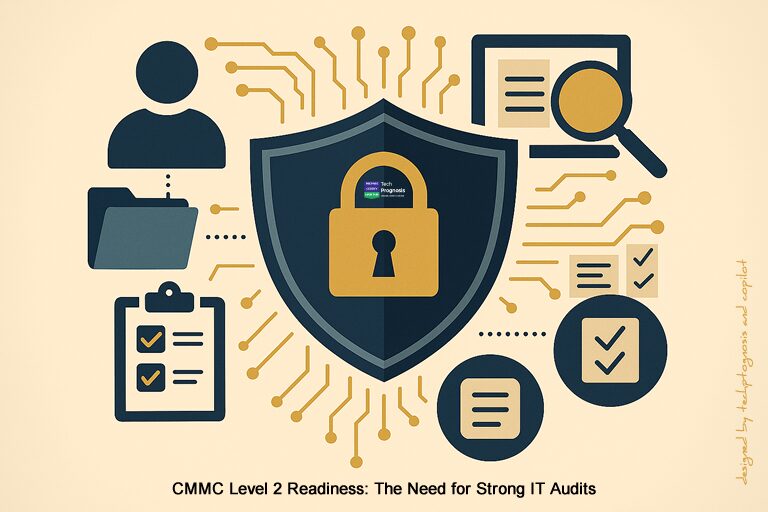
Abstract cybersecurity audit illustration showing a shield with padlock surrounded by checklists, documents, and review icons, representing CMMC Level 2 readiness and evidence‑based defense compliance

CMMC Level 2 Readiness: Why Strong IT Audits Are the Difference Between Compliance and Contract Loss

For defense contractors, CMMC Level 2 is no longer a theoretical requirement—it’s a gatekeeper. As the Department of Defense moves away from self‑attestation toward evidence‑based assessments, organizations handling Controlled Unclassified Information (CUI) must now prove their cybersecurity maturity.

At the core of that proof is one often‑misunderstood capability: the IT audit function.

In our work helping organizations prepare for and pass CMMC Level 2 assessments, we consistently see the same pattern. Companies that treat audits as a last‑minute compliance exercise struggle. Companies that integrate internal and external audit disciplines into their CMMC strategy succeed—and stay compliant long after certification.

This article explains how IT audits directly support CMMC Level 2 readiness, why both internal and external auditors matter, and how audit‑driven programs build real cybersecurity resilience.

Read more

Share

Cyber Resilience for CMMC Contractors: Why It Matters and How to Build It

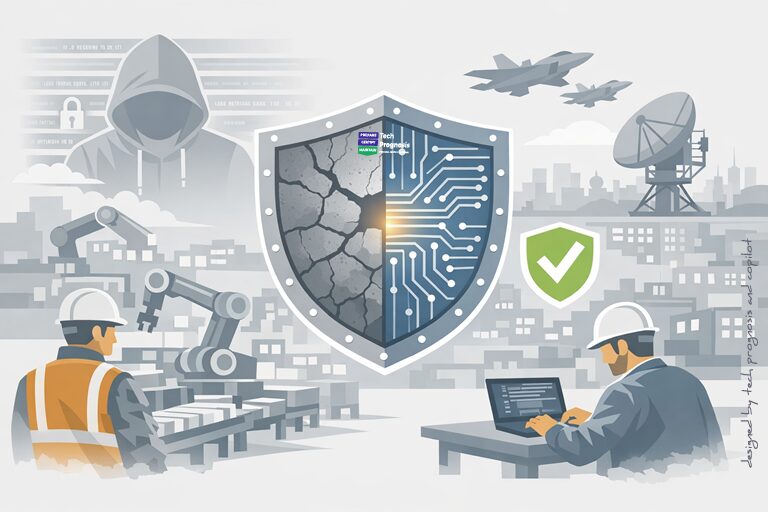
A flat, minimalist illustration showing a manufacturing environment with robotic arms, workers in safety vests, and a central shield symbol split between a cracked surface and a circuit‑board design, representing cyber threats and resilience. Minimalist aircraft, a satellite dish, and a green security checkmark appear in the background.

Cyber Resilience for CMMC Contractors: Why It Matters and How to Build It

Cyber resilience is the capability to anticipate, withstand, recover from, and adapt to adverse cyber conditions—so that your mission‑essential manufacturing operations continue even when an attack succeeds. Resilience complements CMMC’s confidentiality‑focused controls (based on NIST SP 800‑171r3) by emphasizing continuity, restoration, and adaptation across IT and OT.

Audience: Defense Industrial Base (DIB) manufacturers and suppliers that handle FCI/CUI and are preparing for (or maintaining) CMMC compliance.


Why Cyber Resilience Now (Especially in the DIB)

  • The DIB remains a prime target for espionage and ransomware, and the Department of Defense (DoD) created CMMC to raise the floor on contractor protections for FCI/CUI.
  • NIST’s Cybersecurity Framework (CSF) 2.0 underscores governance and recoverability as integral to enterprise risk management—useful language for your board, program managers, and auditors.
  • Ransomware and OT/ICS impacts propagate from IT to plant networks; resilient manufacturers isolate critical processes, segment IT/OT, and test offline backups to maintain production.

Bottom line: CMMC helps protect sensitive data; resilience keeps your line running and deliveries on time.

Read more

Share

CMMC Enclaves Explained

Four-diagram visual illustrating CMMC enclaves showing Level 2 enclave models, including a VDI technical enclave, a physical manufacturing enclave, a cloud enclave pitfall, and a hybrid enclave, with control-domain icons showing how CUI is protected and scoped.

CMMC Enclaves Explained: A Practical Path to Level 2 Compliance Without Securing Everything

For many defense contractors, CMMC Level 2 feels intimidating. You hear phrases like 110 practices, NIST SP 800‑171, assessment-ready, and DoD assessments, and it can sound like your entire business needs to be rebuilt from the ground up.

Here’s the good news: it probably doesn’t.

Most small and mid-sized organizations do not need to secure their entire enterprise to meet CMMC Level 2. Instead, they can use a focused, defensible strategy called a CMMC enclave—a way to protect Controlled Unclassified Information (CUI) – the sensitive data the DoD wants you to protect – without turning the rest of the business upside down.

Think of it this way: instead of installing airport-style security in your entire office building, you build a secure vault for your valuables. That vault is your enclave.

This article explains what a CMMC enclave really is, how it applies specifically to CMMC Level 2, real-world enclave setup examples, how assessors evaluate them, and how to get started without overengineering your environment.

Read more

Share
Share
Share