
The CMMC Revolutionary FAR Overhaul (RFO): Why the DoD’s Quiet Regulatory Reset Changed Cybersecurity Enforcement Forever
Executive Summary (For Decision‑Makers)
In late 2025 and early 2026, the Department of Defense executed a sweeping regulatory cleanup now commonly referred to as the Revolutionary FAR Overhaul (RFO). While much of the attention has focused on the deletion of specific clauses—most notably DFARS 252.204‑7019—the real story is far larger.
RFO fundamentally changed how cybersecurity compliance is enforced, not just how it is described. Temporary, trust‑based mechanisms were removed. Verified, system‑enforced eligibility replaced them. As a result:
- DFARS 7019 disappeared
- SPRS was repositioned
- CMMC became non‑negotiable
- Contract eligibility—not intent—became the enforcement mechanism
This article explains what RFO actually is, why it occurred, and how it permanently reshaped cybersecurity enforcement across the Defense Industrial Base (DIB).
1. What the Revolutionary FAR Overhaul (RFO) Actually Is
The Revolutionary FAR Overhaul (RFO) was not a single rulemaking event and not a new regulation added to the FAR. Instead, it was a coordinated effort by the DoD to clean up, de‑duplicate, and realign FAR and DFARS clauses using class deviations once CMMC was operational and enforceable.
The Revolutionary FAR Overhaul (RFO) is a comprehensive initiative aimed at streamlining federal procurement processes, enhancing efficiency, and reducing unnecessary regulations within the Federal Acquisition Regulation (FAR). This overhaul is guided by Executive Order 14275 and focuses on simplifying the language of the FAR and removing non-statutory rules to improve acquisition outcomes.
Key characteristics of RFO include:
- Timeline: Late 2025 through early 2026, with the majority of cybersecurity‑related changes effective around February 1, 2026
- Method: Class deviations, rather than a single omnibus rule
- Scope:
- Removal of temporary or transitional clauses
- De‑duplication between FAR and DFARS
- Alignment of contractual language with enforcement reality
The critical takeaway is this:
RFO marked the transition from policy signaling to contractual enforcement.
For years, the DoD relied on clauses that created visibility and intent. RFO removed those clauses once enforcement infrastructure was ready.
2. Why the DoD Needed RFO (The Enforcement Failure It Fixed)
To understand RFO, it helps to understand what came before it.
Before CMMC enforcement, the DoD faced a persistent problem:
- Contractors self‑attested compliance
- Enforcement was inconsistent across commands
- Cybersecurity became a paper exercise
- There were limited consequences for misrepresentation
Clauses such as DFARS 7012, 7019, and 7020 existed largely as stopgaps—ways for the DoD to signal expectations without having a scalable enforcement model.
SPRS became a repository of mixed‑confidence data:
- Basic self‑assessments
- Inconsistent scoring
- Little verification
- Minimal operational consequence
This eroded enforcement credibility.
RFO was not bureaucratic cleanup.
It was an enforcement correction.
3. How RFO Changed Cybersecurity Enforcement Mechanics
RFO fundamentally altered how compliance is validated.
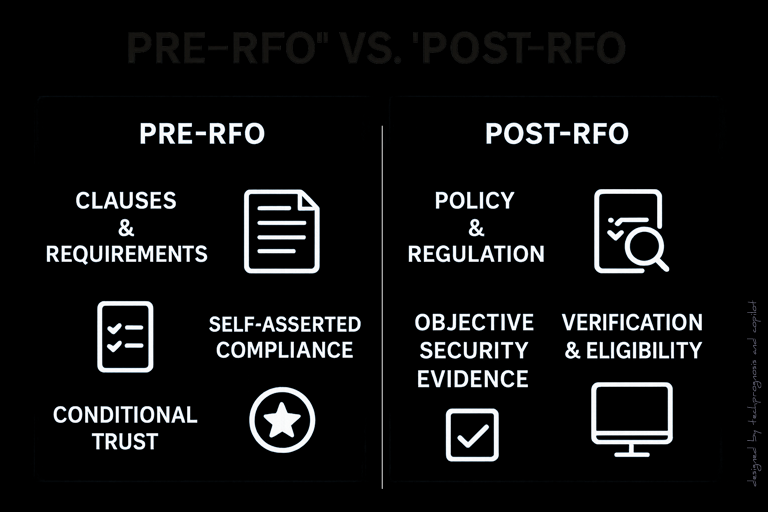
Pre‑Revolutionary FAR Overhaul Enforcement Model
- Clause‑based requirements
- Contractor self‑assertions
- Conditional trust
- Limited systemic verification
Post‑Revolutionary FAR Overhaul Enforcement Model
- System‑based enforcement
- Verified status
- Centralized visibility
- Automatic eligibility decisions
The new enforcement flow now looks like this:
Policy → Evidence → Verification → SPRS → Eligibility
- Policy establishes requirements (FAR, DFARS, RFO)
- Evidence comes from implemented NIST SP 800‑171 controls
- Verification occurs via CMMC assessments (self or third‑party)
- SPRS records authoritative status
- Eligibility determines award, options, and task orders
Breaks anywhere in this chain now stop awards.
4. DFARS 7019 & 7020: Symptoms, Not the Story
Much of the industry conversation around RFO has focused on DFARS clause deletions. That focus misses the point.
4.1 What DFARS 7019 Was Designed to Do
DFARS 7019 required contractors handling CUI to:
- Perform a NIST SP 800‑171 Basic self‑assessment
- Upload scores into SPRS
It was never intended as permanent enforcement. It was a visibility tool.
4.2 Why DFARS 7019 Was Removed
Once CMMC became enforceable:
- Self‑scoring became insufficient
- Legacy visibility conflicted with verified certification
- DFARS 7019 became redundant
Its removal was a signal that trust‑based compliance had ended.
4.3 What Changed With DFARS 7020
DFARS 7020 was renumbered and revised:
- Basic self‑assessment language removed
- Medium and High assessments remain
- DCMA DIBCAC assessments continue
- NIST SP 800‑171A remains the assessment basis
The clause didn’t fail.
The era it belonged to ended.
5. SPRS Repositioned as an Enforcement Gate
One of the most dangerous misconceptions post‑RFO is the idea that “SPRS went away.”
It didn’t.
What changed was what SPRS represents.
Before RFO:
- SPRS stored mixed‑confidence self‑reported data
After RFO:
- SPRS is the system of record for CMMC status
- Contracting officers must check it
- Prime contractors must verify it
- Incorrect or expired entries block awards
SPRS is no longer a database.
It is now an enforcement gate.
6. Why CMMC Became Non‑Negotiable After Revolutionary FAR Overhaul
With the final CMMC rule in effect, CMMC is no longer a future requirement or roadmap item. It is a condition of contract award.
RFO removed every remaining workaround:
- No more “basic compliance”
- No more interim visibility substitutes
- No more self‑asserted trust for CUI
Level Boundaries Now Matter
- Level 1: FCI only—no CUI, no exceptions
- Level 2: Required for any CUI handling or growth‑oriented DoD work
CMMC is no longer about readiness.
It is about permission to compete.
7. Operational Impacts for Primes and Subcontractors
7.1 Prime Contractors
- Mandatory SPRS validation
- No ability to “carry” non‑compliant subs
- Compliance failures propagate into bids, options, and task orders
7.2 Subcontractors
- Loss of transitional buffers
- Increased exclusion risk
- Need for proactive certification alignment
Enforcement now flows up and down the supply chain.
8. Strategic Takeaways for Growth‑Minded Contractors
Contractors treating CMMC as overhead are missing the strategic reality.
Early compliance enables:
- Faster teaming
- Reduced due diligence friction
- Preferred subcontractor positioning
- Stronger M&A posture
- Increased contract velocity
CMMC has become market access insurance.
9. Common Post‑RFO Mistakes to Avoid
- Assuming SPRS no longer matters
- Staying at Level 1 while touching CUI “temporarily”
- Treating CMMC as documentation instead of operations
- Letting BD strategies outpace compliance readiness
These mistakes no longer cause delays.
They cause disqualification.
10. What Contractors Should Do Now
- Remove all legacy DFARS 7019 references
- Confirm correct CMMC level
- Validate SPRS entries for accuracy and currency
- Update subcontractor verification procedures
- Train executives and BD teams on enforcement reality
- Align growth strategies with certification timelines
Final Takeaway: RFO Marked the End of Trust‑Based Compliance
The Revolutionary FAR Overhaul was the inflection point.
- RFO reset the regulatory structure
- CMMC became the enforcement model
- SPRS became the gate
- Eligibility replaced intent
Key Objectives
- Streamlining Procurement: The RFO seeks to simplify the acquisition process, making it faster and more competitive.
- Enhancing Clarity: The initiative focuses on rewriting the FAR in plain language to improve understanding and compliance.
- Removing Non-Statutory Rules: Many non-essential regulations will be eliminated to reduce bureaucratic hurdles.
Major Changes
Implementation Strategy
- Immediate Adoption: Agencies are encouraged to adopt draft revisions immediately, even before formal rulemaking is complete.
- Four-Year Sunset Clause: Non-statutory FAR provisions will automatically expire after four years unless renewed, promoting periodic review and updates.
New Frameworks
- Strategic Acquisition Guidance (SAG): This new approach will replace many non-statutory FAR provisions with practical, scenario-specific guides, starting with areas like Software as a Service (SaaS).
Expected Benefits
- Faster Acquisitions: The RFO aims to reduce the time required for federal procurement.
- Greater Competition: By simplifying regulations, the initiative encourages more entities to participate in federal contracting.
- Improved Results: The overall goal is to achieve better outcomes for federal acquisitions, benefiting taxpayers and agencies alike.
This is no longer about cybersecurity readiness.
It’s about permission to play.
A Final Word for Contractors Navigating Post‑Revolutionary FAR Overhaul Reality
The Revolutionary FAR Overhaul didn’t add new cybersecurity requirements—it removed ambiguity.
If your compliance posture still relies on assumptions formed under DFARS 7019, now is the time to validate whether those assumptions still hold. Eligibility today is determined by verified status, not intent, timelines, or partial readiness.
For organizations that depend on continued access to DoD programs, confirming the correct CMMC level, SPRS accuracy, and supply‑chain alignment is no longer optional—it’s operational hygiene.
Prepare smarter.
Certify with confidence.
Maintain compliance.
If you want support validating where you stand—or pressure‑testing your posture before the next bid—do it before eligibility becomes the issue that surfaces the problem.
References & Authoritative Sources
U.S. Government & Official DoD Sources (Primary)
- Defense Federal Acquisition Regulation Supplement (DFARS)
Department of Defense
https://www.acquisition.gov/dfars
Authoritative source for DFARS clause changes, deletions, renumbering, and class deviations. - FAR & DFARS Class Deviations
Acquisition.gov
https://www.acquisition.gov/class-deviations
Source of record for the Revolutionary FAR Overhaul implementation mechanism. - Cybersecurity Maturity Model Certification (CMMC) Program – 32 CFR Part 170
U.S. Department of Defense
https://www.defense.gov/Resources/CMMC
Authoritative basis for CMMC as a condition of contract award. - Supplier Performance Risk System (SPRS)
Defense Information Systems Agency (DISA)
https://sprs.csd.disa.mil
System‑of‑record for CMMC status and enforcement gating. - NIST Special Publication 800‑171
National Institute of Standards and Technology
https://csrc.nist.gov/publications/detail/sp/800-171/rev-3/final
Baseline security control framework for CMMC Level 2. - NIST SP 800‑171A (Assessment Guide)
NIST
https://csrc.nist.gov/publications/detail/sp/800-171a/final
Assessment methodology for Medium/High DoD assessments and CMMC alignment. - DCMA DIBCAC Assessments
Defense Contract Management Agency
https://www.dcma.mil/DIBCAC
Government assessment authority referenced post‑RFO.
Legal, Policy, and Industry Analysis (Secondary)
- Wiley Rein – DFARS & FAR Overhaul Analysis
https://www.wiley.law
Legal interpretation of DFARS deletions and enforcement implications. - Summit 7 – CMMC & DFARS Policy Analysis
https://www.summit7.us
Industry interpretation of DFARS 7019/7020 removal and CMMC enforcement. - Redstone GCI – SPRS & CMMC Clarifications
Operational context around SPRS misconceptions after DFARS changes. - CyberSheath – DFARS 7019 Deletion & CMMC Impact
Practitioner‑level insight into enforcement transition.
Reference Note
Note: Regulatory timelines and clause applicability may vary by contract vehicle, prime flow‑down requirements, and agency‑specific implementation. Contractors should validate applicability with contracting officers and legal counsel.
About the Author
Daniel Ihonvbere, CISM, CISSP, specializes in CMMC, NIST 800‑171, and DFARS‑aligned security programs for SMBs in the DIB. He focuses on clear governance, defensible evidence, and audit‑ready practices that teams can sustain year‑round.
Connect with Daniel on LinkedIn for CMMC insights | www.techprognosis.com
Disclaimer
This content is for general education and awareness only. Daniel and Tech Prognosis are not a C3PAO, CCP, or CCA and do not provide certification or assessment services. For official certification decisions, organizations must engage an authorized Cyber‑AB C3PAO and follow the CMMC Assessment Process (CAP).
