
Chief Risk Officer Role in Banking: Evolution in the Age of AI

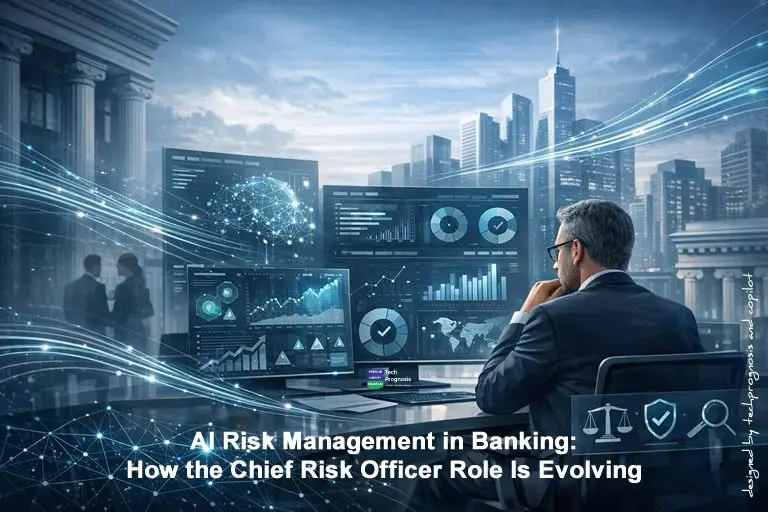
Simulation of how AI risk management is reshaping banking and the Chief Risk Officer role

AI risk management is becoming a defining priority for banks and other financial institutions. As artificial intelligence moves from experimentation to operational use across financial services, the Chief Risk Officer is being asked to do more than monitor exposures and enforce controls. The role now sits at the center of AI governance, model risk management, regulatory discipline, and customer trust.

Over the next several years, AI in banking will reshape how institutions identify emerging threats, assess customer and portfolio risk, detect anomalies, and respond to changing market conditions. For Chief Risk Officers, the shift is not simply technological. It is strategic. The role is evolving from oversight alone to active partnership in enterprise transformation, responsible AI adoption, and predictive risk management.

Read more

Share

Generative AI in Risk and Compliance

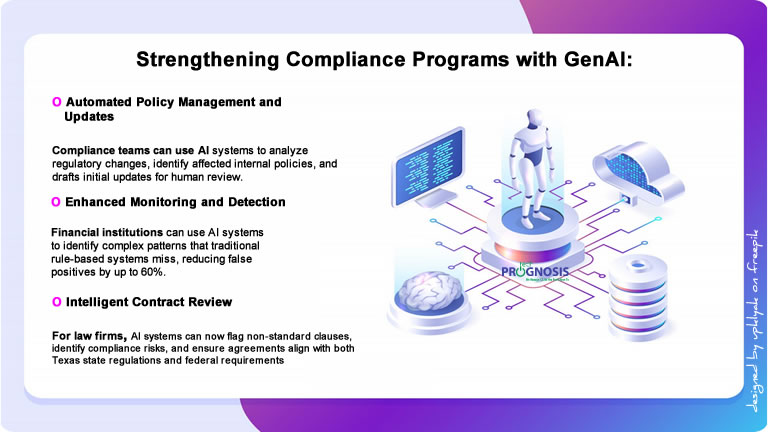
Generative AI concept showing humanoid with neural network, code on a computer monitor, and cloud computing icon.

Generative AI in Risk and Compliance: How Texas Enterprises Are Navigating the New Frontier

The Generative AI revolution isn’t coming—it’s already transforming conference rooms from Round Rock to Richardson, and boardrooms from Austin to Arlington.

When Dell Technologies’ compliance team in Round Rock began experimenting with generative AI tools in early 2023, they discovered something remarkable: what started as a productivity enhancement quickly evolved into a fundamental reshaping of their entire risk landscape. This transformation isn’t unique to Dell—it’s happening across Texas enterprises, from Samsung’s semiconductor facilities in Austin to the financial institutions lining Dallas’s Main Street.

As someone who’s spent years helping organizations navigate the complex waters of governance, risk, and compliance (GRC), I’ve witnessed firsthand how generative AI is simultaneously creating unprecedented opportunities and introducing risks that keep chief compliance officers awake at night.

Let’s explore how this technology is reshaping enterprise risk profiles and where it can genuinely deliver value for your organization.

Read more

Share

Ethical AI Governance Framework for Risk Assessment in Modern Banking

Ethical AI Governance Framework for risk assessment in modern banking concept with artificial intelligence humanoid with neural network and big data technology.

Ethical AI Governance Framework: A Practical Guide to AI Governance in Banking Risk Assessment

Picture this: You’re a risk officer at a major bank, and your AI system just flagged a small business loan application as high-risk. The applicant is a talented entrepreneur from an underserved community with a solid business plan but limited credit history. Your AI model, trained on decades of lending data, sees patterns that correlate with higher default rates. But here’s the catch – those patterns might reflect historical biases rather than true risk indicators. Perhaps, it is time to develop an ethical AI governance framework for Risk Assessment that ensures responsible AI use while maintaining innovation.

As artificial intelligence transforms how banks assess risk and make decisions, we’re witnessing a fundamental shift in the financial services landscape. AI promises faster decisions, better risk prediction, and improved customer experiences. Yet with this power comes unprecedented ethical challenges that keep chief risk officers awake at night. How do we harness AI’s potential while ensuring fairness, transparency, and accountability?

Welcome to the complex world of AI ethics in banking, where innovation meets responsibility at every turn.

Let’s dive into this critical conversation that’s reshaping modern banking. We will look at key ethical considerations when using AI for risk assessment in banking, and for each consideration we will provide a specific example of how it might manifest in practice.

Read more

Share
Share
Share