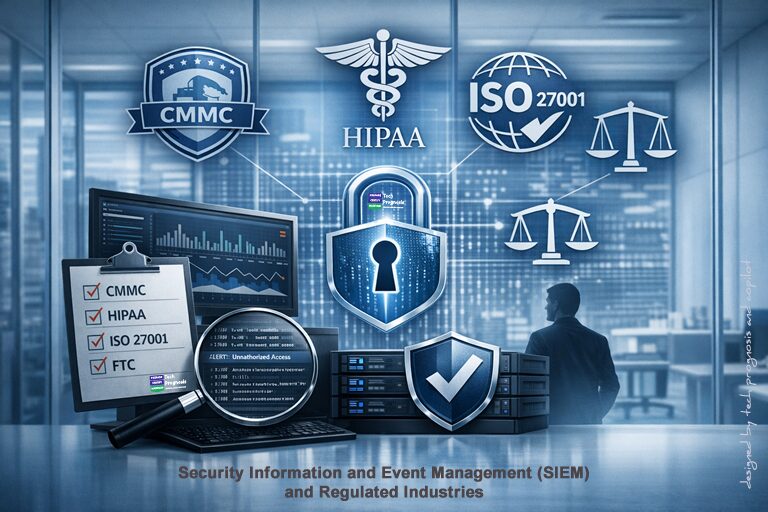
Security Information and Event Management (SIEM) and Regulated Industries

A digital illustration showing cybersecurity, Security Information and Event Management (SIEM) and compliance concepts, including a glowing lock at the center, surrounded by icons for CMMC, HIPAA, ISO 27001, and FTC related compliance, with dashboards, servers, checklists, and security symbols representing monitoring, auditing, and regulatory alignment.

Understanding SIEM in 2026: Limitations—and How to Build a Compliant, Outcome‑Driven Detection Program

Executive summary. Security Information and Event Management (SIEM) remains central to modern detection and response, but the playing field has evolved: cloud‑first estates, identity‑centric attacks, and new or strengthened rules (CMMC, HIPAA Security Rule enforcement practices, FTC Safeguards updates, ISO/IEC 27001:2022, and NIST CSF 2.0) raise the bar for logging, monitoring, and evidence. SIEM alone isn’t enough; you’ll need smart log source prioritization, detection engineering mapped to frameworks like MITRE ATT&CK, and automation you can trust (SOAR), all tuned to produce defensible evidence for audits and assessments.


What is Security Information and Event Management (SIEM) today (and what it isn’t)

A SIEM centrally collects and analyzes logs and events across systems, networks, applications, identities, and cloud services to help analysts detect, investigate, and report incidents. It’s often paired with Security Orchestration, Automation, and Response or SOAR to orchestrate and automate response actions.

SOAR (security orchestration, automation, and response) provides playbooks and automation for triage and remediation; it does not replace analytic rigor or governance.

Governments and industry recently published pragmatic guidance for implementing SIEM/SOAR, highlighting benefits (visibility, faster response) and pitfalls (data normalization, coverage, resource intensity).

Where SIEM fits in frameworks: NIST CSF 2.0 explicitly expects continuous monitoring and event logging outcomes (e.g., PR.PS‑04 requires that log records are generated and made available for continuous monitoring)—functions typically enabled by SIEM + SOAR.

Read more

Share

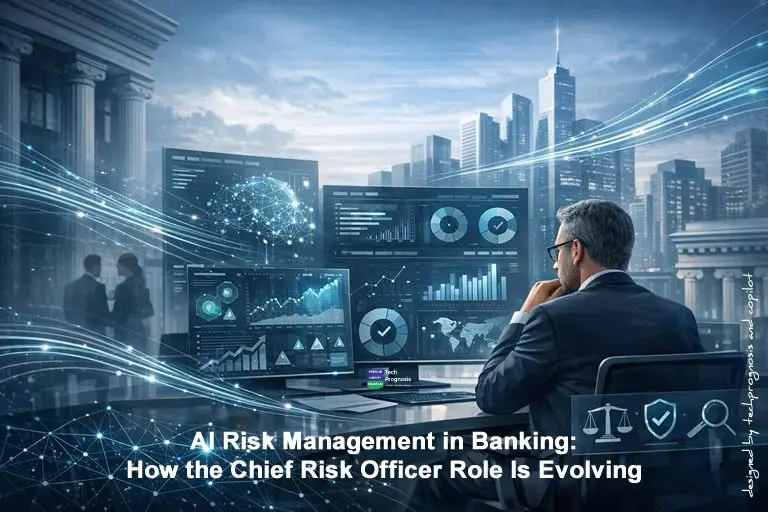
Chief Risk Officer Role in Banking: Evolution in the Age of AI

Simulation of how AI risk management is reshaping banking and the Chief Risk Officer role

AI risk management is becoming a defining priority for banks and other financial institutions. As artificial intelligence moves from experimentation to operational use across financial services, the Chief Risk Officer is being asked to do more than monitor exposures and enforce controls. The role now sits at the center of AI governance, model risk management, regulatory discipline, and customer trust.

Over the next several years, AI in banking will reshape how institutions identify emerging threats, assess customer and portfolio risk, detect anomalies, and respond to changing market conditions. For Chief Risk Officers, the shift is not simply technological. It is strategic. The role is evolving from oversight alone to active partnership in enterprise transformation, responsible AI adoption, and predictive risk management.

Read more

Share

DFARS 252.204 7012 Explained: What Primes and Subs Must Do Before Accepting CUI

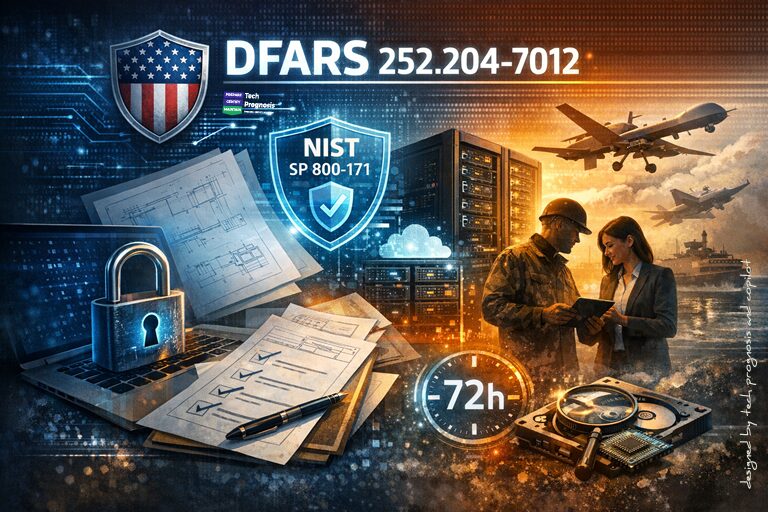
Illustration showing DFARS 252.204 7012 concepts with simple icons: a U.S. shield, a drone and naval vessel, a lock over documents, a NIST SP 800 171 badge, and a 72 hour incident reporting stopwatch.

DFARS 252.204‑7012 Explained (2026 Update): What Primes and Subs Must Do Before Accepting CUI

Bottom line: before a contractor accepts Controlled Unclassified Information (CUI) from DoD or a prime, DFARS 252.204‑7012 imposes concrete security, reporting, and cloud-handling duties—on both primes and subs—that must be in place first, not “as you go.” Non‑compliance risks contractual violations, bid ineligibility as CMMC phases in, and even False Claims Act exposure.

What DFARS 252.204‑7012 Actually Requires

DFARS 252.204‑7012 requires contractors to:

(1) Provide adequate security for Covered Defense Information (CDI/CUI);

(2) Implement NIST SP 800‑171;

(3) Report cyber incidents within 72 hours;

(4) Submit malware to DC3 if discovered;

(5) Preserve images/logs/data for forensic review;

(6) Flow down the entire clause to applicable subcontractors; and

(7) Use FedRAMP Moderate‑equivalent cloud services when CUI touches the cloud.

CDI/CUI defined. DFARS cross‑references the CUI Registry and includes Controlled Technical Information (CTI) and other protected categories provided by DoD or generated in performance and not intended for public release.

Read more

Share

Data Flow Mapping for CMMC Level 2 and Your Entire Compliance Strategy

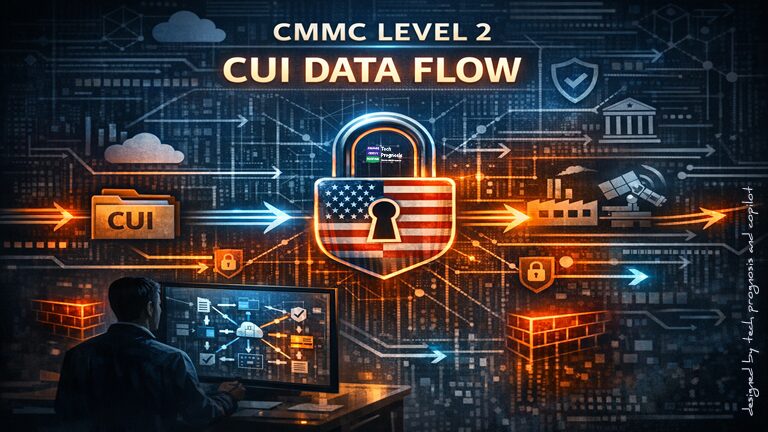
A digital illustration showing a secure CUI data flow concept for CMMC Level 2. A central padlock with a U.S. flag design is surrounded by directional arrows connecting icons representing cloud storage, government systems, industry, and firewalls. A person sits at a workstation viewing a data flow diagram.

Data Flow Mapping for CMMC Level 2: Why Mapping CUI Flow Determines Your Entire Compliance Strategy

If you can’t see where Federal Contract Information (FCI) and Controlled Unclassified Information (CUI) travel in your workflows, you can’t scope your obligations—period. This data flow mapping guide gives you a clear, repeatable way to map data flows, define system boundaries, and stop misclassification before it derails your contract.

Executive Summary

  • Controlling how CUI flows inside and outside your environment determines scope, architecture, tooling, and cost.
  • Design a focused CUI enclave so requirements only follow where CUI actually goes, reducing complexity and spend.
  • Document, enforce, and evidence approved flow paths to satisfy AC.L2-3.1.3 and pass a CMMC Level 2 assessment.

1. Introduction: Data Flow—the Most Underestimated Requirement

Organizations that pass CMMC Level 2 know exactly where CUI is allowed to go and can prove it never goes anywhere else. Information flow control is not just another checkbox—it shapes your boundary, controls, and cost.

2. What “Data Flow Control” Means in CMMC (AC.L2-3.1.3)

Control the flow of CUI in accordance with approved authorizations. Assessors expect to see:

  • Defined information flow control policies;
  • Defined enforcement mechanisms;
  • Designated sources and destinations for CUI;
  • Defined authorizations for CUI flow;
  • Consistent enforcement of those authorizations.

Read more

Share

FAR 52.204-21 Explained: What Actually Counts as FCI

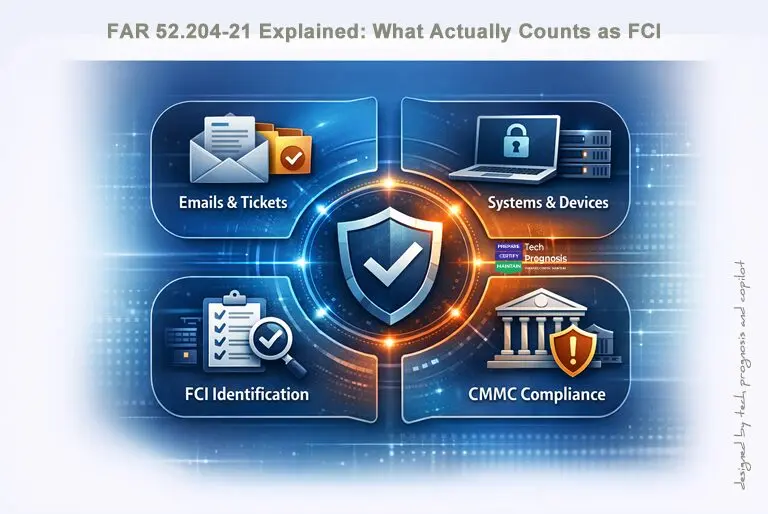
A cybersecurity themed infographic showing four labeled panels—Emails & Tickets, Systems & Devices, FCI Identification, and CMMC Compliance—surrounding a central shield icon representing protection under FAR 52.204 21.

FAR 52.204‑21 Explained: What Actually Counts as FCI (With Real Contractor Examples)

If you’ve ever thought “we don’t have Controlled Unclassified Information (CUI), so we’re off the hook,” this article is for you. FAR 52.204‑21 sets baseline safeguards for contractor systems that process Federal Contract Information (FCI)—and FCI shows up in more places than you might expect. [acquisition.gov]

Why contractors keep misclassifying FCI

The most common mistake we see: teams assume that if CUI isn’t in scope, no cyber obligations apply. But FCI alone triggers the Basic Safeguarding of Covered Contractor Information Systems clause—FAR 52.204‑21—whenever your systems process, store, or transmit it.

Bottom line: If FCI touches your email, ticketing, endpoints, file shares, or cloud tools, those systems inherit baseline safeguarding requirements.

Read more

Share

CMMC Certification in Texas: 2026 Compliance Guide for DoD Contractors

Minimalist illustration representing CMMC cybersecurity for Texas DoD contractors, featuring a CMMC shield with a lock over a Texas outline, simplified defense icons, and U.S. and Texas flags

CMMC Certification for Texas DoD Contractors: The 2026 Comprehensive Guide

Defense contractors in Texas face a rapidly changing compliance landscape as the Department of Defense (DoD) fully implements the Cybersecurity Maturity Model Certification (CMMC) 2.0 program. With the final CMMC rule published on September 10, 2025, and enforcement already underway across new DoD solicitations, organizations that process Federal Contract Information (FCI) or Controlled Unclassified Information (CUI) must act quickly and decisively to ensure eligibility for future defense contracts.
[business.defense.gov]

This updated guide breaks down what CMMC is, what has changed, why Texas defense contractors must take action now, and how to prepare strategically.

What Is CMMC?

The Cybersecurity Maturity Model Certification (CMMC) is the DoD’s unified cybersecurity standard designed to ensure that all contractors within the Defense Industrial Base (DIB) implement adequate safeguards to protect sensitive information. The standard integrates requirements from:

  • FAR 52.204‑21 (for handling FCI)
  • NIST SP 800‑171 Rev. 2 (for protecting CUI)
  • NIST SP 800‑172 (for advanced protection required under Level 3)

CMMC was created in response to persistent compromises of defense information across contractor systems.

Read more

Share
Share
Share