
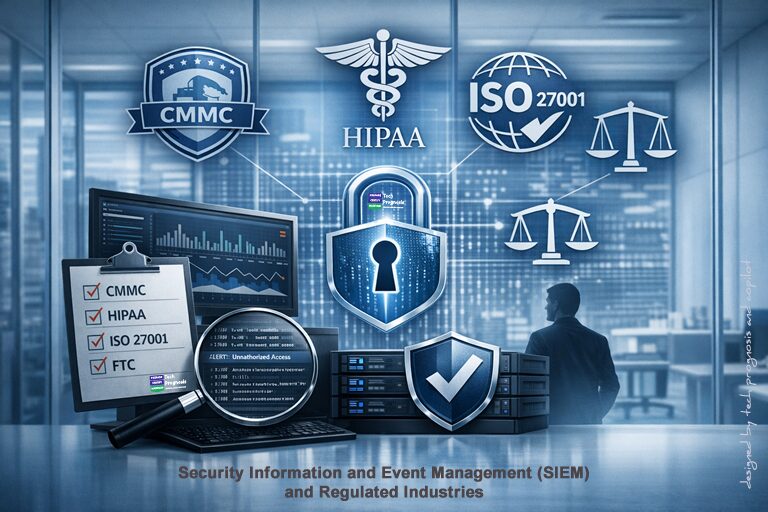
Understanding SIEM in 2026: Limitations—and How to Build a Compliant, Outcome‑Driven Detection Program
Executive summary. Security Information and Event Management (SIEM) remains central to modern detection and response, but the playing field has evolved: cloud‑first estates, identity‑centric attacks, and new or strengthened rules (CMMC, HIPAA Security Rule enforcement practices, FTC Safeguards updates, ISO/IEC 27001:2022, and NIST CSF 2.0) raise the bar for logging, monitoring, and evidence. SIEM alone isn’t enough; you’ll need smart log source prioritization, detection engineering mapped to frameworks like MITRE ATT&CK, and automation you can trust (SOAR), all tuned to produce defensible evidence for audits and assessments.
What is Security Information and Event Management (SIEM) today (and what it isn’t)
A SIEM centrally collects and analyzes logs and events across systems, networks, applications, identities, and cloud services to help analysts detect, investigate, and report incidents. It’s often paired with Security Orchestration, Automation, and Response or SOAR to orchestrate and automate response actions.
SOAR (security orchestration, automation, and response) provides playbooks and automation for triage and remediation; it does not replace analytic rigor or governance.
Governments and industry recently published pragmatic guidance for implementing SIEM/SOAR, highlighting benefits (visibility, faster response) and pitfalls (data normalization, coverage, resource intensity).
Where SIEM fits in frameworks: NIST CSF 2.0 explicitly expects continuous monitoring and event logging outcomes (e.g., PR.PS‑04 requires that log records are generated and made available for continuous monitoring)—functions typically enabled by SIEM + SOAR.
Common Security Information and Event Management (SIEM) weaknesses in 2026 (and why they matter)
- Complexity and tuning burden. Teams struggle with data normalization, log‑source coverage, and building effective analytics—leading to costly ingestion without actionable detection.
- Alert fatigue and low fidelity. Over‑collection without curated detections leads to noise and burnout; guidance stresses priority logs and evidence‑first detections.
- Cloud/SaaS and identity blind spots. As workloads move to cloud and SaaS, agencies and enterprises are expected to log and retain the right events for investigation and enterprise SOC access (e.g., OMB M‑21‑31).
- Gaps in required logging/retention for compliance. New and updated rules require more prescriptive logging, monitoring, and evidence—failing to plan retention, integrity controls, and review cadence creates audit risk.
- Resource intensity. Operating SIEM without playbooks, automation, and clear ownership increases total cost and slows response.
Strengthening Your Detection & Response Program (12 Concrete Moves)
- Adopt a “priority logs” strategy. Start with identity, endpoint, network egress, cloud audit, email, and privileged admin actions; use CISA’s SIEM/SOAR guidance to prioritize.
- Map detections to MITRE ATT&CK. Build/use cases tied to ATT&CK techniques, validating telemetry and response paths; this turns ingestion into measurable coverage.
- Implement SOAR with guardrails. Automate repetitive steps (enrichment, ticketing, containment) but keep human‑in‑the‑loop for higher‑risk actions.
- Engineer detections as products. Maintain a catalog, owners, test cases, and KPIs; update with threat intel and lessons learned. (ATT&CK mapping guidance from CISA helps operationalize this.)
- Align with NIST CSF 2.0 outcomes. Demonstrate DE (Detect) monitoring and analysis, and PR.PS‑04 logging generation and availability.
- Harden log integrity and retention. Use immutable storage/WORM where appropriate; NIST SP 800‑53 Rev.5 AU controls set expectations for content, review, failure handling, and retention.
- Centralize time synchronization. Accurate, consistent timestamps are required by NIST (AU controls) and underpin forensic correlation.
- Use risk‑based alerting and UEBA. Behavior baselines help reduce noise and find real anomalies; CSF 2.0 emphasizes continuous monitoring outcomes rather than tool names.
- Plan for log coverage in cloud and third‑party services. Federal guidance (M‑21‑31) expects centralized SOC access to logs across on‑prem and hosted services.
- Measure what matters. Tie detections to ATT&CK, track MTTD/MTTR, and report coverage against required controls and outcomes—not just ingestion volume. (ATT&CK mapping best practices provide the structure.)
- Exercise your stack. Purple‑team against ATT&CK techniques to validate telemetry, analytics, and playbooks, and retain artifacts as evidence.
- Right‑size with MSSP/MDR when needed. Outsourcing SIEM operations can mitigate staffing pressure while keeping ownership of governance and evidence requirements in‑house.
Compliance Lens: How Security Information and Event Management (SIEM) Supports Specific Regulatory Outcomes
Important: SIEM does not “make you compliant” by itself; it enables the logging, monitoring, alerting, investigation, and evidence demanded by these frameworks—when properly designed and operated.
CMMC (Levels 1–3) and NIST SP 800‑171/172
- Status. DoD finalized the CMMC program rule (32 CFR Part 170) effective Dec 16, 2024, and incorporated CMMC into DFARS for a phased rollout; requirements appear in solicitations starting Nov 10, 2025, with a three‑year phase‑in.
- Relevance. CMMC Level 2 maps to full NIST SP 800‑171 Rev.3 requirements, including Audit & Accountability—event logging, content, review/analysis, correlation, and retention (AU controls), all evidenced via SIEM.
- What to prove with SIEM:
- Event logging enabled and retained; review cadence and alerting on failures; correlation across sources for incidents; time synchronization—aligned to AU controls.
HIPAA Security Rule (45 CFR 164.312 & 164.308)
- Requirements. Audit Controls mandate mechanisms that record and examine activity in systems with ePHI; Information System Activity Review mandates regular review of audit logs, access reports, and incident tracking. SIEM centralizes, analyzes, and evidences those obligations.
- What to prove with SIEM:
- Who/what/when/where data in audit logs; consistent review cadence; alerting and incident documentation—ties directly to §164.312(b) and §164.308(a)(1)(ii)(D).
FTC Safeguards Rule (16 CFR Part 314)
- Updates. The FTC amended the Rule to provide more prescriptive security program elements and added breach notification requirements effective May 2024 for covered entities; logging and monitoring are integral to demonstrating safeguards effectiveness.
- What to prove with SIEM:
- Centralized monitoring, incident detection and reporting artifacts, and evidence of control effectiveness within your written information security program.
ISO/IEC 27001:2022 (Annex A)
- Controls. A.8.15 Logging and A.8.16 Monitoring activities expect production, protection, and analysis of logs, with review and retention aligned to risk and law—SIEM is the natural control implementation.
- What to prove with SIEM:
- Defined log scope, integrity protections (immutability), periodic analysis/review records, and management oversight—mapped to Annex A clauses.
NIST CSF 2.0 (Detect and Protect outcomes)
- CSF 2.0 elevates logging and continuous monitoring outcomes across DE and PR.PS‑04, guiding organizations to treat SIEM outputs as risk outcomes rather than raw tool telemetry.
Quick mapping: SIEM capabilities → required outcomes
| Capability | CMMC / 800‑171 | HIPAA | FTC Safeguards | ISO/IEC 27001 |
|---|---|---|---|---|
| Centralized event logging & retention | AU controls (e.g., log content, review, retention) [csf.tools] | §164.312(b) Audit Controls; §164.308(a)(1)(ii)(D) reviews [ecfr.gov], [ecfr.gov] | Program effectiveness & incident reporting evidence [ecfr.gov], [ftc.gov] | A.8.15 Logging / A.8.16 Monitoring activities [isms.online] |
| Alerting & failure monitoring | AU‑5 (response to logging failures) [csf.tools] | Supports incident tracking & alerts in reviews [ecfr.gov] | Supports incident notification readiness [ftc.gov] | Monitoring and incident mgmt linkage (A.8.16/A.5.24) [hightable.io] |
| Correlation & analysis | AU‑6 / AU‑7 analytics and reporting [csf.tools] | Review and investigation across systems [ecfr.gov] | Demonstrate safeguards performance & risk reduction [ecfr.gov] | Systematic analysis and review evidence [isms.online] |
| Time sync & log integrity | AU‑3 content, accuracy; AU‑11 retention; NTP sync expectations [csf.tools] | Accurate, examinable audit trails [ecfr.gov] | Integrity of records and reporting quality [ecfr.gov] | Integrity/immutability supporting investigations [hightable.io] |
A Practical Security Information and Event Management Roadmap (fit for SMBs to mid‑market)
Phase 1 – Foundation (0–60 days). Define priority log sources (identity, endpoint, email, cloud audit, network egress); configure centralized collection; enable time sync; establish a monthly review cadence and evidence templates.
Phase 2 – Detections & runbooks (60–120 days). Implement high‑value detections mapped to ATT&CK (e.g., suspicious privilege escalation, impossible travel, unusual egress), create SOAR‑backed playbooks with human approval for containment, and define metrics (detection coverage, MTTD/MTTR).
Phase 3 – Compliance evidence (quarterly). Export review logs, incident timelines, and monthly SIEM reports to your CMMC/HIPAA/FTC/ISO evidence folder; validate retention and integrity controls; run a tabletop and purple‑team exercise against ATT&CK techniques in scope.
Phase 4 – Continuous improvement (ongoing). Tune noisy detections, onboard new SaaS/cloud sources, expand automation where risk‑appropriate, and re‑map coverage to ATT&CK quarterly.
Closing Thought on Security Information and Event Management
SIEM is powerful—but only when it is prioritized, mapped to adversary behavior, and operated as an evidence engine for your regulatory obligations. With a risk‑based log strategy, ATT&CK‑mapped detections, and measured automation, you’ll reduce dwell time and walk into audits with confidence.
Need help?
Tech Prognosis provides regulatory standards advisory and hands‑on help for building compliant, right‑sized detection programs across CMMC, HIPAA, FTC Safeguards, and ISO/IEC 27001. Call (512) 814‑8044 or request a complimentary consultation. (Round Rock, Texas and surrounding cities.)
References (selected)
- CISA — New Guidance for SIEM and SOAR Implementation (Executive & Practitioner Guidance; Priority Logs). Link
- NCSC/Australia & partners — Implementing SIEM and SOAR platforms: practitioner guidance. Link
- NIST CSF 2.0 Resource Center — Core outcomes and Detect/Protect logging context. Link
- CSF Tools — PR.PS‑04: Log records are generated and made available for continuous monitoring. Link
- OMB M‑21‑31 — Event Logging (centralized access/visibility; retention tiers). Link
- CMMC — Final program rule (32 CFR Part 170) and DFARS rollout info. Federal Register • eCFR 32 CFR Part 170 • DoD OSBP CMMC 2.0 details & rollout • DFARS incorporation & phase‑in analysis
- NIST SP 800‑171 Rev.3 (May 2024) — Audit & Accountability family and assessment. Link
- Background on AU requirements CSF Tools 3.3.1
- NIST SP 800‑53 Rev.5 — AU controls for event logging, content, review, failures, and retention. CSRC • CSF Tools AU family
- HIPAA Security Rule — 45 CFR §164.312(b) Audit Controls; §164.308(a)(1)(ii)(D) Information System Activity Review. eCFR §164.312 • eCFR §164.308 • HHS Security Rule overview
- FTC Safeguards Rule (16 CFR Part 314) — Text and small‑entity compliance guide (including 2024 breach notices). eCFR Part 314 • FTC guidance • Final rule (2021) summary
- ISO/IEC 27001:2022 — Annex A A.8.15 Logging / A.8.16 Monitoring activities (authoritative overviews). ISMS.online • High Table
- MITRE ATT&CK — Official matrix and knowledge base; mapping best practices (CISA). MITRE ATT&CK • CISA ATT&CK mapping best practices
About the Author
Daniel Ihonvbere, CISM, CISSP, is a cybersecurity and governance professional specializing in CMMC, NIST 800‑171, and DFARS‑aligned security programs. With more than a decade of experience serving small and mid‑sized government contractors, Daniel helps organizations interpret, operationalize, and sustain the requirements found in 32 CFR Part 170, the CMMC Model, and the CMMC Assessment Process (CAP).
Based in Central Texas, he works with defense industrial base (DIB) organizations to transform regulatory requirements into clear governance, defensible evidence, and audit‑ready practices. His approach emphasizes sustainability—programs that leadership understands, teams can operate year‑round, and assessors can verify without confusion.
He publishes practical guidance on CMMC, NIST 800‑171, DFARS 252.204‑7012, and the evolving requirements affecting the defense supply chain—breaking down complex expectations into actionable steps that compliance leaders, business owners, and IT teams can implement with confidence
Connect with Daniel on LinkedIn for CMMC insights | www.techprognosis.com
