
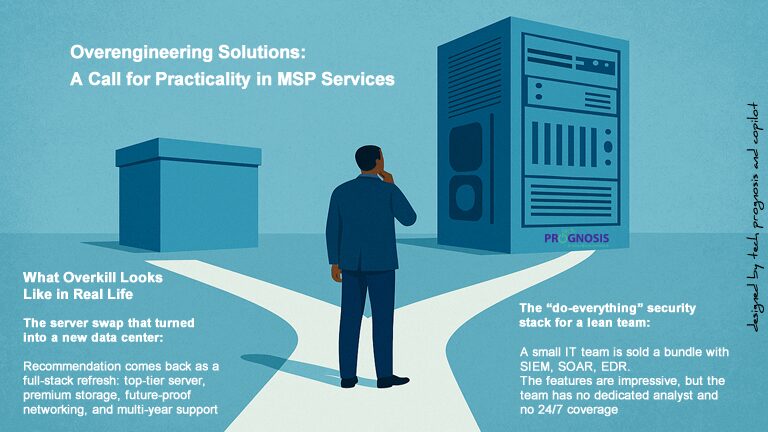
Too many managed service providers (MSPs) still prescribe solutions that are bigger, pricier, and more complex than what clients actually need. Overengineering solutions not only wastes budget—it also slows teams down, erodes trust, and makes day‑to‑day operations harder. The fix is simple, but it takes discipline: start with the business problem, apply a risk‑based lens, right‑size the solution, and co‑design with the people who will live with it.
This post shares real‑world examples, root causes, and a practical framework you can use today.
Why This Question on Overengineering Solutions Still Matters
In a world of nonstop product launches, aggressive vendor marketing, and a constant drumbeat of “more features, more protection,” it’s easy to equate complexity with quality. But for many organizations—especially small and mid‑size businesses—large, layered solutions can be the wrong fit. They can consume scarce budgets, demand skills that the team doesn’t have, and introduce new points of failure.
Right‑sizing solutions is not about cutting corners. It’s about delivering outcomes that match the organization’s goals, resources, and risk tolerance. It’s about respect: the kind that honors each client’s constraints and aspirations. And it’s about trust—because teams remember when you take care to recommend what works, not simply what sells.
What Overkill or Overengineering Solutions Looks Like in Real Life
1) The server swap that turned into a new data center.
A client’s aging server shows signs of imminent failure. The fix is straightforward: replace the motherboard, or replace the server with a solid, standard model and migrate workloads cleanly. Instead, the recommendation comes back as a full‑stack refresh: top‑tier server, premium storage, future‑proof networking, and multi‑year support. The projected cost is many times higher than necessary. The client delays, hoping the old server limps along. The risk climbs. A right‑sized plan would prioritize uptime and data integrity first—then layer in options only if they materially reduce risk for this specific environment.
2) The café captive portal with enterprise‑class baggage.
A neighborhood café wants a simple captive portal to welcome visitors, show house rules, and offer free Wi‑Fi. They’re offered an enterprise‑grade platform with advanced marketing, analytics, and integrations they won’t use. Monthly costs and setup fees land hard on a tight budget. A better approach: a modest, secure gateway with a clear acceptance page, basic content filtering, and sensible rate limiting—nothing more. It meets the need, protects patrons, and leaves room to grow later.
3) The “do‑everything” security stack for a lean team.
A small IT team is sold a bundle with SIEM, SOAR, EDR, advanced threat intelligence, and multiple overlapping tools. The features are impressive, but the team has no dedicated analyst and no 24/7 coverage. Alerts pile up. Playbooks gather dust. The risk actually increases because visibility without response is false comfort. A right‑sized plan would start with strong endpoint protection, secure configuration, multi-factor authentication (MFA), backup hygiene, and a clear incident process—with an option to outsource monitoring when the volume justifies it.
4) Compliance tooling before culture.
An organization begins its journey toward stronger cybersecurity maturity. They purchase complex compliance software and policy automation tools before aligning on basic security practices and shared responsibilities. People feel overwhelmed. Progress stalls. A better path is a staged roadmap: first calm the “noisy basics” (like patching, MFA, backups, and access management), then add specialized tooling to support the process once it’s stable and owned by the team.
Why Overengineering Solutions Happens
Vendor pressure, risk aversion, feature bias, one‑size‑fits‑all thinking, and missing voices all contribute to overkill. These factors skew decisions toward complexity instead of clarity.
The Cost of Overkill (Beyond Dollars)
Financial strain, operational drag, security gaps from complexity, and trust erosion are common outcomes when solutions overshoot the mark.
A Practical Right‑Sizing Framework
Start with outcomes, map current reality, assess risk in plain language, design the minimum effective solution, layer only what adds value, and co‑design with users.
Inclusive Service Design: Make Solutions Work for Everyone
Inclusive design means clear language, accessible materials, flexible training, shared ownership, budget empathy, and community impact.
Prominent IT or compliance strategy Call‑to‑Action
Want a fast, practical help right-sizing your IT or compliance strategy?
Book a free 15‑minute discovery call and we’ll:
- Map your Infrastructure gaps (server sizing, RBAC, MFA, admin pathways)
- Verify monitoring and alerting across critical log sources
- Pressure‑test your Incident Response plan against compliance and uptime requirements
Further Reading
If you’d like to explore more on right-sizing IT solutions, cybersecurity best practices, and inclusive design, here are some authoritative resources:
NIST Cybersecurity Framework: https://www.nist.gov/cyberframework
CIS Controls: https://www.cisecurity.org/controls
Verizon Data Breach Investigations Report: https://www.verizon.com/business/resources/reports/dbir/
Ponemon Institute Research: https://www.ponemon.org/
W3C Accessibility Guidelines: https://www.w3.org/WAI/standards-guidelines/wcag/
Gartner MSP Market Trends: https://www.gartner.com/en/information-technology
About the Author
Daniel Ihonvbere, CISM, CISSP, Qualys is a cybersecurity and risk management professional with over a decade of experience helping small businesses navigate complex compliance and security requirements. He specializes in ISO standards, FTC Safeguards, NIST frameworks, TX-RAMP, TAC 202, and other risk-based programs. Daniel is actively engaged in supporting organizations preparing for CMMC compliance and aligning with Cyber-AB guidance through practical, defensible strategies. Based in Central Texas, he partners with businesses in Round Rock, Austin, and beyond to build scalable security programs that meet regulatory and contractual obligations.
