
COTS in the CMMC Ecosystem: What’s In, What’s Out, and Where Contractors Get Burned
Why this topic matters
“COTS is exempt” gets repeated so often that many teams rely on it as a blanket pass. It isn’t. In DoD contracting, COTS has a precise definition in FAR 2.101, and certain DFARS cybersecurity clauses don’t apply to contracts solely for COTS—but mislabeling work or overlooking how data actually flows can still drag you under CMMC and DFARS obligations. Understanding where COTS really fits prevents over‑scoping (wasted spend) and under‑scoping (eligibility and FCA risk).
1) What “COTS” means (and what it doesn’t)
COTS (Commercially Available Off‑The‑Shelf) is a very specific status under federal acquisition rules—a commercial item sold in substantial quantities in the commercial marketplace and offered to the Government without modification, among other detailed conditions in FAR 2.101. If something is tweaked, custom‑configured, government‑unique, or bundled with non‑commercial services, it may stop being COTS. Many “we thought it was COTS” arguments fall apart when you check the definition.
Why it matters for cyber:
- FAR 52.204‑21 (the Safeguarding Rule) applies when FCI is processed, stored, or transmitted—and is flowed down when subs may have FCI (except for pure COTS scenarios).
- DFARS 252.204‑7012 (CUI/CDI clause) does not apply to contracts solely for COTS items, but if any performance involves CUI, 7012 comes back into play—including 72‑hour incident reporting and FedRAMP Moderate‑equivalent clouds. Misclassify work as COTS when CUI is present, and you’re out of compliance.
2) How CMMC interacts with COTS
The CMMC DFARS rule (effective November 10, 2025) phases CMMC into contracts over three years and makes cyber assurance a condition of award and continued performance. CMMC requirements generally do not apply to procurements solely for COTS items, but the moment your performance processes, stores, or transmits FCI or CUI, appropriate CMMC levels apply and flow down across the supply chain. Program guidance and legal analyses emphasize these carve‑outs and the phased implementation.
Practical translation:
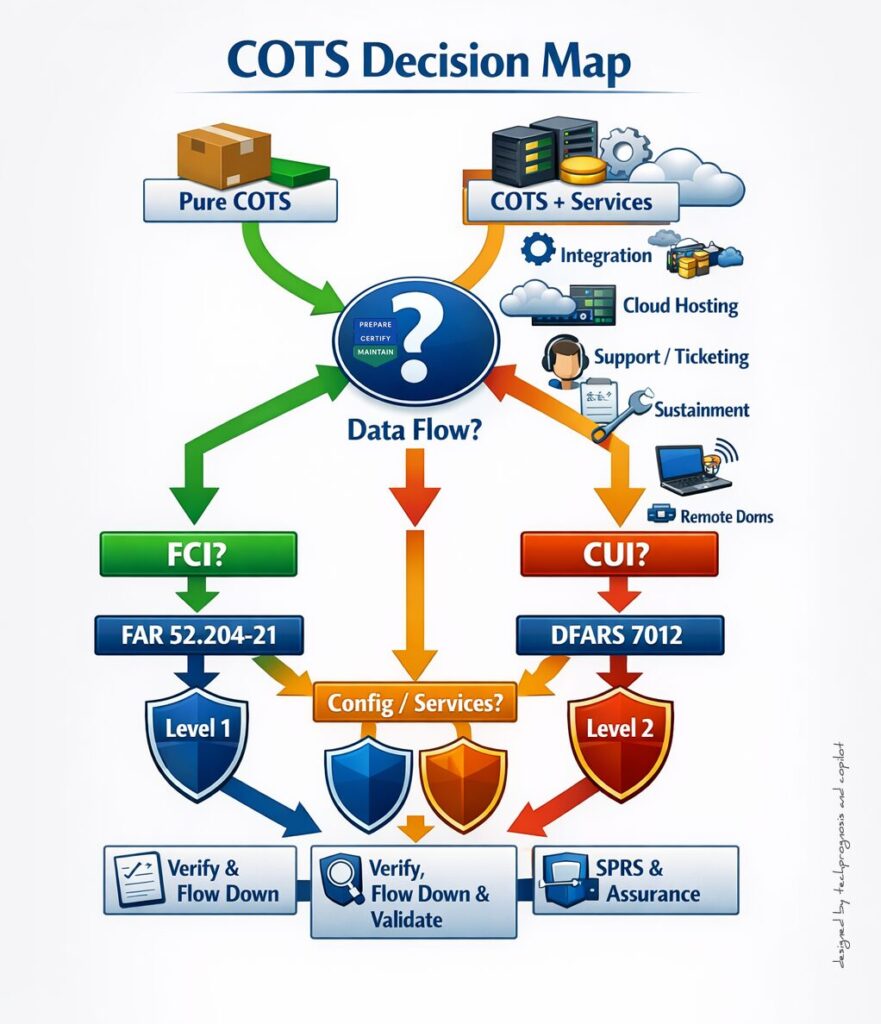
- Pure COTS purchase with no FCI/CUI exposure → CMMC may not be invoked.
- COTS + configuration/services where FCI/CUI flows (e.g., provisioning, uploading, ticketing, sustainment) → CMMC Level 1 (FCI) or Level 2 (CUI) likely applies; primes must flow down and verify.
3) Five common COTS myths that create risk
- “If we buy it as COTS, none of the cyber clauses apply.”
Not so. FAR 52.204‑21 can still apply if FCI touches your systems, and DFARS 7012 is triggered when CUI is in performance (even if the product is COTS). - “Our cloud app is COTS, so it’s automatically fine for CUI.”
If CUI touches that cloud, 7012 requires FedRAMP Moderate‑equivalency and specific incident‑response support. “Commercial availability” ≠ “7012‑ready.” - “COTS with minor tweaks is still COTS.”
Customization, bundling of non‑commercial services, or unique government requirements may defeat COTS status under FAR 2.101 tests—re‑check the definition before flowing clauses or making representations. - “We can just flow down everything to be safe.”
For commercial subcontracts, DFARS 252.244‑7000 now limits flowdowns to mandatory ones—ending the “kitchen sink” practice. Over‑flowing non‑mandatory clauses can violate the rule and damage vendor relationships. - “Since COTS is excluded, we don’t need to check the subcontractor’s status.”
If a sub will handle FCI or CUI (e.g., install, integrate, host), CMMC and DFARS flow down by data, not by label. Primes are on the hook to verify sub status and keep evidence (SPRS screenshots/letters).
4) Quick framework: Map data first, then clauses, then CMMC level
- Data: Will any part of performance process/store/transmit FCI or CUI? (Look at intake, support tickets, remote admin, telemetry, logs.) If FCI → Level 1, if CUI → Level 2 (often C3PAO at prime’s requirement).
- Clauses: If CUI exists → DFARS 252.204‑7012 (unaltered); if FCI exists → FAR 52.204‑21; avoid non‑mandatory flowdowns to commercial subs (252.244‑7000).
- Assurance: CMMC clause(s) per DFARS rule; annual affirmations and SPRS postings where required.
5) Real‑world patterns (and fixes)
- Pattern: “COTS device drop‑in,” but onboarding uses email and SharePoint to exchange manuals, configs, and schedules.
- Risk: That content is usually FCI → triggers FAR 52.204‑21 and CMMC L1.
- Fix: Keep FCI inside a designated enclave/tenant; enforce only Level‑1 safeguards on systems with FCI; flow down to any sub that touches those artifacts.
- Pattern: “COTS SaaS for ticketing,” but a program manager uploads export‑controlled drawings.
- Risk: That’s CUI → DFARS 7012 + CMMC Level 2; cloud must be FedRAMP‑Mod‑equivalent and contract must support reporting/preservation.
- Fix: Move CUI handling to a compliant enclave/cloud, or obtain provider attestations and contract terms that satisfy 7012.
- Pattern: Prime “covers everything” by flowing down a thick clause pack to a commercial distributor.
- Risk: 252.244‑7000 now prohibits non‑mandatory FAR/DFARS clauses in commercial subcontracts; you can’t “solve” risk with the kitchen sink anymore.
- Fix: Limit to mandatory clauses; add bespoke commercial terms (e.g., termination assistance) without violating the rule.
6) COTS Mini‑playbooks
For Primes
- Before award: Confirm whether the effort is pure COTS or COTS+services.
Map data flows; if FCI or CUI appear, pick the CMMC level and clauses accordingly. - Contracting: Insert 7012 if CUI, 52.204‑21
if FCI; avoid non‑mandatory flowdowns to commercial subs;
add verification deliverables (SPRS proof, status letters). - Performance: Keep COTS support data in the right enclave;
monitor for data creep (CUI in tickets, logs, attachments).
For Subs/Distributors
- Ask: “Will we receive FCI or CUI?”
If none, document COTS basis;
if yes, align with L1/L2 accordingly. - For CUI cloud handling, demand provider FedRAMP‑Mod equivalency and 7012 support in the prime‑sub agreement.
Is It Pure COTS or COTS+services (Decision Map)
7) Compliance checklist
□ Confirm COTS status against FAR 2.101; note any customization/services.
□ Map data: Will FCI or CUI flow during ordering, provisioning, support, or telemetry? (Yes → CMMC applies by level.)
□ Select clauses: FCI → FAR 52.204‑21; CUI → DFARS 7012; avoid non‑mandatory flowdowns for commercial subs.
□ Assurance & proof: CMMC clause/level per DFARS; SPRS postings/affirmations; collect sub proofs.
Conclusion: COTS Isn’t a Shortcut — It’s a Classification With Consequences
COTS can simplify procurement, but it does not simplify cybersecurity. The label only shields you when the acquisition is purely for a commercial item and no FCI or CUI ever touches performance. The moment information flows into onboarding, support, ticketing, cloud hosting, integrations, or sustainment, the protections and obligations of FAR 52.204‑21, DFARS 252.204‑7012, and the associated CMMC Level 1 or Level 2 requirements follow.
For primes, mislabeling something as COTS can expose you to flow‑down failures, ineligible subs, and even FCA risk if your assertions don’t align with reality. For subs, accepting a COTS subcontract without understanding whether you’ll handle FCI or CUI is a quick way to inherit obligations you didn’t budget or staff for.
The safest approach is simple:
Map the data first. Label the work second.
When you understand the information flowing through the engagement, choosing clauses and CMMC levels becomes clear, defensible, and contractually sound.
Call to Action: Map Your Data — Protect Your Eligibility
If you’re unsure whether your COTS purchases, services, or configurations trigger cybersecurity requirements, now is the right time to get clarity. The CMMC rollout is active, flow‑down enforcement is tightening, and primes are being held accountable for verifying subcontractor posture.
Here’s what you can do next:
➡️ 1. Request a COTS/CMMC Data‑Flow Review
I can help you identify whether your COTS activity creates FCI or CUI exposure, and which clauses and CMMC levels apply.
➡️ 2. Get the COTS Decision Map & Flow‑Down Checklist
If you want a ready‑to‑use reference that aligns with the latest DFARS and CMMC rulemaking, I can send you a clean, contractor‑friendly one‑pager.
➡️ 3. Strengthen Your Supply‑Chain Controls
Whether you’re a prime or sub, I can help you implement practical, right‑sized controls and verification steps that avoid missteps and over‑scoping.
Ready to remove uncertainty from your COTS decisions?
Just tell me: “Send the COTS Checklist” — and I’ll package everything (visuals, templates, and flow‑down guides).
About the Author
Daniel Ihonvbere, CISM, CISSP, is a cybersecurity and governance professional specializing in CMMC, NIST 800‑171, and DFARS‑aligned security programs. With more than a decade of experience serving small and mid‑sized government contractors, Daniel helps organizations interpret, operationalize, and sustain the requirements found in 32 CFR Part 170, the CMMC Model, and the CMMC Assessment Process (CAP).
Based in Central Texas, he works with defense industrial base (DIB) organizations to transform regulatory requirements into clear governance, defensible evidence, and audit‑ready practices. His approach emphasizes sustainability—programs that leadership understands, teams can operate year‑round, and assessors can verify without confusion.
He publishes practical guidance on CMMC, NIST 800‑171, DFARS 252.204‑7012, and the evolving requirements affecting the defense supply chain—breaking down complex expectations into actionable steps that compliance leaders, business owners, and IT teams can implement with confidence
Connect with Daniel on LinkedIn for CMMC insights | www.techprognosis.com
