
Revolutionary FAR Overhaul (RFO) for CMMC

Revolutionary FAR Overhaul (RFO) article header illustrating the shift to verified cybersecurity enforcement.

The CMMC Revolutionary FAR Overhaul (RFO): Why the DoD’s Quiet Regulatory Reset Changed Cybersecurity Enforcement Forever

Executive Summary (For Decision‑Makers)

In late 2025 and early 2026, the Department of Defense executed a sweeping regulatory cleanup now commonly referred to as the Revolutionary FAR Overhaul (RFO). While much of the attention has focused on the deletion of specific clauses—most notably DFARS 252.204‑7019—the real story is far larger.

RFO fundamentally changed how cybersecurity compliance is enforced, not just how it is described. Temporary, trust‑based mechanisms were removed. Verified, system‑enforced eligibility replaced them. As a result:

  • DFARS 7019 disappeared
  • SPRS was repositioned
  • CMMC became non‑negotiable
  • Contract eligibility—not intent—became the enforcement mechanism

This article explains what RFO actually is, why it occurred, and how it permanently reshaped cybersecurity enforcement across the Defense Industrial Base (DIB).

Read more

Share

COTS in the CMMC Ecosystem: Where Contractors Get Burned

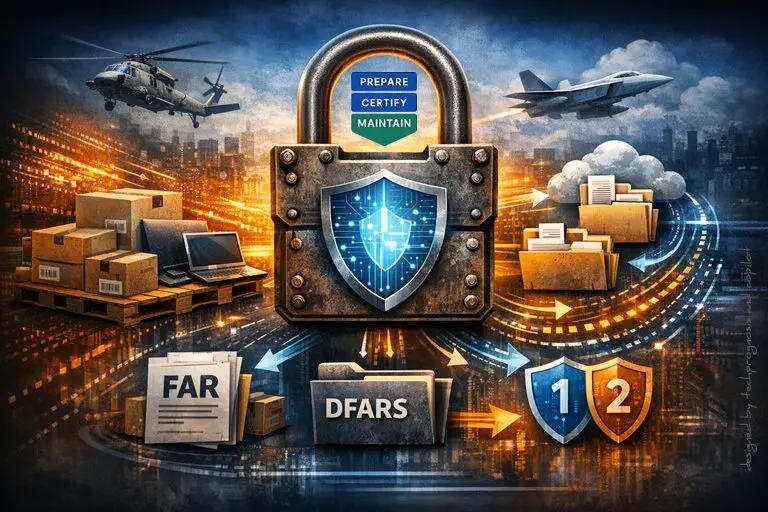
A large central padlock with a digital shield symbol, surrounded by military aircraft, cloud folders, shipping boxes, and FAR/DFARS compliance icons illustrating how COTS items, when paired with services or data handling, can quickly trigger FAR 52.204 21, DFARS 252.204 7012, and the associated CMMC and cybersecurity requirements in the defense supply chain.”

COTS in the CMMC Ecosystem: What’s In, What’s Out, and Where Contractors Get Burned

Why this topic matters

“COTS is exempt” gets repeated so often that many teams rely on it as a blanket pass. It isn’t. In DoD contracting, COTS has a precise definition in FAR 2.101, and certain DFARS cybersecurity clauses don’t apply to contracts solely for COTS—but mislabeling work or overlooking how data actually flows can still drag you under CMMC and DFARS obligations. Understanding where COTS really fits prevents over‑scoping (wasted spend) and under‑scoping (eligibility and FCA risk).

1) What “COTS” means (and what it doesn’t)

COTS (Commercially Available Off‑The‑Shelf) is a very specific status under federal acquisition rules—a commercial item sold in substantial quantities in the commercial marketplace and offered to the Government without modification, among other detailed conditions in FAR 2.101. If something is tweaked, custom‑configured, government‑unique, or bundled with non‑commercial services, it may stop being COTS. Many “we thought it was COTS” arguments fall apart when you check the definition.

Why it matters for cyber:

  • FAR 52.204‑21 (the Safeguarding Rule) applies when FCI is processed, stored, or transmitted—and is flowed down when subs may have FCI (except for pure COTS scenarios).
  • DFARS 252.204‑7012 (CUI/CDI clause) does not apply to contracts solely for COTS items, but if any performance involves CUI, 7012 comes back into play—including 72‑hour incident reporting and FedRAMP Moderate‑equivalent clouds. Misclassify work as COTS when CUI is present, and you’re out of compliance.

Read more

Share
Share
Share