
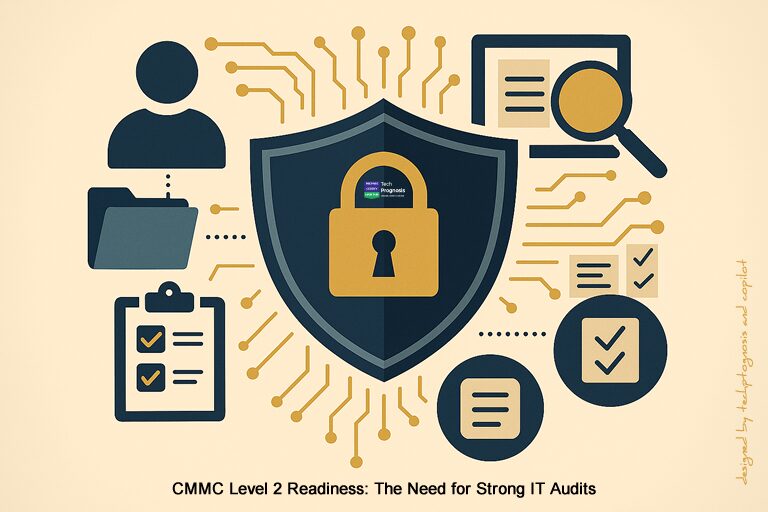
CMMC Level 2 Readiness: The Need for Strong IT Audits

Abstract cybersecurity audit illustration showing a shield with padlock surrounded by checklists, documents, and review icons, representing CMMC Level 2 readiness and evidence‑based defense compliance

CMMC Level 2 Readiness: Why Strong IT Audits Are the Difference Between Compliance and Contract Loss

For defense contractors, CMMC Level 2 is no longer a theoretical requirement—it’s a gatekeeper. As the Department of Defense moves away from self‑attestation toward evidence‑based assessments, organizations handling Controlled Unclassified Information (CUI) must now prove their cybersecurity maturity.

At the core of that proof is one often‑misunderstood capability: the IT audit function.

In our work helping organizations prepare for and pass CMMC Level 2 assessments, we consistently see the same pattern. Companies that treat audits as a last‑minute compliance exercise struggle. Companies that integrate internal and external audit disciplines into their CMMC strategy succeed—and stay compliant long after certification.

This article explains how IT audits directly support CMMC Level 2 readiness, why both internal and external auditors matter, and how audit‑driven programs build real cybersecurity resilience.

Read more

Share

COTS in the CMMC Ecosystem: Where Contractors Get Burned

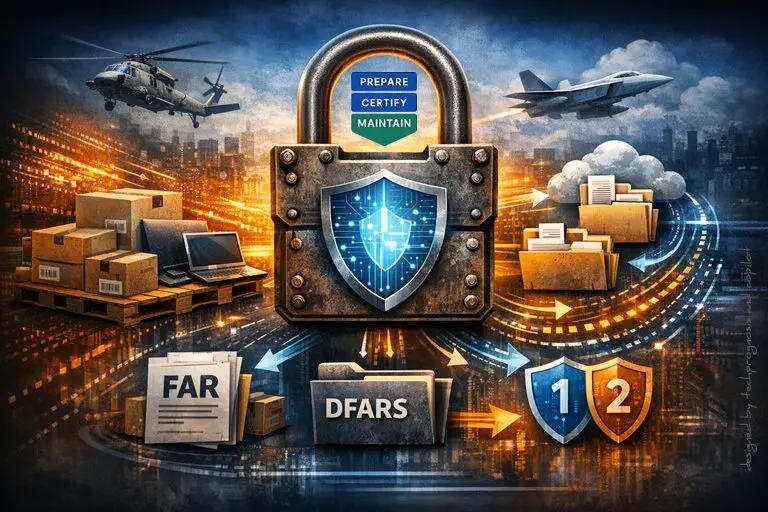
A large central padlock with a digital shield symbol, surrounded by military aircraft, cloud folders, shipping boxes, and FAR/DFARS compliance icons illustrating how COTS items, when paired with services or data handling, can quickly trigger FAR 52.204 21, DFARS 252.204 7012, and the associated CMMC and cybersecurity requirements in the defense supply chain.”

COTS in the CMMC Ecosystem: What’s In, What’s Out, and Where Contractors Get Burned

Why this topic matters

“COTS is exempt” gets repeated so often that many teams rely on it as a blanket pass. It isn’t. In DoD contracting, COTS has a precise definition in FAR 2.101, and certain DFARS cybersecurity clauses don’t apply to contracts solely for COTS—but mislabeling work or overlooking how data actually flows can still drag you under CMMC and DFARS obligations. Understanding where COTS really fits prevents over‑scoping (wasted spend) and under‑scoping (eligibility and FCA risk).

1) What “COTS” means (and what it doesn’t)

COTS (Commercially Available Off‑The‑Shelf) is a very specific status under federal acquisition rules—a commercial item sold in substantial quantities in the commercial marketplace and offered to the Government without modification, among other detailed conditions in FAR 2.101. If something is tweaked, custom‑configured, government‑unique, or bundled with non‑commercial services, it may stop being COTS. Many “we thought it was COTS” arguments fall apart when you check the definition.

Why it matters for cyber:

  • FAR 52.204‑21 (the Safeguarding Rule) applies when FCI is processed, stored, or transmitted—and is flowed down when subs may have FCI (except for pure COTS scenarios).
  • DFARS 252.204‑7012 (CUI/CDI clause) does not apply to contracts solely for COTS items, but if any performance involves CUI, 7012 comes back into play—including 72‑hour incident reporting and FedRAMP Moderate‑equivalent clouds. Misclassify work as COTS when CUI is present, and you’re out of compliance.

Read more

Share
Share
Share