
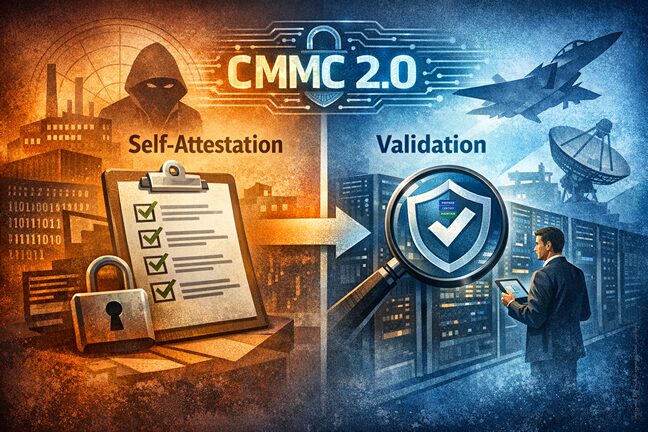
Self‑Attestation vs. Validation: Why CMMC 2.0 Exists — And What It Means for Today’s Defense Contractors
For years, the Defense Industrial Base (DIB) ran on trust. Contractors handling Federal Contract Information (FCI) or Controlled Unclassified Information (CUI) would self‑attest that they followed required cybersecurity practices. But as nation‑states and criminal groups shifted tactics, that honor‑system model showed cracks—particularly among smaller, sub‑tier suppliers where much of the sensitive technical work happens. The Department of Defense (DoD) created the Cybersecurity Maturity Model Certification (CMMC) 2.0 to close the gap between “what we think we’re doing” and “what’s actually implemented.” CMMC formalizes validation—in some cases via third‑party assessors—so the DoD can verify protections before and during contract performance.
The program sits on two pillars:
- Policy (32 CFR Part 170): establishes CMMC as the program of record (effective Dec. 16, 2024).
- Contracting (DFARS amendments): phases CMMC requirements into solicitations and awards starting Nov. 10, 2025, with a multi‑year rollout.
Meanwhile, NIST SP 800‑171 Rev. 3 (May 2024) updated the underlying security requirements for protecting CUI, emphasizing clearer, more specific controls and the use of assessment procedures in 800‑171A.
In this article, I’m your plain‑language guide and advocate. My goal is to:
- Demystify self‑attestation vs. validation, without jargon.
- Encourage small and mid‑sized businesses: compliance is achievable—step by step.
- Clarify how CMMC 2.0 actually works, who needs what, and when.
- Guide you to a practical next step (a complimentary 15‑minute discovery call).
1) The Shift from Trust to “Trust, Then Verify”
If your shop machines a single component for a prime, you’re part of a 200,000‑plus‑supplier ecosystem delivering U.S. military capability. A breach at your tier can cascade into the mission. GAO has counted thousands of cyber incidents across DoD networks since 2015 and highlighted persistent weaknesses in incident reporting and DIB data sharing—signals that voluntary measures and mixed compliance weren’t enough. [gao.gov]
CMMC 2.0 didn’t appear to “punish” contractors; it exists to raise assurance that required safeguards are implemented—and stay implemented—so contracts can flow with less risk to national security. The final program rule made that official in 2024, and DFARS now moves it into contracts. [federalregister.gov]
2) What Self‑Attestation Was Supposed to Do
Self‑attestation aimed to reduce overhead and accelerate readiness. Under DFARS 252.204‑7012, contractors handling CUI have long been required to implement NIST SP 800‑171 controls; initially, enforcement relied heavily on contractor statements and occasional government reviews. [acquisition.gov]
There were also mechanisms like the Supplier Performance Risk System (SPRS) where vendors uploaded assessment information—again, largely self‑asserted. [sprs.csd.disa.mil]
The intent was good: flexibility, speed, and trust in professional contractors. But intent didn’t consistently translate to robust practices across such a vast, distributed supply chain.
3) Where Self‑Attestation Fell Apart (Real‑World Scenarios)
- Misinterpretation of Controls: A small machining shop equates “we have antivirus” with “we meet 800‑171.” In reality, 800‑171 spans access control, configuration management, incident response, audit, and more—historically 110 requirements (Rev. 2), updated in Rev. 3 with reorganized, clarified requirements and supply chain risk emphasis. [csrc.nist.gov]
- Cloud Assumptions: A contractor assumes that using a commercial cloud automatically confers compliance. DFARS 252.204‑7012 has explicit expectations for cloud handling of CUI (e.g., FedRAMP Moderate equivalence). Gaps here led to False Claims Act (FCA) consequences in recent enforcement actions.
- Check‑the‑Box Culture: GAO and ODNI/NCSC have repeatedly warned about supply chain visibility gaps—especially in lower tiers—where adversaries target the “easier door.” A single weak link can expose CUI or enable counterfeit or compromised components.
The result? Validation became necessary to ensure the controls that protect sensitive data are actually in place—consistently and verifiably.
4) Why CMMC 2.0 Exists: The DoD / DIB Supply Chain Risk
DoD and intelligence community reporting point to persistent foreign dependency and sub‑tier visibility problems across the DIB. Knowing where components (and code) come from—and how suppliers protect data—matters. GAO’s 2025 report urged DoD to coordinate supply chain visibility and even test contract clauses to capture country‑of‑origin details.
At the same time, cyber risk is dynamic: CISA continuously publishes advisories and known exploited vulnerabilities; adversaries target managed file transfer systems, vendor OAuth, and other supply‑chain entry points. This is not hypothetical; it’s a moving front. [cisa.gov]
CMMC 2.0 addresses the assurance gap: it aligns with NIST SP 800‑171 for CUI and FAR basic safeguarding for FCI, and it adds assessment and affirmation so the government can rely on more than promises.
5) Why Validation Matters (and How It Helps You)
- Clarity & Consistency: With CMMC, requirements and assessment procedures are standardized. For CUI environments, assessment evidence maps to NIST SP 800‑171A objectives; for FCI, Level 1 maps to basic safeguarding requirements.
- Market Credibility: Primes prefer subs they can trust. Demonstrable, validated security (especially Level 2) is becoming a differentiator in teaming decisions. DFARS CMMC incorporation formalizes that reality.
- Early Issue Detection: A readiness review before a third‑party assessment surfaces gaps—access control, logging, multi‑factor authentication, enclave scoping—before they become deal‑breakers. (NIST SP 800-171 Rev. 3 heightens clarity around several of these areas.)
- Reduced Legal Exposure: The DOJ’s Civil Cyber‑Fraud Initiative has led to FCA settlements where companies misrepresented cybersecurity compliance. Verified compliance—and accurate documentation—lowers that risk surface. [justice.gov]
6) What Validation Looks Like Under CMMC 2.0
Levels & Assessment Types (plain‑English):
- Level 1 (Foundational) — for FCI only. Annual self‑assessment + affirmation in SPRS per the CMMC rule (32 CFR §170.15). [ecfr.gov]
- Level 2 (Advanced) — for CUI, aligned to NIST SP 800‑171 (Rev. 2 baseline with future evolution toward Rev. 3). Assessment is either self‑assessment (for some contracts) or third‑party via a C3PAO every three years, as specified in solicitations.
- Level 3 (Expert) — selected programs handling high‑value CUI; DoD‑led assessments against Level 2 plus selected NIST SP 800‑172 requirements. [war.gov]
Who are C3PAOs?
They’re accredited by the Cyber AB to conduct CMMC Level 2 certification assessments and must themselves pass rigorous authorization requirements (e.g., Level 2 assessment by the Defense Industrial Base Cybersecurity Assessment Center or DCMA DIBCAC, FOCI (Foreign Ownership, Control or Influence) checks, insurance, staffing). Engage them for official third‑party assessments—not for consulting on your own readiness (to avoid conflicts of interest). [cyberab.org]
Process Snapshot (Level 2, Third‑Party):
- Scoping & SSP Review — Define system boundaries; review your System Security Plan (SSP) and diagrams.
- Evidence & Interviews — Map policies/procedures to 800‑171A objectives; exam, test, interview.
- Technical Validation — MFA, logging, configuration baselines, backups, encryption, incident response.
- POA&Ms (limited) — Under CMMC, conditional certification may allow specific POA&Ms with defined timelines (per the program rule).
- Decision & Posting — C3PAO issues the certification decision; status appears in government systems used by contracting officials.
Note on Assessment Mechanics: DFARS has evolved. In early 2026, DoD’s class deviation and FAR overhaul eliminated the DFARS 7019 basic self‑assessment upload construct and renumbered 7020 assessment mechanics, consolidating validation under CMMC and government‑led Medium/High assessments. Practically, this underscores the shift away from “score‑yourself and upload” toward CMMC‑centric verification. Always read your clauses and the current SPRS guidance.
7) The Consequences of Non‑Compliance
Let’s keep it real and encouraging: this is manageable—but ignoring it has costs.
- Bid Ineligibility / Contract Loss: DFARS now conditions award eligibility on meeting the required CMMC level in the solicitation. No certification when required → no award.
- False Claims Act Risk: Misrepresenting compliance (e.g., “we’re 800‑171 compliant” when controls aren’t implemented) can bring FCA settlements—even if a breach never happens. Recent cases show penalties and reputational harm; voluntary self‑disclosure and cooperation can reduce penalties, but prevention is better.
- Breach Remediation Cost: Recovering after an incident—legal, forensics, notification, downtime—is far costlier than implementing controls proactively. CISA’s continuously updated advisories show how fast vulnerabilities get weaponized.
Bottom line: Compliance isn’t just a hurdle; it’s a competitive advantage—especially for small contractors that can demonstrate maturity.
8) A Real‑World Success Pattern
Scenario: A 45‑person precision manufacturer believed “we’re too small to be a target.” During a readiness review, they discovered gaps: shared admin accounts, flat network, no MFA for remote access, inconsistent logging, and unclear boundaries for CUI.
What changed (90–180 days):
- Scoped an enclave for CUI, reducing blast radius and cost.
- Implemented MFA on all accounts with remote/privileged access, tightened password policies, and established role‑based access control aligned to least privilege.
- Deployed centralized logging and alerting for key systems; standardized secure configs.
- Wrote an SSP that reflected reality and a crisp incident response plan with contact trees and tabletop exercises.
- Addressed supply‑chain exposure by vetting critical software suppliers and aligning with NIST SP 800‑161 Rev. 1 guidance for cybersecurity supply chain risk management practices.
Outcome: They passed a C3PAO Level 2 assessment with a small set of low‑risk POA&Ms closed within the allowed window. More importantly, a prime selected them for additional work, citing “maturity and responsiveness” as deciding factors. This arc is common: once you scope smartly and focus on evidence, the path is achievable without derailing operations.
9) A Practical Path to Compliance (Step‑by‑Step)
- Identify Your Likely Level. If you only handle FCI, plan for Level 1 (annual self‑assessment + affirmation). Handling CUI? Aim for Level 2 (self‑ or third‑party per contract) and align to NIST SP 800‑171 controls and 800‑171A objectives.
- Scope Before You Spend. Inventory where FCI/CUI is created, processed, stored, and transmitted; segment CUI enclaves to contain cost and complexity. (DoD and DAU materials reinforce that CMMC level is driven by data type and risk.)
- Build/Update Your SSP. Your System Security Plan is the single source of truth for how requirements are implemented; keep it current and evidence‑backed.
- Map Evidence to 800‑171A. For each requirement, be ready to show configuration, logs, tickets, and change records—not just policy text.
- Tackle the High‑Value Controls First. Think identity/MFA, least privilege, secure configuration, logging/monitoring, backups, incident response, and boundary protection—the same hot spots adversaries exploit and that CISA flags in advisories.
- Practice the Assessment. Conduct an internal or third‑party readiness review (separate from your eventual C3PAO, to avoid conflicts). Close gaps; prepare SMEs (Subject Matter Experts) for interviews.
- Engage a C3PAO (if required). Choose from the Cyber AB marketplace; confirm authorization and independence (no consulting on your environment).
- Affirm and Maintain. For Level 1, submit your annual affirmation; for higher levels, track your certification cycle and manage continuous improvement.
Tip: Keep an eye on evolving alignments to NIST SP 800‑171 Rev. 3—the CMMC program signaled flexibility and ongoing updates as standards evolve. Building governance that can adapt will save you rework later.
You’ve got this. We’ll break it down, scope smartly, and move in manageable increments. The aim isn’t perfection on day one; it’s verifiable, risk‑aligned progress that earns trust from primes and the DoD.
Real‑World Examples & Scenarios
- Vendor Email Scenario: Your team uses a non‑FedRAMP‑equivalent email host for CUI. A C3PAO (or government assessment) asks for evidence of hosting security controls. Lacking equivalence triggers remediation, or worse, an FCA risk if you attested otherwise. This scenario mirrors allegations from actual enforcement narratives.
- SPRS Confusion Scenario: You previously uploaded an internal “score.” After the FAR/DFARS overhaul, you’re unsure whether to refresh it. The direction of travel is: CMMC‑centric validation (and government Medium/High assessments), not perpetual self‑scoring uploads under defunct provisions. Check your clauses and current SPRS guides.
- Sub‑Tier Exposure Scenario: You outsource specialized software for a CNC line; the vendor’s remote access uses shared credentials and no MFA. CISA advisories and NIST 800‑161 SCRM guidance point to enforcing MFA, unique credentials, and vendor monitoring to limit third‑party blast radius.
Book a complimentary 15‑minute discovery call.
Not sure if your next award will require Level 1 self‑assessment or a Level 2 third‑party certification? In 15 minutes, we’ll map your data flows (FCI vs. CUI), clarify likely assessment type, and outline a right‑sized readiness plan—no jargon, just clear next steps. (We can also share a one‑page readiness checklist you can use with your team.)
Closing Thought
CMMC 2.0 is changing the conversation from “promise” to “proof.” That’s good for the mission—and good for your business, when you can show your maturity. Let’s make the process clear, doable, and value‑adding for your team.
Interested? Reach out and we’ll chart your fastest, least‑disruptive path to validated compliance.
References & Source Notes (for attribution and further reading)
- CMMC Program (32 CFR Part 170) — Final program rule; scope, levels, assessments; effective Dec. 16, 2024. [federalregister.gov]
- DFARS Incorporation of CMMC — DoD final rule to include CMMC in solicitations and contracts (phased starting Nov. 10, 2025). [goodwinlaw.com], [defensescoop.com]
- NIST SP 800‑171 Rev. 3 (May 2024) — Updated CUI requirements and alignment with 800‑171A assessment procedures. [csrc.nist.gov]
- C3PAOs & Cyber AB — Authorization requirements; role boundaries; marketplace expectations. [cyberab.org], [ibsscorp.com]
- FCA & Cyber Enforcement — DOJ Civil Cyber‑Fraud Initiative and recent settlements (e.g., Aero Turbine; enforcement trends). [justice.gov], [mintz.com]
- Supply Chain Risk Context — GAO reports on DoD/DIB incidents and foreign dependency; ODNI/NCSC supply chain spotlights; NIST SP 800‑161 Rev. 1 C‑SCRM practices; CISA advisories. [gao.gov], [gao.gov], [dni.gov], [csrc.nist.gov], [cisa.gov]
- SPRS & Recent Clause Changes — Current SPRS guidance and notes on FAR/DFARS overhaul and class deviation removing legacy basic self‑assessment uploads. Always check your active clauses. [sprs.csd.disa.mil], [summit7.us]
About the Author
Daniel Ihonvbere, CISM, CISSP, is a cybersecurity and governance professional specializing in CMMC, NIST 800‑171, and DFARS‑aligned security programs. With more than a decade of experience serving small and mid‑sized government contractors, Daniel helps organizations interpret, operationalize, and sustain the requirements found in 32 CFR Part 170, the CMMC Model, and the CMMC Assessment Process (CAP).
Based in Central Texas, he works with defense industrial base (DIB) organizations to transform regulatory requirements into clear governance, defensible evidence, and audit‑ready practices. His approach emphasizes sustainability—programs that leadership understands, teams can operate year‑round, and assessors can verify without confusion.
He publishes practical guidance on CMMC, NIST 800‑171, DFARS 252.204‑7012, and the evolving requirements affecting the defense supply chain—breaking down complex expectations into actionable steps that compliance leaders, business owners, and IT teams can implement with confidence
Connect with Daniel on LinkedIn for CMMC insights | www.techprognosis.com
Disclaimer
