FAR 52.204-21 Explained: What Actually Counts as FCI

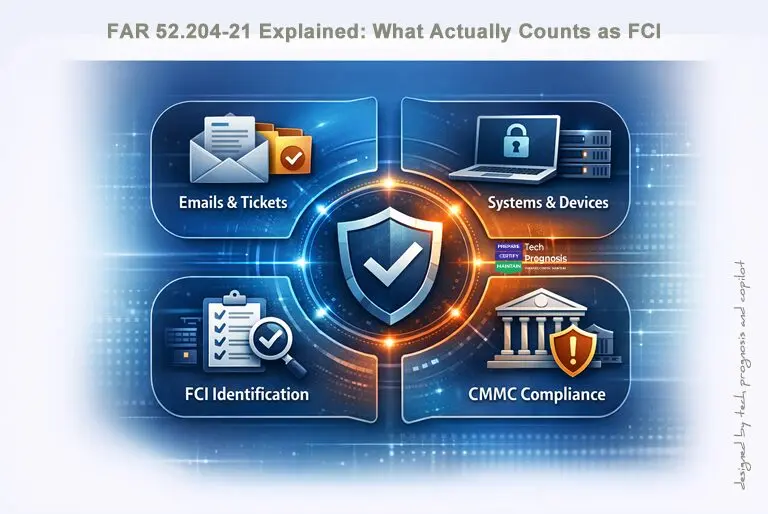
A cybersecurity themed infographic showing four labeled panels—Emails & Tickets, Systems & Devices, FCI Identification, and CMMC Compliance—surrounding a central shield icon representing protection under FAR 52.204 21.

FAR 52.204‑21 Explained: What Actually Counts as FCI (With Real Contractor Examples)

If you’ve ever thought “we don’t have Controlled Unclassified Information (CUI), so we’re off the hook,” this article is for you. FAR 52.204‑21 sets baseline safeguards for contractor systems that process Federal Contract Information (FCI)—and FCI shows up in more places than you might expect. [acquisition.gov]

Why contractors keep misclassifying FCI

The most common mistake we see: teams assume that if CUI isn’t in scope, no cyber obligations apply. But FCI alone triggers the Basic Safeguarding of Covered Contractor Information Systems clause—FAR 52.204‑21—whenever your systems process, store, or transmit it.

Bottom line: If FCI touches your email, ticketing, endpoints, file shares, or cloud tools, those systems inherit baseline safeguarding requirements.

Read more

Share

CUI vs. FCI: What Every DoD Contractor Must Get Right Before Chasing CMMC

Minimalist illustration showing CUI vs FCI folders, a balanced scale labeled Level 1 and Level 2, and CMMC compliance icons referencing FAR 52.204 21 and DFARS 7012.

Why this article on CUI vs. FCI matters

If you’re a prime, a sub, or an overwhelmed SMB in the Defense Industrial Base (DIB), your CMMC journey starts with one decision: What data are we protecting – Federal Contract Information (FCI), Controlled Unclassified Information (CUI), or both? Get this wrong and everything downstream – scope, controls, budget, tools, even your chances at award – will be off. The good news: you can make this call with clear, objective criteria grounded in FAR 52.204‑21 (FCI) and 32 CFR Part 2002 (CUI), along with DoD and NIST guidance.


Quick CUI vs. FCI definitions (plain English)

  • FCI (Federal Contract Information)
    Information not intended for public release that the Government provides to you or that you generate under a Federal contract to deliver a product or service. If it’s on a public website or simple payment data, it’s not FCI. Think SOWs, deliverable drafts, CO emails, project plans. FCI invokes FAR 52.204‑21 and its 15 basic safeguards.
  • CUI (Controlled Unclassified Information)
    Unclassified information that Federal law/regulation/policy requires or permits safeguarding or limited dissemination. It is created or possessed by the Government, or by you for/on behalf of the Government. CUI is standardized under the government‑wide CUI Program and cataloged in the CUI Registry; DoD also maintains a DoD‑specific registry. In DoD contracts, CUI generally triggers DFARS 252.204‑7012 and NIST SP 800‑171 implementation.

Practical rule of thumb: If it’s just contract‑related but not public, it’s probably FCI. If a law/regulation/policy says it needs protection (e.g., export control, Controlled Technical Information (CTI), Personally Identifiable Information (PII) tied to a DoD purpose), it’s CUI – check the registry category and your contract.

Read more

Share

COTS in the CMMC Ecosystem: Where Contractors Get Burned

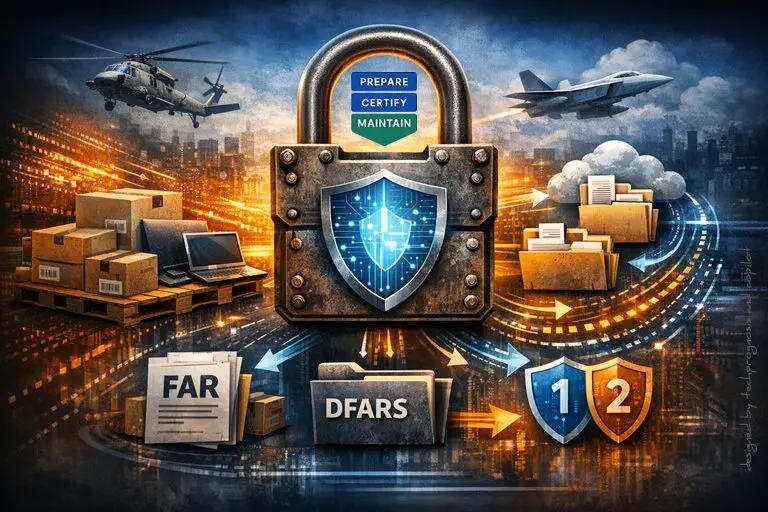
A large central padlock with a digital shield symbol, surrounded by military aircraft, cloud folders, shipping boxes, and FAR/DFARS compliance icons illustrating how COTS items, when paired with services or data handling, can quickly trigger FAR 52.204 21, DFARS 252.204 7012, and the associated CMMC and cybersecurity requirements in the defense supply chain.”

COTS in the CMMC Ecosystem: What’s In, What’s Out, and Where Contractors Get Burned

Why this topic matters

“COTS is exempt” gets repeated so often that many teams rely on it as a blanket pass. It isn’t. In DoD contracting, COTS has a precise definition in FAR 2.101, and certain DFARS cybersecurity clauses don’t apply to contracts solely for COTS—but mislabeling work or overlooking how data actually flows can still drag you under CMMC and DFARS obligations. Understanding where COTS really fits prevents over‑scoping (wasted spend) and under‑scoping (eligibility and FCA risk).

1) What “COTS” means (and what it doesn’t)

COTS (Commercially Available Off‑The‑Shelf) is a very specific status under federal acquisition rules—a commercial item sold in substantial quantities in the commercial marketplace and offered to the Government without modification, among other detailed conditions in FAR 2.101. If something is tweaked, custom‑configured, government‑unique, or bundled with non‑commercial services, it may stop being COTS. Many “we thought it was COTS” arguments fall apart when you check the definition.

Why it matters for cyber:

  • FAR 52.204‑21 (the Safeguarding Rule) applies when FCI is processed, stored, or transmitted—and is flowed down when subs may have FCI (except for pure COTS scenarios).
  • DFARS 252.204‑7012 (CUI/CDI clause) does not apply to contracts solely for COTS items, but if any performance involves CUI, 7012 comes back into play—including 72‑hour incident reporting and FedRAMP Moderate‑equivalent clouds. Misclassify work as COTS when CUI is present, and you’re out of compliance.

Read more

Share
Share
Share