Revolutionary FAR Overhaul (RFO) for CMMC

Revolutionary FAR Overhaul (RFO) article header illustrating the shift to verified cybersecurity enforcement.

The CMMC Revolutionary FAR Overhaul (RFO): Why the DoD’s Quiet Regulatory Reset Changed Cybersecurity Enforcement Forever

Executive Summary (For Decision‑Makers)

In late 2025 and early 2026, the Department of Defense executed a sweeping regulatory cleanup now commonly referred to as the Revolutionary FAR Overhaul (RFO). While much of the attention has focused on the deletion of specific clauses—most notably DFARS 252.204‑7019—the real story is far larger.

RFO fundamentally changed how cybersecurity compliance is enforced, not just how it is described. Temporary, trust‑based mechanisms were removed. Verified, system‑enforced eligibility replaced them. As a result:

  • DFARS 7019 disappeared
  • SPRS was repositioned
  • CMMC became non‑negotiable
  • Contract eligibility—not intent—became the enforcement mechanism

This article explains what RFO actually is, why it occurred, and how it permanently reshaped cybersecurity enforcement across the Defense Industrial Base (DIB).


Read more

Share

Cyber Resilience for CMMC Contractors: Why It Matters and How to Build It

A flat, minimalist illustration showing a manufacturing environment with robotic arms, workers in safety vests, and a central shield symbol split between a cracked surface and a circuit‑board design, representing cyber threats and resilience. Minimalist aircraft, a satellite dish, and a green security checkmark appear in the background.

Cyber Resilience for CMMC Contractors: Why It Matters and How to Build It

Cyber resilience is the capability to anticipate, withstand, recover from, and adapt to adverse cyber conditions—so that your mission‑essential manufacturing operations continue even when an attack succeeds. Resilience complements CMMC’s confidentiality‑focused controls (based on NIST SP 800‑171r3) by emphasizing continuity, restoration, and adaptation across IT and OT.

Audience: Defense Industrial Base (DIB) manufacturers and suppliers that handle FCI/CUI and are preparing for (or maintaining) CMMC compliance.


Why Cyber Resilience Now (Especially in the DIB)

  • The DIB remains a prime target for espionage and ransomware, and the Department of Defense (DoD) created CMMC to raise the floor on contractor protections for FCI/CUI.
  • NIST’s Cybersecurity Framework (CSF) 2.0 underscores governance and recoverability as integral to enterprise risk management—useful language for your board, program managers, and auditors.
  • Ransomware and OT/ICS impacts propagate from IT to plant networks; resilient manufacturers isolate critical processes, segment IT/OT, and test offline backups to maintain production.

Bottom line: CMMC helps protect sensitive data; resilience keeps your line running and deliveries on time.

Read more

Share

CUI vs. FCI: What Every DoD Contractor Must Get Right Before Chasing CMMC

Minimalist illustration showing CUI vs FCI folders, a balanced scale labeled Level 1 and Level 2, and CMMC compliance icons referencing FAR 52.204 21 and DFARS 7012.

Why this article on CUI vs. FCI matters

If you’re a prime, a sub, or an overwhelmed SMB in the Defense Industrial Base (DIB), your CMMC journey starts with one decision: What data are we protecting – Federal Contract Information (FCI), Controlled Unclassified Information (CUI), or both? Get this wrong and everything downstream – scope, controls, budget, tools, even your chances at award – will be off. The good news: you can make this call with clear, objective criteria grounded in FAR 52.204‑21 (FCI) and 32 CFR Part 2002 (CUI), along with DoD and NIST guidance.


Quick CUI vs. FCI definitions (plain English)

  • FCI (Federal Contract Information)
    Information not intended for public release that the Government provides to you or that you generate under a Federal contract to deliver a product or service. If it’s on a public website or simple payment data, it’s not FCI. Think SOWs, deliverable drafts, CO emails, project plans. FCI invokes FAR 52.204‑21 and its 15 basic safeguards.
  • CUI (Controlled Unclassified Information)
    Unclassified information that Federal law/regulation/policy requires or permits safeguarding or limited dissemination. It is created or possessed by the Government, or by you for/on behalf of the Government. CUI is standardized under the government‑wide CUI Program and cataloged in the CUI Registry; DoD also maintains a DoD‑specific registry. In DoD contracts, CUI generally triggers DFARS 252.204‑7012 and NIST SP 800‑171 implementation.

Practical rule of thumb: If it’s just contract‑related but not public, it’s probably FCI. If a law/regulation/policy says it needs protection (e.g., export control, Controlled Technical Information (CTI), Personally Identifiable Information (PII) tied to a DoD purpose), it’s CUI – check the registry category and your contract.

Read more

Share

CMMC Certification in Texas: 2026 Compliance Guide for DoD Contractors

Minimalist illustration representing CMMC cybersecurity for Texas DoD contractors, featuring a CMMC shield with a lock over a Texas outline, simplified defense icons, and U.S. and Texas flags

CMMC Certification for Texas DoD Contractors: The 2026 Comprehensive Guide

Defense contractors in Texas face a rapidly changing compliance landscape as the Department of Defense (DoD) fully implements the Cybersecurity Maturity Model Certification (CMMC) 2.0 program. With the final CMMC rule published on September 10, 2025, and enforcement already underway across new DoD solicitations, organizations that process Federal Contract Information (FCI) or Controlled Unclassified Information (CUI) must act quickly and decisively to ensure eligibility for future defense contracts.
[business.defense.gov]

This updated guide breaks down what CMMC is, what has changed, why Texas defense contractors must take action now, and how to prepare strategically.

What Is CMMC?

The Cybersecurity Maturity Model Certification (CMMC) is the DoD’s unified cybersecurity standard designed to ensure that all contractors within the Defense Industrial Base (DIB) implement adequate safeguards to protect sensitive information. The standard integrates requirements from:

  • FAR 52.204‑21 (for handling FCI)
  • NIST SP 800‑171 Rev. 2 (for protecting CUI)
  • NIST SP 800‑172 (for advanced protection required under Level 3)

CMMC was created in response to persistent compromises of defense information across contractor systems.

Read more

Share

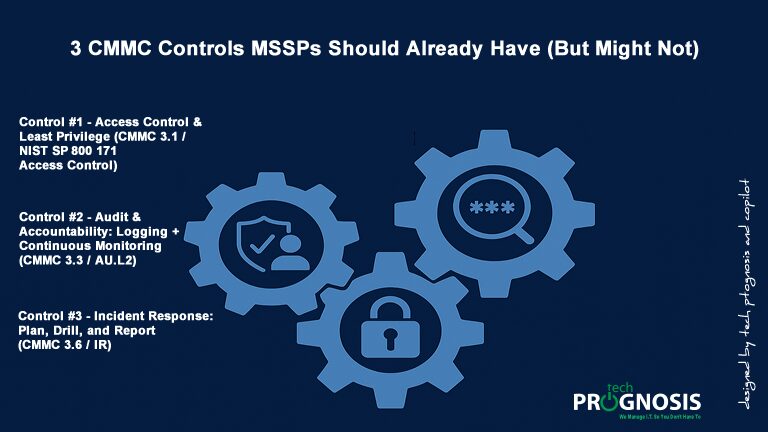
CMMC Controls MSSPs Should Already Have (But Might Not)

Three interlocking gears on a dark blue background, each containing security icons: a shield with a user silhouette, a magnifying glass with password symbols, and a padlock. Above the gears, bold white text reads ‘3 CMMC Controls MSSPs Should Already Have (But Might Not)’.

3 CMMC Controls MSSPs Should Already Have (But Might Not) — Plus Real‑World Case Studies

Hey there, MSSP heroes! Let’s cut to the chase: If you’re prepping for a CMMC audit, you’re already ahead of the game. But here’s the kicker—many MSSPs (just like you!) might be missing a few key CMMC controls staring them right in the face.

CMMC isn’t just about checking boxes—it’s about proving you’re trustworthy enough to protect sensitive government data. And while you’ve likely got solid security practices in place, CMMC’s specific requirements can trip you up if you’re not paying attention.

As a CISM & CISSP‑holding MSSP myself, I know how overwhelming the CMMC landscape can feel. There are so many controls! But here’s the good news: You probably already have the foundation for several critical CMMC controls… you just might not realize it!

In this post, we’ll uncover three essential CMMC controls that every MSSP should have in their toolbox — yet many overlook. I’ll break each one down with real‑world examples, a simple analogy, and actionable tips. Let’s turn “uh‑oh” into “I’ve got this!”

Read more

Share
Share
Share