
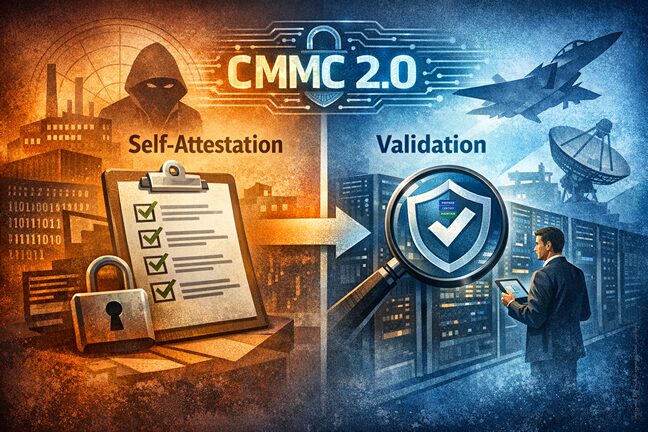
Self‑Attestation vs. Validation: Why CMMC 2.0 Exists — And What It Means for Today’s Defense Contractors
For years, the Defense Industrial Base (DIB) ran on trust. Contractors handling Federal Contract Information (FCI) or Controlled Unclassified Information (CUI) would self‑attest that they followed required cybersecurity practices. But as nation‑states and criminal groups shifted tactics, that honor‑system model showed cracks—particularly among smaller, sub‑tier suppliers where much of the sensitive technical work happens. The Department of Defense (DoD) created the Cybersecurity Maturity Model Certification (CMMC) 2.0 to close the gap between “what we think we’re doing” and “what’s actually implemented.” CMMC formalizes validation—in some cases via third‑party assessors—so the DoD can verify protections before and during contract performance.
The program sits on two pillars:
- Policy (32 CFR Part 170): establishes CMMC as the program of record (effective Dec. 16, 2024).
- Contracting (DFARS amendments): phases CMMC requirements into solicitations and awards starting Nov. 10, 2025, with a multi‑year rollout.
Meanwhile, NIST SP 800‑171 Rev. 3 (May 2024) updated the underlying security requirements for protecting CUI, emphasizing clearer, more specific controls and the use of assessment procedures in 800‑171A.
In this article, I’m your plain‑language guide and advocate. My goal is to:
- Demystify self‑attestation vs. validation, without jargon.
- Encourage small and mid‑sized businesses: compliance is achievable—step by step.
- Clarify how CMMC 2.0 actually works, who needs what, and when.
- Guide you to a practical next step (a complimentary 15‑minute discovery call).

