CMMC Certification in Texas: 2026 Compliance Guide for DoD Contractors

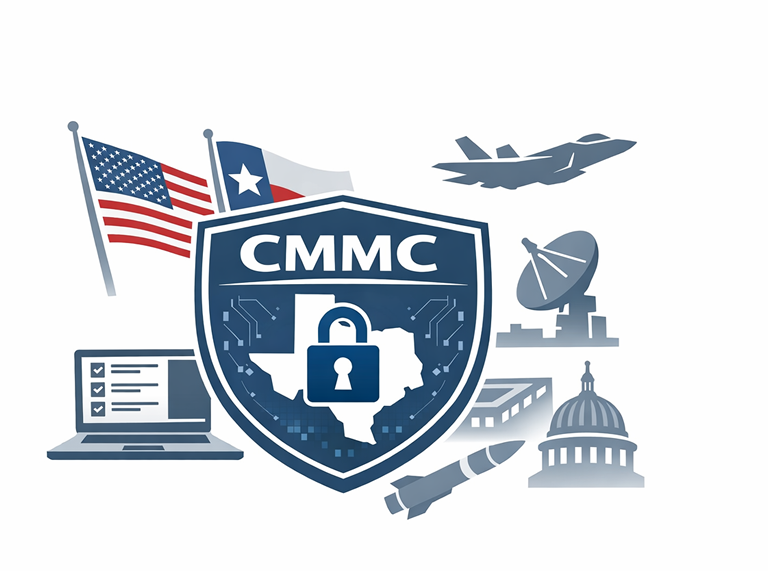
Minimalist illustration representing CMMC cybersecurity for Texas DoD contractors, featuring a CMMC shield with a lock over a Texas outline, simplified defense icons, and U.S. and Texas flags

CMMC Certification for Texas DoD Contractors: The 2026 Comprehensive Guide

Defense contractors in Texas face a rapidly changing compliance landscape as the Department of Defense (DoD) fully implements the Cybersecurity Maturity Model Certification (CMMC) 2.0 program. With the final CMMC rule published on September 10, 2025, and enforcement already underway across new DoD solicitations, organizations that process Federal Contract Information (FCI) or Controlled Unclassified Information (CUI) must act quickly and decisively to ensure eligibility for future defense contracts.
[business.defense.gov]

This updated guide breaks down what CMMC is, what has changed, why Texas defense contractors must take action now, and how to prepare strategically.

What Is CMMC?

The Cybersecurity Maturity Model Certification (CMMC) is the DoD’s unified cybersecurity standard designed to ensure that all contractors within the Defense Industrial Base (DIB) implement adequate safeguards to protect sensitive information. The standard integrates requirements from:

  • FAR 52.204‑21 (for handling FCI)
  • NIST SP 800‑171 Rev. 2 (for protecting CUI)
  • NIST SP 800‑172 (for advanced protection required under Level 3)

CMMC was created in response to persistent compromises of defense information across contractor systems.

Read more

Share

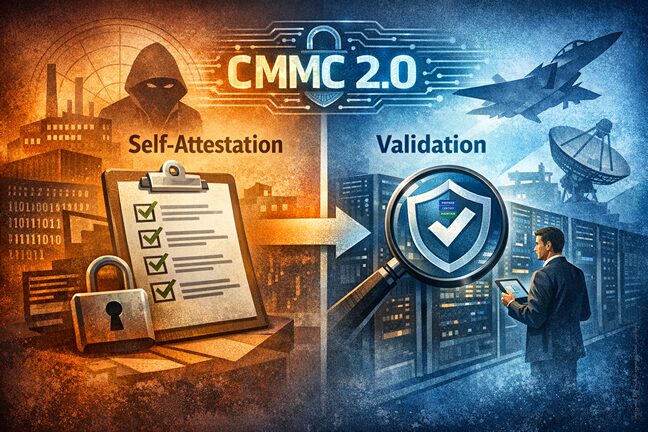
Self‑Attestation vs. Validation: Why CMMC 2.0 Exists

The contrast between self attestation (checklist, minimal assurance) and validation (formal inspection, cybersecurity hardening).

Self‑Attestation vs. Validation: Why CMMC 2.0 Exists — And What It Means for Today’s Defense Contractors

For years, the Defense Industrial Base (DIB) ran on trust. Contractors handling Federal Contract Information (FCI) or Controlled Unclassified Information (CUI) would self‑attest that they followed required cybersecurity practices. But as nation‑states and criminal groups shifted tactics, that honor‑system model showed cracks—particularly among smaller, sub‑tier suppliers where much of the sensitive technical work happens. The Department of Defense (DoD) created the Cybersecurity Maturity Model Certification (CMMC) 2.0 to close the gap between “what we think we’re doing” and “what’s actually implemented.” CMMC formalizes validation—in some cases via third‑party assessors—so the DoD can verify protections before and during contract performance.

The program sits on two pillars:

  • Policy (32 CFR Part 170): establishes CMMC as the program of record (effective Dec. 16, 2024).
  • Contracting (DFARS amendments): phases CMMC requirements into solicitations and awards starting Nov. 10, 2025, with a multi‑year rollout.

Meanwhile, NIST SP 800‑171 Rev. 3 (May 2024) updated the underlying security requirements for protecting CUI, emphasizing clearer, more specific controls and the use of assessment procedures in 800‑171A.

In this article, I’m your plain‑language guide and advocate. My goal is to:

  • Demystify self‑attestation vs. validation, without jargon.
  • Encourage small and mid‑sized businesses: compliance is achievable—step by step.
  • Clarify how CMMC 2.0 actually works, who needs what, and when.
  • Guide you to a practical next step (a complimentary 15‑minute discovery call).

Read more

Share

Generative AI in Risk and Compliance

Generative AI concept showing humanoid with neural network, code on a computer monitor, and cloud computing icon.

Generative AI in Risk and Compliance: How Texas Enterprises Are Navigating the New Frontier

The Generative AI revolution isn’t coming—it’s already transforming conference rooms from Round Rock to Richardson, and boardrooms from Austin to Arlington.

When Dell Technologies’ compliance team in Round Rock began experimenting with generative AI tools in early 2023, they discovered something remarkable: what started as a productivity enhancement quickly evolved into a fundamental reshaping of their entire risk landscape. This transformation isn’t unique to Dell—it’s happening across Texas enterprises, from Samsung’s semiconductor facilities in Austin to the financial institutions lining Dallas’s Main Street.

As someone who’s spent years helping organizations navigate the complex waters of governance, risk, and compliance (GRC), I’ve witnessed firsthand how generative AI is simultaneously creating unprecedented opportunities and introducing risks that keep chief compliance officers awake at night.

Let’s explore how this technology is reshaping enterprise risk profiles and where it can genuinely deliver value for your organization.

Read more

Share

Risk Authorization Decisions in the NIST Risk Management Framework

Cybersecurity risk authorization decisions isometric concept showing businessmen shaking hands, a huge tablet with signatures, a secure padlock, and blockchain technology.

Why Your Business Can’t Afford to Ignore Cybersecurity Risk Authorization Decisions: A Round Rock Business Leader’s Guide to the NIST Risk Management Framework

How Central Texas organizations can protect sensitive data and avoid million-dollar mistakes through proper security risk authorization decisions


If your Round Rock, Austin, or Cedar Park business handles sensitive financial data, healthcare records, or customer information, there’s a critical decision-making process that could make or break your organization’s future. It’s called the cyber risk authorization decision within the NIST Risk Management Framework (RMF), and understanding it could save your company from devastating breaches, regulatory fines, and reputational damage.

Let me share a story that illustrates why this matters to every business leader from Georgetown to San Marcos.

Read more

Share

Risk Assessment Program: Real-World Scenarios & Smart Strategies

Simulation of people reviewing a risk assessment program showing a checklist dashboard on a laptop.

Why Round Rock Businesses Can’t Afford to Skip a Risk Assessment Program: Real-World Scenarios & Smart Strategies

Learn how Round Rock, Texas businesses can manage cybersecurity and operational risks using practical, real-world examples. Understand PII breaches, DDoS attacks, and software update failures — and how to build a proactive risk management program or plan under the NIST RMF.

Estimated Reading Time: 10 minutes (≈1,950 words)


Introduction

Round Rock and its neighboring communities — Georgetown, Cedar Park, Pflugerville, Hutto, and Taylor — are thriving tech hubs. With that growth comes a new level of responsibility: keeping data safe, systems reliable, and operations compliant.

As a Governance, Risk, and Compliance (GRC) specialist, I’ve seen how even small and mid-sized companies can suffer serious setbacks when they don’t treat risk assessment as a business priority. This post breaks down how to identify, categorize, and document risks — using three realistic examples your business might face.

Read more

Share

Protect Function of the NIST Cybersecurity Framework: A Practical Guide

Infographic concept with a six-point point list of what the Protect function of the NIST Cybersecurity Framework covers like access control, awareness training, data security.

The NIST Cybersecurity Framework Protect Function: A Practical Guide for Small Businesses in Austin, Texas

Cybersecurity often feels overwhelming for small businesses. With headlines about major breaches and new regulations, it’s easy to think that strong cybersecurity is something only large corporations can afford. But the truth is, businesses of every size—whether you’re running a coffee shop in East Austin, a dental clinic in South Lamar, or a boutique retail store downtown—have critical systems, data, and people to protect.

That’s where the Protect Function of the NIST Cybersecurity Framework (CSF) comes in. While the framework sounds technical, it’s essentially a guide to help organizations reduce risk by protecting what matters most. In this article, we’ll break down the Protect Function in simple terms, explore how Austin businesses can apply it, and highlight practical steps you can take today.


What Is the Protect Function?

The NIST CSF has five core functions: Identify, Protect, Detect, Respond, and Recover. The Protect function focuses on proactive measures—safeguarding your people, assets, systems, and data before something goes wrong.

Think of it as putting locks on your doors, training your staff, and installing smoke detectors before there’s a fire. Protection doesn’t eliminate all risks, but it makes you less vulnerable and better prepared.

Read more

Share
Share
Share