CMMC Enclaves Explained

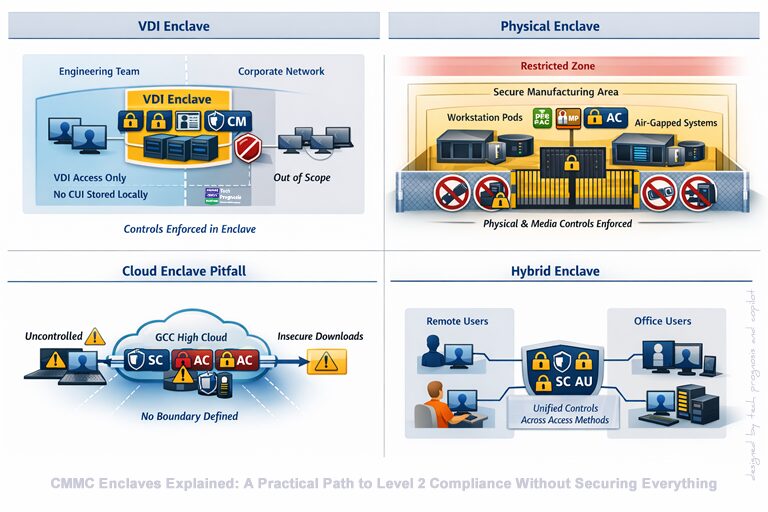
Four-diagram visual illustrating CMMC enclaves showing Level 2 enclave models, including a VDI technical enclave, a physical manufacturing enclave, a cloud enclave pitfall, and a hybrid enclave, with control-domain icons showing how CUI is protected and scoped.

CMMC Enclaves Explained: A Practical Path to Level 2 Compliance Without Securing Everything

For many defense contractors, CMMC Level 2 feels intimidating. You hear phrases like 110 practices, NIST SP 800‑171, assessment-ready, and DoD assessments, and it can sound like your entire business needs to be rebuilt from the ground up.

Here’s the good news: it probably doesn’t.

Most small and mid-sized organizations do not need to secure their entire enterprise to meet CMMC Level 2. Instead, they can use a focused, defensible strategy called a CMMC enclave—a way to protect Controlled Unclassified Information (CUI) – the sensitive data the DoD wants you to protect – without turning the rest of the business upside down.

Think of it this way: instead of installing airport-style security in your entire office building, you build a secure vault for your valuables. That vault is your enclave.

This article explains what a CMMC enclave really is, how it applies specifically to CMMC Level 2, real-world enclave setup examples, how assessors evaluate them, and how to get started without overengineering your environment.

Read more

Share

CMMC Certification in Texas: 2026 Compliance Guide for DoD Contractors

Minimalist illustration representing CMMC cybersecurity for Texas DoD contractors, featuring a CMMC shield with a lock over a Texas outline, simplified defense icons, and U.S. and Texas flags

CMMC Certification for Texas DoD Contractors: The 2026 Comprehensive Guide

Defense contractors in Texas face a rapidly changing compliance landscape as the Department of Defense (DoD) fully implements the Cybersecurity Maturity Model Certification (CMMC) 2.0 program. With the final CMMC rule published on September 10, 2025, and enforcement already underway across new DoD solicitations, organizations that process Federal Contract Information (FCI) or Controlled Unclassified Information (CUI) must act quickly and decisively to ensure eligibility for future defense contracts.
[business.defense.gov]

This updated guide breaks down what CMMC is, what has changed, why Texas defense contractors must take action now, and how to prepare strategically.

What Is CMMC?

The Cybersecurity Maturity Model Certification (CMMC) is the DoD’s unified cybersecurity standard designed to ensure that all contractors within the Defense Industrial Base (DIB) implement adequate safeguards to protect sensitive information. The standard integrates requirements from:

  • FAR 52.204‑21 (for handling FCI)
  • NIST SP 800‑171 Rev. 2 (for protecting CUI)
  • NIST SP 800‑172 (for advanced protection required under Level 3)

CMMC was created in response to persistent compromises of defense information across contractor systems.

Read more

Share

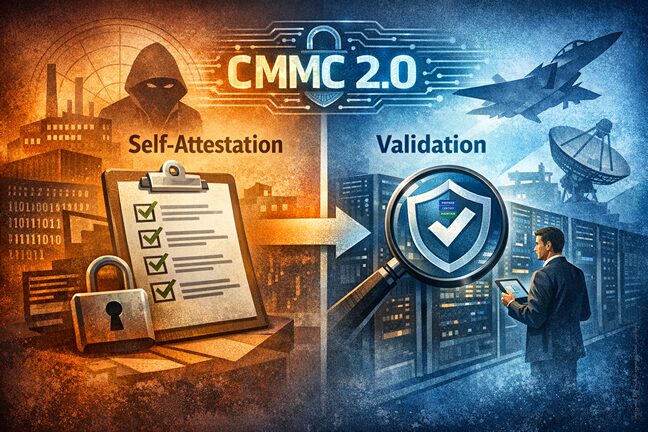
Self‑Attestation vs. Validation: Why CMMC 2.0 Exists

The contrast between self attestation (checklist, minimal assurance) and validation (formal inspection, cybersecurity hardening).

Self‑Attestation vs. Validation: Why CMMC 2.0 Exists — And What It Means for Today’s Defense Contractors

For years, the Defense Industrial Base (DIB) ran on trust. Contractors handling Federal Contract Information (FCI) or Controlled Unclassified Information (CUI) would self‑attest that they followed required cybersecurity practices. But as nation‑states and criminal groups shifted tactics, that honor‑system model showed cracks—particularly among smaller, sub‑tier suppliers where much of the sensitive technical work happens. The Department of Defense (DoD) created the Cybersecurity Maturity Model Certification (CMMC) 2.0 to close the gap between “what we think we’re doing” and “what’s actually implemented.” CMMC formalizes validation—in some cases via third‑party assessors—so the DoD can verify protections before and during contract performance.

The program sits on two pillars:

  • Policy (32 CFR Part 170): establishes CMMC as the program of record (effective Dec. 16, 2024).
  • Contracting (DFARS amendments): phases CMMC requirements into solicitations and awards starting Nov. 10, 2025, with a multi‑year rollout.

Meanwhile, NIST SP 800‑171 Rev. 3 (May 2024) updated the underlying security requirements for protecting CUI, emphasizing clearer, more specific controls and the use of assessment procedures in 800‑171A.

In this article, I’m your plain‑language guide and advocate. My goal is to:

  • Demystify self‑attestation vs. validation, without jargon.
  • Encourage small and mid‑sized businesses: compliance is achievable—step by step.
  • Clarify how CMMC 2.0 actually works, who needs what, and when.
  • Guide you to a practical next step (a complimentary 15‑minute discovery call).

Read more

Share

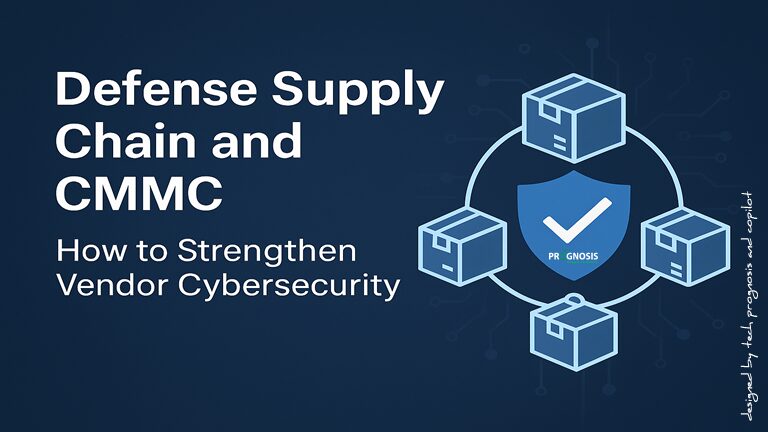
Defense Supply Chain and CMMC: Practical Steps for Vendor Security

Illustration of secure defense supply chain with shield and interconnected boxes representing vendors

CMMC 2.0 and Defense Supply Chain Attacks: Practical Steps to Build Resilience Across Your Vendor Ecosystem

Supply chain attacks keep rising because attackers go where trust and access already exist—third-party vendors, managed service providers, and software suppliers. If you handle Federal Contract Information (FCI) or Controlled Unclassified Information (CUI), your security posture is only as strong as your partners’. CMMC 2.0 responds to this reality by placing verifiable expectations on every tier that touches sensitive DoD data. In this post, we’ll break down the threat, connect it to CMMC’s objectives, and share a practical roadmap you can start using today—grounded in inclusive, plain language and real-world scenarios.

Why the Defense Supply Chain Is a Prime Target

  • The attack surface is huge. Organizations share data with hundreds of vendors, yet few have mature processes to evaluate and improve vendor cybersecurity posture. In 2023, 15% of breaches involved a defense supply chain compromise, and 98% of companies had at least one vendor that experienced a breach. This is a perfect storm of exposure and limited oversight.
  • High-profile cases illustrate the risk. The SolarWinds Orion compromise showed how malicious code in a trusted update can ripple across government and commercial networks. Likewise, the 2023 third-party breach linked to Infosys McCamish Systems affected more than 57,000 Bank of America-related entities, underscoring how downstream vendors can become a gateway for attackers.

Inclusive takeaway: regardless of your organization’s size, role, or location within the Defense Industrial Base (DIB), defense supply chain risk touches everyone who processes, stores, or transmits FCI/CUI.

Read more

Share
Share
Share