
Combating Cloud Security Threats in Cloud Computing: A Guide to Cloud Security for Austin’s Financial Services
As someone who’s spent over a decade helping financial institutions navigate the complex world of cybersecurity, I’ve watched Austin’s financial services sector transform dramatically. From the bustling tech corridors along MoPac to the financial districts downtown, our city’s banks, credit unions, and fintech startups are increasingly moving their operations to the cloud. But with this shift comes the critical questions I hear almost daily: “How do we combat security threats in cloud computing”, and “How do we keep our customers’ financial data safe in the cloud?”
Let me share what I’ve learned about security threats in our industry, drawing from real experiences right here in Central Texas, particularly as artificial intelligence reshapes how we think about data protection and financial services.
Understanding Cloud Computing in Today’s AI-Driven World
Cloud computing has evolved far beyond simple data storage. Today, it’s the backbone that powers everything from your mobile banking app to the AI systems that detect fraudulent transactions before they hit your account. When we talk about “the cloud,” we’re really discussing powerful networks of remote servers that store, manage, and process data over the internet instead of on local computers.
In the age of AI, cloud computing has become even more critical. Those fraud detection algorithms I mentioned? They require massive computational power that most individual banks couldn’t afford to maintain on-site. The cloud makes these advanced AI capabilities accessible to financial institutions of all sizes, from major banks to local credit unions.
The distinction between private and public clouds is particularly important for financial services. A public cloud is like renting space in a massive, shared apartment building – providers like Amazon Web Services (AWS), Microsoft Azure, or Google Cloud Platform offer their infrastructure to multiple organizations. It’s cost-effective and scalable, but you’re sharing resources with other tenants.
A private cloud, on the other hand, is like owning your own building. The infrastructure is dedicated exclusively to your organization, either hosted on-premises or by a third-party provider. Many Austin financial institutions opt for a hybrid approach, keeping sensitive customer data in private clouds while leveraging public clouds for less sensitive operations.
The Cloud Security Threats and Challenges Financial Services Providers Face
Managing cloud security in financial services isn’t just about technology – it’s about protecting the trust our community places in us. Here in Austin, where tech innovation meets traditional Texas values, that trust is everything.
One of the biggest challenges I’ve encountered is the shared responsibility model. When Frost Bank or University Federal Credit Union (UFCU) moves operations to the cloud, they’re not handing over all security responsibilities to their cloud provider. Instead, security becomes a partnership. The cloud provider secures the infrastructure, but the financial institution must secure everything they put into that infrastructure. I’ve seen confusion about this model lead to dangerous gaps in security coverage.
Data residency and compliance present another significant hurdle. Financial institutions must comply with regulations like the Gramm-Leach-Bliley Act and various state privacy laws. When your data might be stored in data centers across multiple states or countries, ensuring compliance becomes exponentially more complex. A credit union based in Round Rock, Texas needs to know exactly where their customers’ data resides and ensure it meets all applicable regulations.
The sophistication of cyber threats targeting financial services has also increased dramatically. In 2023, a Texas-based community bank (which I won’t name for security reasons) faced a sophisticated attack where criminals used stolen credentials to access their cloud-based loan processing system. The attackers didn’t just steal data – they attempted to manipulate loan records to approve fraudulent applications. Only robust cloud-based anomaly detection prevented significant losses.
Visibility and control represent ongoing challenges. When your infrastructure was in your own data center, you could physically walk in and see your servers. In the cloud, that direct visibility disappears. Financial institutions must rely on logs, metrics, and alerts provided by their cloud platforms, requiring new skills and tools to maintain security oversight.
The Security Advantages of Cloud Computing
Despite these challenges, I’ve seen firsthand how cloud computing can actually enhance security for financial institutions when implemented correctly. The advantages often outweigh the risks, especially for small to medium-sized financial services providers in our area.
Cloud providers invest billions in security – far more than any individual bank or credit union could afford. AWS, for instance, employs thousands of security professionals and maintains certifications that would be prohibitively expensive for most financial institutions to achieve independently. When Austin’s Amplify Credit Union moved to the cloud, they gained access to enterprise-grade security tools that would have cost millions to implement on-premises.
The scalability of cloud-based security is particularly valuable during high-stress periods. Remember the surge in digital banking during the early days of COVID-19? Cloud-based institutions could rapidly scale their security monitoring and fraud detection capabilities to match the increased traffic. Traditional on-premises systems often struggled to keep pace.
Automated security updates and patches represent another significant advantage. In the cloud, critical security updates can be applied across entire infrastructures within hours, not weeks. This rapid response capability proved crucial when the Log4j vulnerability was discovered in late 2021. Cloud-based financial institutions in Austin were able to patch their systems much faster than those relying on traditional infrastructure.
Best Practices for Mitigating Cloud Security Threats in Financial Services
Through years of helping Austin’s financial institutions secure their cloud environments, I’ve identified several best practices that consistently deliver results.
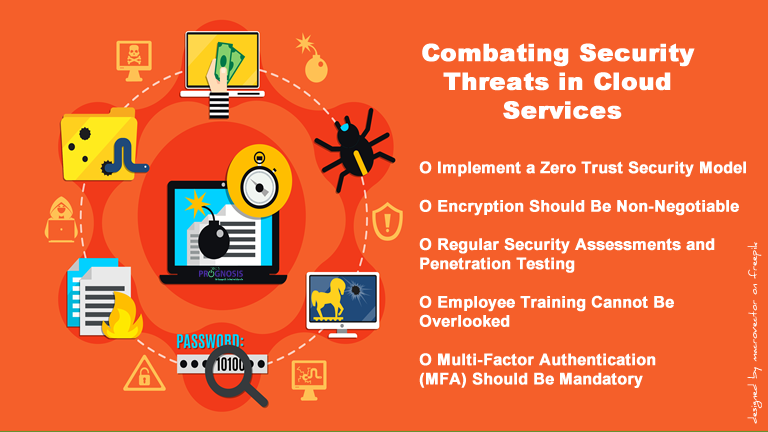
First, implement a zero-trust security model. Never assume that anyone or anything inside your cloud environment is trustworthy by default. Every user, device, and application should be verified before gaining access to resources. One Austin fintech startup I worked with reduced their security incidents by 78% after implementing zero-trust principles.
Encryption should be non-negotiable. Encrypt data at rest, in transit, and during processing. Modern cloud platforms offer robust encryption options, but you need to ensure they’re properly configured. I recommend using customer-managed encryption keys for sensitive financial data, giving you ultimate control over who can access your information.
Regular security assessments and penetration testing are crucial. The cloud environment changes rapidly, and new vulnerabilities emerge constantly. Schedule quarterly assessments at minimum, and consider continuous automated scanning for critical systems. Several Austin banks have adopted a “purple team” approach, where internal security teams work alongside external penetration testers to identify and fix vulnerabilities collaboratively.
Employee training cannot be overlooked. The most sophisticated security technology fails if employees fall for phishing attacks or mishandle credentials. Develop cloud-specific security training that addresses the unique risks of remote access and cloud-based tools. Make it relevant to Austin – I’ve seen great success with training scenarios based on local examples and familiar situations.
Multi-factor authentication (MFA) should be mandatory for all cloud access, especially for privileged accounts. But go beyond basic SMS-based MFA, which can be compromised through SIM swapping attacks. Use hardware tokens or authenticator apps for critical systems. When a local investment firm implemented hardware-based MFA for all cloud administrator accounts, they eliminated account compromise incidents entirely.
Leading Cloud Security Solutions for Financial Services
The cloud security landscape offers numerous solutions, but some stand out for financial services applications.
Cloud Access Security Brokers (CASBs) act as intermediaries between your users and cloud services, providing visibility and control over data movement. Solutions like Netskope and Zscaler have proven particularly effective for Austin financial institutions managing multiple cloud environments.
Cloud Workload Protection Platforms (CWPPs) secure your actual cloud workloads. Tools like Palo Alto Networks Prisma Cloud and Check Point CloudGuard provide comprehensive protection for applications and data running in the cloud. These platforms excel at identifying misconfigurations – a leading cause of cloud security breaches.
Security Information and Event Management (SIEM) solutions designed for cloud environments help detect and respond to threats in real-time. Splunk Cloud and Microsoft Sentinel have strong adoption among Texas financial institutions, offering powerful analytics and automated response capabilities.
For smaller financial services providers, integrated cloud-native security solutions often provide the best value. AWS Security Hub, Azure Security Center, and Google Cloud Security Command Center offer comprehensive security management within their respective platforms.
The Path Forward for Austin’s Financial Services
Cloud security in financial services isn’t just about protecting data – it’s about maintaining the trust that forms the foundation of our financial system. As Austin continues to grow as a fintech hub, with companies like Q2 Holdings and Kasasa leading innovation, robust cloud security becomes even more critical.
The financial institutions that thrive will be those that embrace cloud computing’s benefits while taking security seriously. This means investing in the right tools, training your team, and partnering with security experts who understand both the technology and the unique requirements of financial services.
Remember, perfect security doesn’t exist, but with the right approach, cloud services can be more secure than traditional on-premises infrastructure. The key is understanding your responsibilities, implementing best practices, and staying vigilant as the threat landscape evolves.
Ready to Secure Your Cloud Journey?
If you’re a financial services provider in the Austin area looking to strengthen your cloud security posture, let’s talk. I offer a complimentary 15-minute discovery call where we can discuss your specific cloud security threats and challenges and identify potential solutions tailored to your institution’s needs. Whether you’re just beginning your cloud journey or looking to enhance existing security measures, I’m here to help protect your customers and your reputation.
Schedule your free 15-minute cloud security discovery call today, or call us at 512-814-8044.
Together, we can ensure that Austin’s financial services sector remains both innovative and secure, building a stronger financial future for our entire community.
References:
- National Institute of Standards and Technology (NIST) Cloud Computing Security Reference Architecture
- Federal Financial Institutions Examination Council (FFIEC) Cloud Computing Guidance
- Cloud Security Alliance (CSA) Security Guidance for Critical Areas of Focus in Cloud Computing
- Gramm-Leach-Bliley Act (GLBA) Compliance Guidelines
- Texas Department of Banking Security Guidelines for Financial Institutions
About the Author: Daniel Ihonvbere, CISM, CISSP is a Risk Management and GRC expert with 15+ years of experience helping organizations and businesses navigate technological transformation and complex regulatory guidelines and frameworks.
