
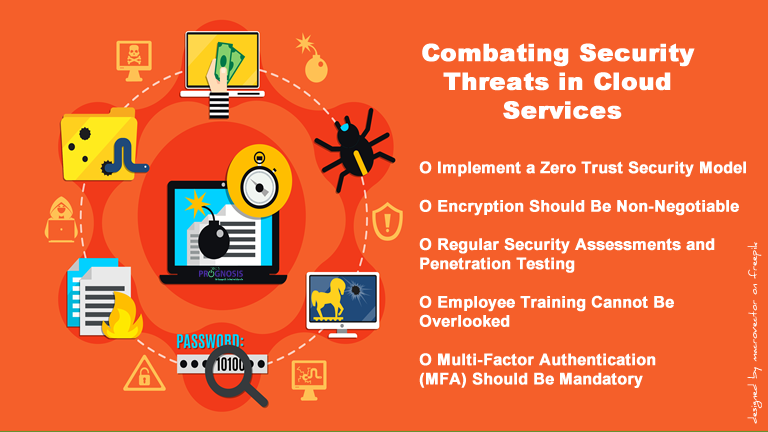
Cloud Security Threats and Mitigation: A Guide for Financial Services in Austin, Texas

Cloud security threats that target financial services in Austin, Texas like spam threats, hackers, fraud, password thefts, and mitigation solutions like email security, firewalls, data security

Combating Cloud Security Threats in Cloud Computing: A Guide to Cloud Security for Austin’s Financial Services

As someone who’s spent over a decade helping financial institutions navigate the complex world of cybersecurity, I’ve watched Austin’s financial services sector transform dramatically. From the bustling tech corridors along MoPac to the financial districts downtown, our city’s banks, credit unions, and fintech startups are increasingly moving their operations to the cloud. But with this shift comes the critical questions I hear almost daily:  “How do we combat security threats in cloud computing”, and “How do we keep our customers’ financial data safe in the cloud?”

Let me share what I’ve learned about security threats in our industry, drawing from real experiences right here in Central Texas, particularly as artificial intelligence reshapes how we think about data protection and financial services.

Read more

Share

Continuity Planning: Unexpected Disasters Your IT Provider Should Be Planning For

Simulation of risk management consultants looking at a diagram illustration of a business continuity planning dashboard.

Continuity Planning: The Unexpected Disaster Your IT Provider Should Be Planning For

Power outages, cyberattacks, hardware failures and natural disasters rarely arrive with a warning, and when they hit, the impact on small businesses can be devastating. Many assume that having a backup is enough, but the truth is, restoring a file isn’t the same as staying operational. If you can’t access systems, support remote work or keep your team and clients in the loop, even a short disruption can turn into a long-term setback. A reliable IT partner should prepare you for these moments – not just with backups, but with a complete plan to keep your business running no matter what.

Read more

Share

Cloud Technology: Understanding the Invisible Backbone of Modern Life

Cloud technology isometric showing icons of a cloud, datacenters and a laptop, with text of best practices for managing cloud dependence responsibly.

Cloud Technology Is Like Air: Understanding the Invisible Backbone of Modern Life

Introduction: The Air We Breathe, the Cloud We Use

We rarely think about the air around us until something disrupts it — a smoky day, a strong gust, or a breathless moment. The same goes for cloud technology. It’s always there, powering everything from our mobile apps and streaming platforms to business-critical systems and secure backups. Yet, unless there’s a service outage or data breach, many people don’t give it a second thought.

But in today’s digital-first world, understanding cloud technology is as essential as understanding electricity or plumbing. This blog explores the analogy of cloud computing as air, revealing just how pervasive and vital the cloud has become in both personal and professional contexts.

Read more

Share

True Cost of Neglecting IT (Information Technology) and Support

Illustration of essential IT investments concept with technology symbols and text of collaboration and communication, cloud computing and storage, cybersecurity, and secure remote work solutions as a remedy for organizations and businesses neglecting IT (Information Technology) and Support

Neglecting IT (Information Technology) and Support : The Make-Or-Break Factor Business Owners Overlook—Until It’s Too Late

A CIO’s Perspective on IT as a Growth Driver, Not Just a Cost

As the vCIO of a couple of businesses and organizations, I have seen firsthand how technology can be either a strategic enabler or a major roadblock. Too often, business owners focus on growth, sales, and customer experience while leaving IT decisions on the back burner—until something goes wrong.

For many business owners, IT is seen as a necessary expense rather than a strategic asset. But the reality is that your technology infrastructure directly impacts efficiency, security, and growth. Slow computer systems, dropped phone calls impacting sales, outdated software, or weak cybersecurity measures that leave an organization’s data vulnerable don’t just cause occasional frustration—they can create significant vulnerabilities that cost your business time, money, and reputation.

Here’s the hard truth: neglecting IT and support can cost your business more than you think—in lost productivity, security risks, and missed opportunities. The right technology isn’t just an operational necessity; it is a competitive advantage.

So, let me ask you: Is your IT helping your business grow, or is it quietly holding you back?

Read more

Share

AWS Well-Architected Framework

Image of a creative web homepage simulating AWS Well-Architected Framework with text of the five pillars of the framework.

Understanding the AWS Well-Architected Framework: A Guide for All Sectors

Introduction

The shift to cloud computing is more than just a trend—it’s a necessity. Amazon Web Services (AWS), a pioneer in cloud services, has developed the AWS Well-Architected Framework to guide organizations in creating secure, high-performing, resilient, and efficient infrastructures for their applications. This framework is not just for tech experts; it’s a valuable resource for anyone involved in managing and optimizing cloud-based systems.

The AWS Well-Architected Framework is a crucial guide designed to help organizations build secure, high-performing, resilient, and efficient infrastructure for their applications. Whether you’re in healthcare, finance, retail, or any other sector, understanding and implementing the principles of this framework can significantly enhance your cloud operations.

In this blog, we’ll explore the five pillars of the AWS Well-Architected Framework, discuss common challenges organizations face, and provide sector-specific examples. We’ll also share best practices and recommend popular tools to help you build robust cloud architectures.

Read more

Share

Information Systems Acquisition, Development, and Implementation

Image of isometric composition simulating information systems acquisition, development, and implementation showing IT professionals with system admin symbols

A Comprehensive Guide to Information Systems Acquisition, Development, and Implementation

Information systems (IS) are the backbone of successful organizations. They streamline operations, enhance decision-making, and improve customer satisfaction. However, acquiring, developing, and implementing these systems can be a daunting task.

This guide will walk you through the process, using examples from various sectors, addressing common challenges, and offering best practices to ensure a smooth journey.

Whether you’re a small business owner or part of a large enterprise, this comprehensive guide will help you understand the intricacies involved and offer best practices to ensure successful information systems projects.

Introduction to Information Systems

Information systems (IS) are integrated sets of components designed to collect, store, and process data, providing information, knowledge, and digital products. They play a pivotal role in managing operations, interacting with customers and suppliers, and competing in the marketplace. In essence, they form the backbone of modern organizations, driving efficiency and innovation.

Read more

Share
Share
Share