Data Flow Mapping for CMMC Level 2 and Your Entire Compliance Strategy

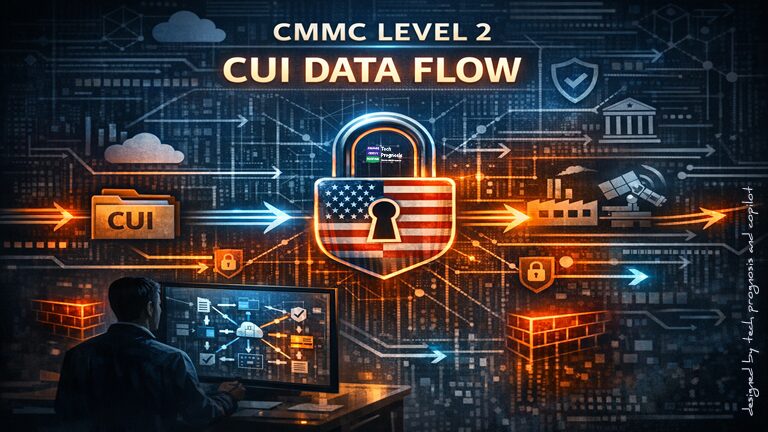
A digital illustration showing a secure CUI data flow concept for CMMC Level 2. A central padlock with a U.S. flag design is surrounded by directional arrows connecting icons representing cloud storage, government systems, industry, and firewalls. A person sits at a workstation viewing a data flow diagram.

Data Flow Mapping for CMMC Level 2: Why Mapping CUI Flow Determines Your Entire Compliance Strategy

If you can’t see where Federal Contract Information (FCI) and Controlled Unclassified Information (CUI) travel in your workflows, you can’t scope your obligations—period. This data flow mapping guide gives you a clear, repeatable way to map data flows, define system boundaries, and stop misclassification before it derails your contract.

Executive Summary

  • Controlling how CUI flows inside and outside your environment determines scope, architecture, tooling, and cost.
  • Design a focused CUI enclave so requirements only follow where CUI actually goes, reducing complexity and spend.
  • Document, enforce, and evidence approved flow paths to satisfy AC.L2-3.1.3 and pass a CMMC Level 2 assessment.

1. Introduction: Data Flow—the Most Underestimated Requirement

Organizations that pass CMMC Level 2 know exactly where CUI is allowed to go and can prove it never goes anywhere else. Information flow control is not just another checkbox—it shapes your boundary, controls, and cost.

2. What “Data Flow Control” Means in CMMC (AC.L2-3.1.3)

Control the flow of CUI in accordance with approved authorizations. Assessors expect to see:

  • Defined information flow control policies;
  • Defined enforcement mechanisms;
  • Designated sources and destinations for CUI;
  • Defined authorizations for CUI flow;
  • Consistent enforcement of those authorizations.

Read more

Share

FAR 52.204-21 Explained: What Actually Counts as FCI

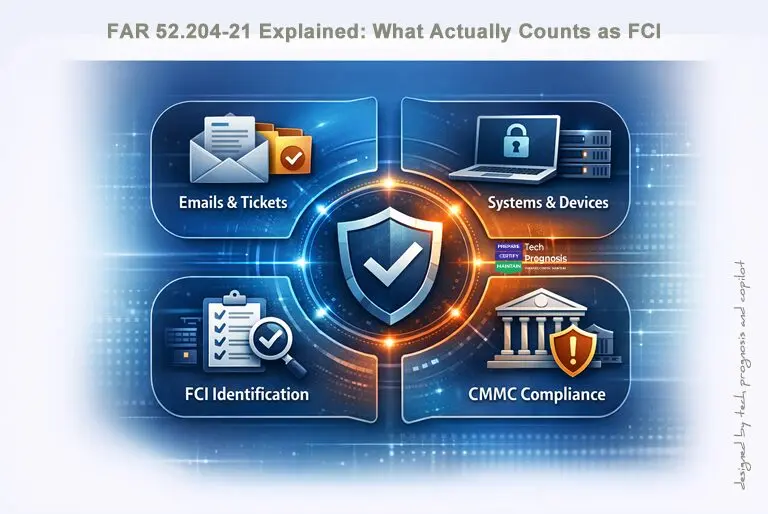
A cybersecurity themed infographic showing four labeled panels—Emails & Tickets, Systems & Devices, FCI Identification, and CMMC Compliance—surrounding a central shield icon representing protection under FAR 52.204 21.

FAR 52.204‑21 Explained: What Actually Counts as FCI (With Real Contractor Examples)

If you’ve ever thought “we don’t have Controlled Unclassified Information (CUI), so we’re off the hook,” this article is for you. FAR 52.204‑21 sets baseline safeguards for contractor systems that process Federal Contract Information (FCI)—and FCI shows up in more places than you might expect. [acquisition.gov]

Why contractors keep misclassifying FCI

The most common mistake we see: teams assume that if CUI isn’t in scope, no cyber obligations apply. But FCI alone triggers the Basic Safeguarding of Covered Contractor Information Systems clause—FAR 52.204‑21—whenever your systems process, store, or transmit it.

Bottom line: If FCI touches your email, ticketing, endpoints, file shares, or cloud tools, those systems inherit baseline safeguarding requirements.

Read more

Share

CMMC Certification in Texas: 2026 Compliance Guide for DoD Contractors

Minimalist illustration representing CMMC cybersecurity for Texas DoD contractors, featuring a CMMC shield with a lock over a Texas outline, simplified defense icons, and U.S. and Texas flags

CMMC Certification for Texas DoD Contractors: The 2026 Comprehensive Guide

Defense contractors in Texas face a rapidly changing compliance landscape as the Department of Defense (DoD) fully implements the Cybersecurity Maturity Model Certification (CMMC) 2.0 program. With the final CMMC rule published on September 10, 2025, and enforcement already underway across new DoD solicitations, organizations that process Federal Contract Information (FCI) or Controlled Unclassified Information (CUI) must act quickly and decisively to ensure eligibility for future defense contracts.
[business.defense.gov]

This updated guide breaks down what CMMC is, what has changed, why Texas defense contractors must take action now, and how to prepare strategically.

What Is CMMC?

The Cybersecurity Maturity Model Certification (CMMC) is the DoD’s unified cybersecurity standard designed to ensure that all contractors within the Defense Industrial Base (DIB) implement adequate safeguards to protect sensitive information. The standard integrates requirements from:

  • FAR 52.204‑21 (for handling FCI)
  • NIST SP 800‑171 Rev. 2 (for protecting CUI)
  • NIST SP 800‑172 (for advanced protection required under Level 3)

CMMC was created in response to persistent compromises of defense information across contractor systems.

Read more

Share

CMMC Audit Guide: How to Detect Hidden or Forgotten Systems

Simulation of a CMMC audit showing a cybersecurity auditor reviewing network map and CMMC scoping guide to detect hidden systems during compliance assessment.

Detecting Concealed, Forgotten, or “Conveniently Omitted” Systems During a CMMC Audit

Hidden assets—forgotten servers, unregistered devices, and unmonitored cloud instances—can derail a CMMC assessment. This practical guide helps you spot them early, align your scope with DoD rules, and prepare for a CMMC audit like a pro.

Why hidden systems matter for a CMMC Audit

In CMMC Level 2, your environment must meet the NIST SP 800‑171 requirements for systems that process, store, or transmit CUI—and certain systems that provide security services to those systems. If your scope misses assets, your controls won’t cover the real environment, which leads to findings. The DoD’s Final CMMC Rule formalizes verification, introduces annual affirmations of ongoing compliance, and ties certification status to contract award and performance—so accuracy isn’t optional. [cmmcaudit.org]

Read more

Share

Generative AI in Risk and Compliance

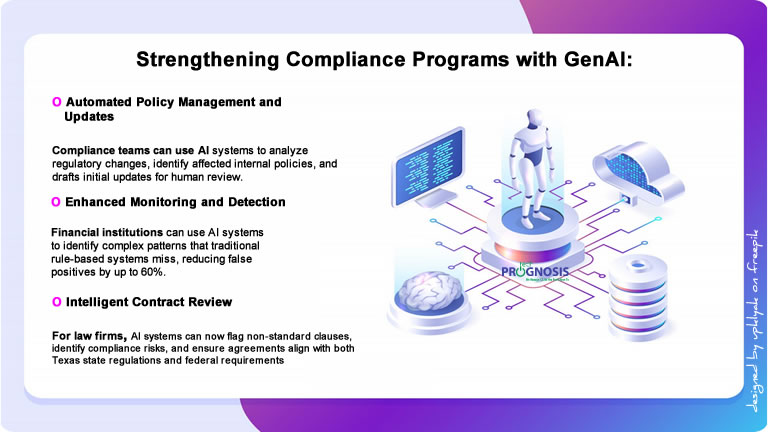
Generative AI concept showing humanoid with neural network, code on a computer monitor, and cloud computing icon.

Generative AI in Risk and Compliance: How Texas Enterprises Are Navigating the New Frontier

The Generative AI revolution isn’t coming—it’s already transforming conference rooms from Round Rock to Richardson, and boardrooms from Austin to Arlington.

When Dell Technologies’ compliance team in Round Rock began experimenting with generative AI tools in early 2023, they discovered something remarkable: what started as a productivity enhancement quickly evolved into a fundamental reshaping of their entire risk landscape. This transformation isn’t unique to Dell—it’s happening across Texas enterprises, from Samsung’s semiconductor facilities in Austin to the financial institutions lining Dallas’s Main Street.

As someone who’s spent years helping organizations navigate the complex waters of governance, risk, and compliance (GRC), I’ve witnessed firsthand how generative AI is simultaneously creating unprecedented opportunities and introducing risks that keep chief compliance officers awake at night.

Let’s explore how this technology is reshaping enterprise risk profiles and where it can genuinely deliver value for your organization.

Read more

Share

Risk Authorization Decisions in the NIST Risk Management Framework

Cybersecurity risk authorization decisions isometric concept showing businessmen shaking hands, a huge tablet with signatures, a secure padlock, and blockchain technology.

Why Your Business Can’t Afford to Ignore Cybersecurity Risk Authorization Decisions: A Round Rock Business Leader’s Guide to the NIST Risk Management Framework

How Central Texas organizations can protect sensitive data and avoid million-dollar mistakes through proper security risk authorization decisions


If your Round Rock, Austin, or Cedar Park business handles sensitive financial data, healthcare records, or customer information, there’s a critical decision-making process that could make or break your organization’s future. It’s called the cyber risk authorization decision within the NIST Risk Management Framework (RMF), and understanding it could save your company from devastating breaches, regulatory fines, and reputational damage.

Let me share a story that illustrates why this matters to every business leader from Georgetown to San Marcos.

Read more

Share
Share
Share