Security Information and Event Management (SIEM) and Regulated Industries

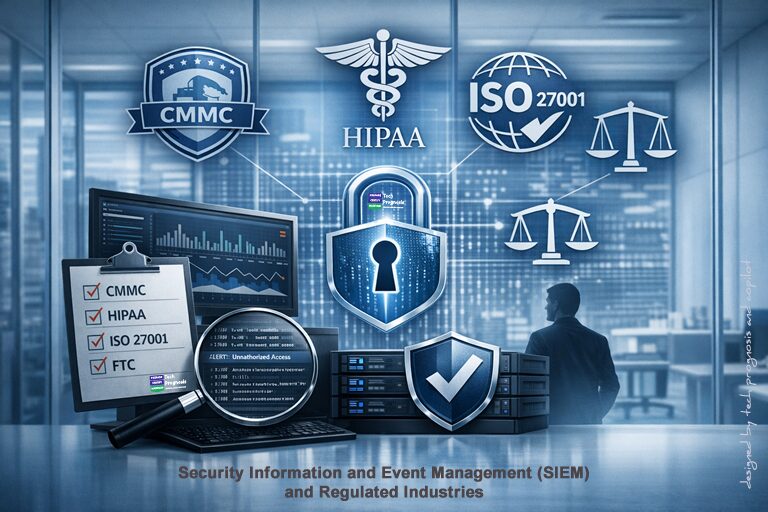
A digital illustration showing cybersecurity, Security Information and Event Management (SIEM) and compliance concepts, including a glowing lock at the center, surrounded by icons for CMMC, HIPAA, ISO 27001, and FTC related compliance, with dashboards, servers, checklists, and security symbols representing monitoring, auditing, and regulatory alignment.

Understanding SIEM in 2026: Limitations—and How to Build a Compliant, Outcome‑Driven Detection Program

Executive summary. Security Information and Event Management (SIEM) remains central to modern detection and response, but the playing field has evolved: cloud‑first estates, identity‑centric attacks, and new or strengthened rules (CMMC, HIPAA Security Rule enforcement practices, FTC Safeguards updates, ISO/IEC 27001:2022, and NIST CSF 2.0) raise the bar for logging, monitoring, and evidence. SIEM alone isn’t enough; you’ll need smart log source prioritization, detection engineering mapped to frameworks like MITRE ATT&CK, and automation you can trust (SOAR), all tuned to produce defensible evidence for audits and assessments.


What is Security Information and Event Management (SIEM) today (and what it isn’t)

A SIEM centrally collects and analyzes logs and events across systems, networks, applications, identities, and cloud services to help analysts detect, investigate, and report incidents. It’s often paired with Security Orchestration, Automation, and Response or SOAR to orchestrate and automate response actions.

SOAR (security orchestration, automation, and response) provides playbooks and automation for triage and remediation; it does not replace analytic rigor or governance.

Governments and industry recently published pragmatic guidance for implementing SIEM/SOAR, highlighting benefits (visibility, faster response) and pitfalls (data normalization, coverage, resource intensity).

Where SIEM fits in frameworks: NIST CSF 2.0 explicitly expects continuous monitoring and event logging outcomes (e.g., PR.PS‑04 requires that log records are generated and made available for continuous monitoring)—functions typically enabled by SIEM + SOAR.

Read more

Share

Compensating Security Controls for Texas Businesses

Informative isometric simulation of compensating security controls showing icons for surveillance camera, data privacy, and security system

When Your Cloud Security Falls Short: A Practical Guide to Compensating Security Controls for Texas Businesses

How Round Rock and Austin-Area Companies Can Bridge Security Gaps with Compensating Security Controls Without Breaking the Budget


If you’re running a business in Round Rock, Austin, or anywhere in Central Texas’s booming tech corridor, you’re likely using cloud services for at least part of your operations. Maybe you’re a healthcare provider in Cedar Park storing patient records, a financial services firm in Georgetown processing transactions, or a tech startup in Pflugerville building the next big thing.

Here’s something that might keep you up at night: what happens when your cloud provider’s security features don’t quite meet your industry’s requirements?

Let me share a story about “Adam,” a security analyst at a Austin-area financial services company, whose experience might sound familiar to many of you.

Read more

Share

Amazon Macie: A Guide to Securing Sensitive Data in the Cloud

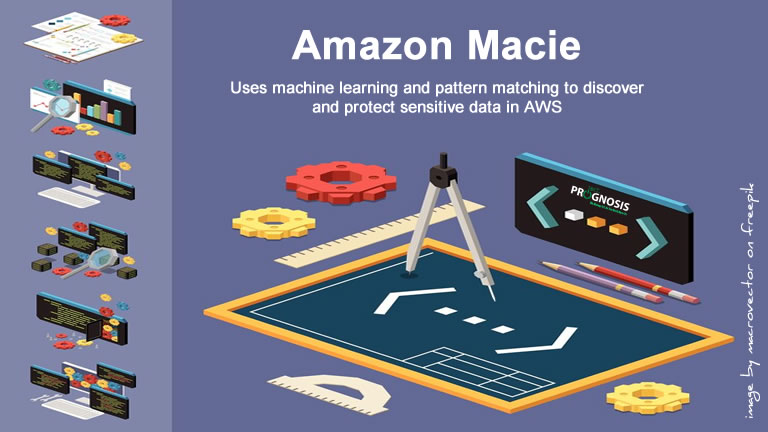
Image of V Model software development isometric composition with gear, icons, code screens, and computer workstations as a simulation of how Amazon Macie uses machine learning and pattern matching to discover and protect sensitive data in AWS.

Securing Sensitive Data in the Cloud: A Comprehensive Guide to Amazon Macie

Data security and privacy are more important than ever. With the increasing amount of sensitive information stored in the cloud, organizations face growing challenges in safeguarding their data. As a service designed to enhance data security and privacy, Amazon Macie helps organizations discover, monitor, and protect sensitive data stored in Amazon S3 (Simple Storage Service).

In this article, we’ll explore how Amazon Macie can help your organization stay compliant and secure, highlight common challenges in data protection, and offer best practices and popular tools to enhance your data security strategy.

Read more

Share
Share
Share