Security Information and Event Management (SIEM) and Regulated Industries

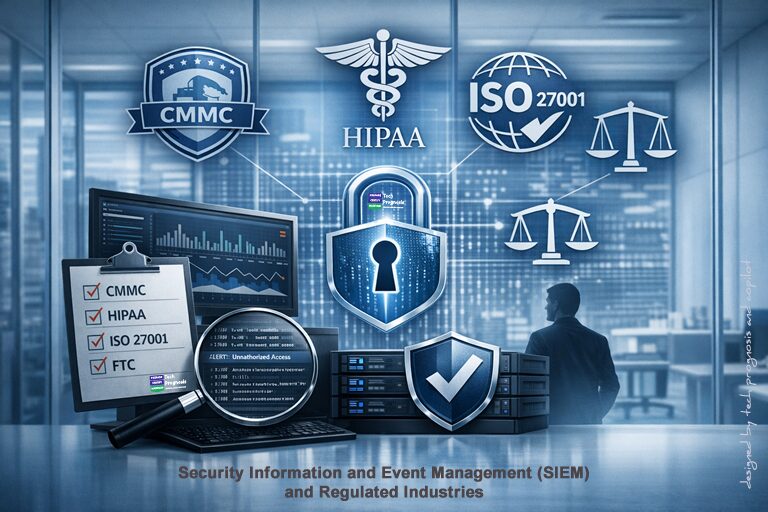
A digital illustration showing cybersecurity, Security Information and Event Management (SIEM) and compliance concepts, including a glowing lock at the center, surrounded by icons for CMMC, HIPAA, ISO 27001, and FTC related compliance, with dashboards, servers, checklists, and security symbols representing monitoring, auditing, and regulatory alignment.

Understanding SIEM in 2026: Limitations—and How to Build a Compliant, Outcome‑Driven Detection Program

Executive summary. Security Information and Event Management (SIEM) remains central to modern detection and response, but the playing field has evolved: cloud‑first estates, identity‑centric attacks, and new or strengthened rules (CMMC, HIPAA Security Rule enforcement practices, FTC Safeguards updates, ISO/IEC 27001:2022, and NIST CSF 2.0) raise the bar for logging, monitoring, and evidence. SIEM alone isn’t enough; you’ll need smart log source prioritization, detection engineering mapped to frameworks like MITRE ATT&CK, and automation you can trust (SOAR), all tuned to produce defensible evidence for audits and assessments.


What is Security Information and Event Management (SIEM) today (and what it isn’t)

A SIEM centrally collects and analyzes logs and events across systems, networks, applications, identities, and cloud services to help analysts detect, investigate, and report incidents. It’s often paired with Security Orchestration, Automation, and Response or SOAR to orchestrate and automate response actions.

SOAR (security orchestration, automation, and response) provides playbooks and automation for triage and remediation; it does not replace analytic rigor or governance.

Governments and industry recently published pragmatic guidance for implementing SIEM/SOAR, highlighting benefits (visibility, faster response) and pitfalls (data normalization, coverage, resource intensity).

Where SIEM fits in frameworks: NIST CSF 2.0 explicitly expects continuous monitoring and event logging outcomes (e.g., PR.PS‑04 requires that log records are generated and made available for continuous monitoring)—functions typically enabled by SIEM + SOAR.

Read more

Share

Cyber Resilience for CMMC Contractors: Why It Matters and How to Build It

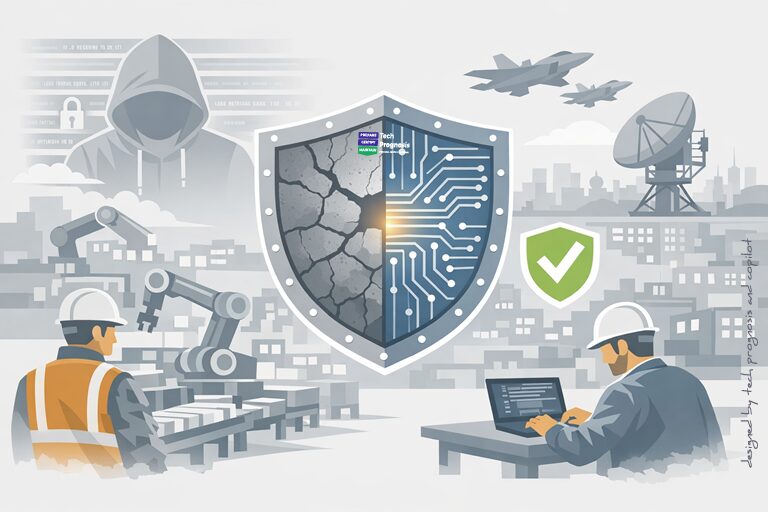
A flat, minimalist illustration showing a manufacturing environment with robotic arms, workers in safety vests, and a central shield symbol split between a cracked surface and a circuit‑board design, representing cyber threats and resilience. Minimalist aircraft, a satellite dish, and a green security checkmark appear in the background.

Cyber Resilience for CMMC Contractors: Why It Matters and How to Build It

Cyber resilience is the capability to anticipate, withstand, recover from, and adapt to adverse cyber conditions—so that your mission‑essential manufacturing operations continue even when an attack succeeds. Resilience complements CMMC’s confidentiality‑focused controls (based on NIST SP 800‑171r3) by emphasizing continuity, restoration, and adaptation across IT and OT.

Audience: Defense Industrial Base (DIB) manufacturers and suppliers that handle FCI/CUI and are preparing for (or maintaining) CMMC compliance.


Why Cyber Resilience Now (Especially in the DIB)

  • The DIB remains a prime target for espionage and ransomware, and the Department of Defense (DoD) created CMMC to raise the floor on contractor protections for FCI/CUI.
  • NIST’s Cybersecurity Framework (CSF) 2.0 underscores governance and recoverability as integral to enterprise risk management—useful language for your board, program managers, and auditors.
  • Ransomware and OT/ICS impacts propagate from IT to plant networks; resilient manufacturers isolate critical processes, segment IT/OT, and test offline backups to maintain production.

Bottom line: CMMC helps protect sensitive data; resilience keeps your line running and deliveries on time.

Read more

Share

CMMC Controls MSSPs Should Already Have (But Might Not)

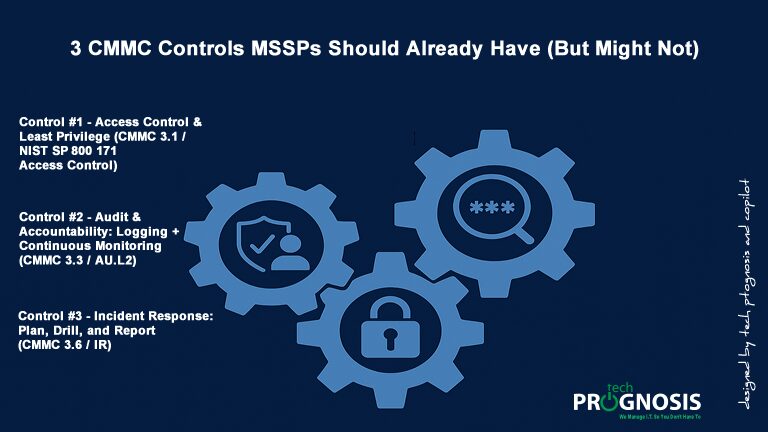
Three interlocking gears on a dark blue background, each containing security icons: a shield with a user silhouette, a magnifying glass with password symbols, and a padlock. Above the gears, bold white text reads ‘3 CMMC Controls MSSPs Should Already Have (But Might Not)’.

3 CMMC Controls MSSPs Should Already Have (But Might Not) — Plus Real‑World Case Studies

Hey there, MSSP heroes! Let’s cut to the chase: If you’re prepping for a CMMC audit, you’re already ahead of the game. But here’s the kicker—many MSSPs (just like you!) might be missing a few key CMMC controls staring them right in the face.

CMMC isn’t just about checking boxes—it’s about proving you’re trustworthy enough to protect sensitive government data. And while you’ve likely got solid security practices in place, CMMC’s specific requirements can trip you up if you’re not paying attention.

As a CISM & CISSP‑holding MSSP myself, I know how overwhelming the CMMC landscape can feel. There are so many controls! But here’s the good news: You probably already have the foundation for several critical CMMC controls… you just might not realize it!

In this post, we’ll uncover three essential CMMC controls that every MSSP should have in their toolbox — yet many overlook. I’ll break each one down with real‑world examples, a simple analogy, and actionable tips. Let’s turn “uh‑oh” into “I’ve got this!”

Read more

Share

Cybersecurity Crisis Management: Building Resilient Responses

Simulation of stressed executive instructing employees in office about cybersecurity crisis management.

Cybersecurity Crisis Management: Building Resilient Responses Across Manufacturing, Healthcare, and Finance

When it comes to cybersecurity, it’s not a question of if an incident will occur—it’s when. Whether you’re in manufacturing, healthcare, or finance, cyber threats don’t just disrupt business—they can harm people’s safety, compromise sensitive information, or destabilize markets.

This is why Cybersecurity Crisis Management has become one of the most vital disciplines in modern governance, risk, and compliance (GRC). At its heart, crisis management is about more than just reacting to an incident. It’s about preparing, escalating, containing, and learning from disruptions in a structured way—so your organization can bounce back stronger than before.

In this article, we’ll take a deep dive into the principles of cybersecurity crisis management, explore escalation matrices in detail (with step-by-step guidance for manufacturing, healthcare, and finance), walk through playbook examples, discuss common challenges, and outline how metrics can drive post-incident improvements.

We’ll also highlight some trusted tools and share best practices to help you build resilience in your organization.

Read more

Share

Texas Cybersecurity Framework: Fortifying Your Texas Digital Fortress

Half-circle Infographic with text flyouts of the five functions of the Texas Cybersecurity Framework - Identify, Protect, Detect, Respond, and Recover.

Texas Cybersecurity Framework: A Deep Dive into Fortifying Your Texas Digital Fortress

As a GRC (Governance, Risk, and Compliance) expert, I’ve had the privilege of guiding many organizations through the sometimes-dusty trails of cybersecurity. And when it comes to securing digital assets right here in the Lone Star State, one framework consistently stands tall: the Texas Cybersecurity Framework (TCF).

Now, cybersecurity might sound like complicated tech-speak, but at its heart, it’s about protecting what matters most – your data, your operations, and the trust of your customers. Think of the TCF as a well-laid-out blueprint for building a strong and resilient digital fortress. It provides a clear roadmap to help organizations, both big and small, navigate the ever-evolving landscape of cyber threats.

In this deep dive, we’ll unpack the TCF in plain language, exploring its origins, how it’s structured, some of its key components, the hurdles organizations often face, and practical ways to get started. So, grab your virtual Stetson, and let’s get to it!

Read more

Share

Insider Risk Management: Protecting Your Organization from Within

Image of isometric people and client profile on screen with a magnifying glass on a user profile simulating the assessment of an employee as a potential insider risk threat to an organization.

Insider Risk Management: Protecting Your Organization from Within

Insider risk management is a crucial aspect of modern organizational security strategies. Unlike external threats, insider risks originate from within an organization, often involving employees, contractors, or partners who have access to sensitive information. Understanding how to create and manage insider risks, investigate alerts, and overcome common challenges is essential for safeguarding your organization.

This article explores what insider risk management is, how to create and manage insider risk programs, investigate insider risk alerts, and the challenges organizations face in this domain.

We will also discuss best practices to help safeguard your organization. By the end of this article, you’ll have a solid understanding of how to mitigate insider risks effectively.

Read more

Share
Share
Share