How Small Businesses Can Use Virtualization in 2026
Virtualization has moved from “promising” to practical and pervasive. In 2009, running six servers on 8 GB of RAM felt remarkable. Today, consolidation, hybrid cloud, containerization, and Desktop‑as‑a‑Service (DaaS) make modern small‑business IT more scalable, secure, and cost‑aware than ever. This guide shows how to choose—and succeed with—the right mix of virtual machines (VMs), containers, and cloud desktops for your business.
1) What “Virtualization” Means Today
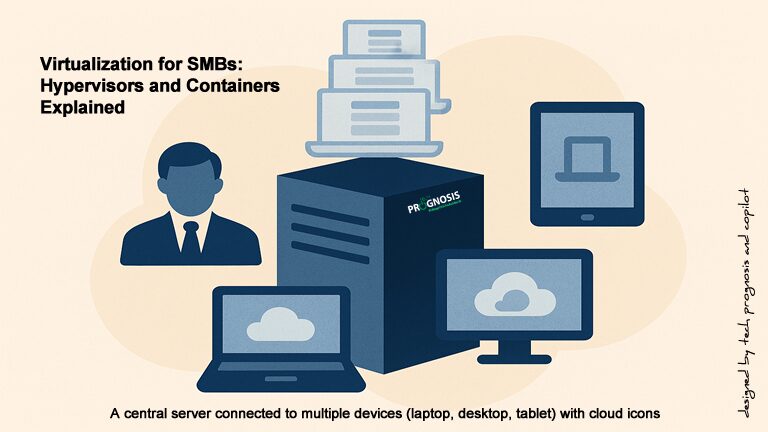
Virtual machines (VMs) still anchor most business workloads. A hypervisor (like Hyper‑V, KVM, or VMware by Broadcom’s vSphere) runs multiple guest operating systems on one physical host, isolating workloads while boosting utilization. Linux’s KVM is built into the kernel, delivering near‑native performance for many workloads and supporting both x86 and Arm hosts. [kernel.org]
Containers (e.g., Docker) are lighter‑weight than VMs; they package apps and dependencies, and are orchestrated by platforms like Kubernetes. Adoption has grown steadily and now underpins modern DevOps and microservices. Industry telemetry shows rising use of serverless containers across clouds as teams seek to cut ops overhead. [datadoghq.com]
Across the industry, 2025–2026 trends emphasize diversification (avoiding lock‑in), hybrid deployments, and operational simplicity with platforms that run VMs and containers side‑by‑side. [redhat.com]
2) The Hypervisors SMBs Actually Use (and Why)
VMware by Broadcom: know the changes before you renew
Since Broadcom closed the VMware acquisition (Nov. 2023), licensing and packaging changed dramatically (subscription‑only, consolidated bundles, partner program shifts). In 2025, several updates affected cost models—such as minimum 72 licensed cores per CPU and late‑renewal penalties—with outsized impact on smaller environments. If you’ve relied on Essentials/ROBO SKUs, plan for a different path. [licensefortress.com], [servermonkey.com], [intelisys.com]
Many SMBs are reassessing VMware due to rising costs and fewer tailored options. Some evaluate alternatives (Hyper‑V, Proxmox, Nutanix, etc.) or shift to managed/hyperconverged stacks. [servermonkey.com], [ck-tek.com]
Bottom line: If you’re a VMware shop, inventory your licenses, model OPEX over 1–3 years, and consider phased migration or hybrid strategies rather than auto‑renewing on old assumptions. [licensefortress.com]
Microsoft Hyper‑V on Windows Server 2025: Mainstream and Feature‑rich
Hyper‑V remains a type‑1 hypervisor tightly integrated with Windows Server, with improved scalability and modern features in the Windows Server 2025 wave. Official and community guidance highlight advances like nested virtualization scenarios for labs/training and performance/security improvements for production. [lenovopres…lenovo.com], [techcommun…rosoft.com]
A notable change for budget planning: the free “Hyper‑V Server” SKU has been phased out, so virtualization now rides on paid Windows Server editions (Core or GUI), with Standard vs Datacenter influencing virtualization rights and density. [starwindsoftware.com]
For GPU‑heavy work (rendering, AI inference, VDI graphics), Windows Server 2025 adds GPU partitioning (GPU‑P) and other clustering enhancements that improve portability and HA of accelerated VMs compared to older DDA approaches. [checkyourlogs.net]
KVM / Proxmox VE: Open‑Source, Capable, and Increasingly SMB‑Friendly
Linux’s KVM + QEMU offer robust virtualization without license fees, and platforms like Proxmox VE wrap that stack in an approachable web UI, clustering, storage, and backup integrations. Proxmox VE 8.2 added a VMware ESXi import wizard, unattended installs, modern firewalling, and backup “fleecing” to buffer I/O during remote backups—features aimed squarely at migrations and operational polish. [proxmox.com], [servethehome.com]
If you’re exiting VMware, Proxmox’s import tools reduce friction; optional enterprise support subscriptions keep costs predictable while preserving open‑source flexibility. [virtualiza…nhowto.com]
Oracle VirtualBox: Still Ideal for Desktops, Labs, and Cross‑platform testing
For workstation‑level virtualization (tech support benches, QA/labs, developer testing), VirtualBox remains actively maintained. Releases through 2024–2025 improved UEFI/Secure Boot, host/guest compatibility, and performance; the project is now on the 7.2.x train. [blogs.oracle.com], [virtualbox.org]
3) Desktop‑as‑a‑Service (DaaS): Cloud PCs without the PC Headaches
If your challenge is secure access for remote or rotating staff, Azure Virtual Desktop (AVD) and Windows 365 Cloud PC can simplify provisioning, management, and security—especially with Microsoft Intune integration and the unified Windows App experience. Microsoft is recognized as a Leader in the 2024 Gartner Magic Quadrant for DaaS. [microsoft.com]
Analyst coverage in 2025 noted that hosted desktops often deliver lower TCO than laptops (in many use cases), and net‑new on‑prem VDI is increasingly rare as organizations prefer DaaS or cloud‑based control planes. [theregister.com]
When it fits: contractors, seasonal workers, BYOD scenarios, compliance‑sensitive apps, or a need to surface Windows apps securely to macOS/iPadOS/Chromebook devices with minimal local data footprint. [microsoft.com]
4) Containers and “Modernization” (without boiling the ocean)
Even small teams benefit from containers for apps like websites, APIs, and internal tools. Docker’s 2024 report shows developers increasingly building in cloud‑hosted environments and leveraging AI tooling; adoption trends remain strong across organizations of all sizes. [docker.com]
Datadog’s multi‑cloud telemetry highlights rising serverless container usage (e.g., Cloud Run, Azure Container Apps, AWS Fargate), reducing infrastructure overhead for small teams. [datadoghq.com]
For security, follow NIST SP 800‑190 (Application Container Security Guide) for image scanning, least‑privilege configs, registry hardening, and runtime controls—it’s a concise, vendor‑neutral baseline that maps well to common compliance regimes. [csrc.nist.gov]
5) AI and graphics: GPU virtualization for real‑world SMB tasks
Design firms, CAD shops, and analytics teams increasingly virtualize GPU access for remote users and VM‑based AI inference. NVIDIA’s vGPU stack supports multi‑vGPU per VM and profiles that fit everything from knowledge‑worker VDI to professional visualization workloads. Use NVIDIA vPC for knowledge workers and RTX vWS for pro graphics/CUDA workloads. [docs.nvidia.com], [docs.nvidia.com]
On Windows Server 2025, GPU‑P enables fractional sharing with live migration support—an operational win compared to older pass‑through methods. [checkyourlogs.net]
6) Backup, Disaster Recovery, and Ransomware Resilience
Virtualization simplifies rapid recovery—but only if your backups are air‑gapped/immutable and tested. Vendors like Veeam have expanded from VM backup to cyber‑resiliency, introducing Data Cloud Vault (managed immutable storage in Azure) and hybrid on‑prem offerings that support diversified hypervisors and cloud targets. [futurumgroup.com]
For SMBs, keep a simple discipline:
- 3‑2‑1‑1‑0 strategy: 3 copies, 2 media, 1 off‑site, 1 immutable/air‑gapped, 0 errors after verification. Portable/offline backups still matter. [veeam.com], [storagenew…letter.com]
- Test restores quarterly (include cloud‑target restores). Architect copy jobs to object storage or a secondary site for DR. [sysadminstories.com]
7) Energy and sustainability: Virtualization’s Quiet ROI
Virtualization reduces physical server counts, cutting energy use and cooling demand. ENERGY STAR notes that consolidating workloads onto fewer, higher‑utilization hosts saves substantial power and can speed disaster recovery (via live migration and failover features). Smaller data centers still have big opportunities to adopt virtualization for efficiency gains. [energystar.gov]
Research continues to optimize consolidation strategies and minimize overhead, reinforcing the performance–energy trade‑off considerations for planners. [link.springer.com]
8) Three Practical Build‑outs (you can execute this year)
- A) Lean On‑Prem Cluster (2–3 hosts):
- Hypervisor: Proxmox VE or Windows Server 2025 Hyper‑V. [proxmox.com], [lenovopres…lenovo.com]
- Workloads: AD/DNS, file server, line‑of‑business app, small SQL instance, lightweight VDI or Remote Apps.
- Resiliency: Shared‑nothing HA with local NVMe tiers; off‑site immutable backups to Azure/AWS object storage. [futurumgroup.com]
- Why: Control, predictable costs, room to grow; easy to add GPU‑P partitions later for graphics/AI if on Hyper‑V. [checkyourlogs.net]
- B) Hybrid App Platform (VMs + Containers):
- Hypervisor: KVM/Proxmox for stateful VM workloads; containers for web/API on managed serverless platforms (Cloud Run / Azure Container Apps). [proxmox.com], [datadoghq.com]
- Security: Follow NIST SP 800‑190 for images/registries; use private registries and CI vulnerability scans. [csrc.nist.gov]
- Why: Faster iteration for apps while keeping databases/Windows workloads in VMs.
- C) Cloud‑First Workforce (DaaS + minimal on‑prem):
- Desktops: Windows 365 or AVD for remote and rotating staff; Intune for policy/compliance. [microsoft.com]
- Core services: AD in Azure (or Entra ID), SaaS email/office, thin on‑prem footprint or none.
- Why: Lower device management overhead, strong security posture, pay‑as‑you‑need scale; often lower TCO than laptops in many roles. [theregister.com]
9) Virtualization Licensing & Budgeting Realities (so you’re not surprised)
- VMware by Broadcom: Expect subscription bundles (e.g., VCF/VVF) and minimum‑core licensing considerations. If you previously used Essentials, plan alternatives. [licensefortress.com], [servermonkey.com]
- Microsoft: No more free Hyper‑V Server; plan Windows Server Standard vs Datacenter based on VM density/features. [starwindsoftware.com]
- Open‑source (KVM/Proxmox): Software is free; budget for enterprise support, backups, and monitoring—still often cost‑advantaged for SMB scale. [servethehome.com]
- DaaS: Treat as OPEX; compare against laptop lifecycle + support. Analysts suggest strong ROI for targeted use cases. [theregister.com]
If you need a side‑by‑side cost exploration (VMware vs Hyper‑V vs Proxmox), independent articles and calculators can help scope annual license/support footprints for typical clusters. [wintelguy.com], [cloudnews.tech]
10) Virtualization Security and Compliance: Keep It Simple, Follow Proven Baselines
Hypervisors/VMs: Use NIST SP 800‑125/800‑125A recommendations (secure configs, hardening, isolation, patching, logging). These are evergreen baselines applicable across vendors. [csrc.nist.gov], [nvlpubs.nist.gov]
Networks and edge devices: Recent CISA/NSA guidance stresses visibility, configuration monitoring, strong authentication, and hardening—lessons that apply to any on‑prem equipment protecting virtualized estates. [cisa.gov]
Containers: Apply NIST SP 800‑190 (image scanning, secrets management, runtime controls, and orchestrator hardening). [csrc.nist.gov]
Tie these baselines into your broader cybersecurity program (e.g., CIS Controls). They’re practical, auditable, and vendor‑neutral.
11) From “Six Servers on One Box” to a Resilient 2026 Stack
In 2009, I spun up web, mail, CRM, file, firewall, and backup VMs on a single 8 GB host. Today, the same roles are smaller, faster, and safer by design:
- Web/API → containerized, auto‑scaled, protected behind WAF, backed by CI/CD. [docker.com]
- Mail/office → SaaS (Microsoft 365), MFA/Conditional Access, device compliance. [microsoft.com]
- File/identity → 2–3 small VMs on a lean cluster; snapshots + immutable copies. [futurumgroup.com]
- Firewall/edge → hardened appliances, centralized logs/alerts per CISA guidance. [cisa.gov]
- Backup/DR → tested quarterly; on‑prem + cloud object storage; portable recovery paths. [sysadminstories.com]
This mix balances cost, control, and convenience—and it scales with your staff count and risk posture.
12) A Quick, Opinionated Virtualization Checklist for SMB Success
- Decide your anchor:
- Three choices: on‑prem VMs, hybrid VMs+containers, cloud desktops. Pick one as primary, add the others as needed. [proxmox.com], [microsoft.com]
- Budget right:
- If you’re on VMware, model the new subscriptions vs alternatives; ask partners for 12‑month terms while you evaluate. [licensefortress.com]
- For Hyper‑V, include Windows Server licensing (no free SKU). [starwindsoftware.com]
- For Proxmox/KVM, earmark support + backup. [servethehome.com]
- Backups:
- Implement 3‑2‑1‑1‑0 with immutable or offline copies; test restores quarterly. [veeam.com], [futurumgroup.com]
- Security baselines:
- Apply NIST hardening for hypervisors and containers; monitor configs per CISA guidance. [csrc.nist.gov], [csrc.nist.gov], [cisa.gov]
- Energy & hardware:
- Consolidate to reduce power/cooling; favor NVMe storage and right‑sized CPUs/GPUs. [energystar.gov]
- Pilot first:
- Run a 30‑day pilot (min. two hosts or DaaS workloads), validate performance, cost, and user experience before full cutover. [microsoft.com]
Final thoughts
Virtualization’s promise hasn’t changed; its tooling, economics, and security playbooks have matured. Whether you choose a lean Proxmox cluster, a Windows Server 2025 Hyper‑V deployment with GPU‑P, or cloud desktops via Windows 365/AVD, today’s landscape lets small businesses operate like much larger ones—without over‑engineering.
About the Author
Daniel Ihonvbere, CISM, CISSP, is a cybersecurity and risk management professional with more than a decade of experience helping small businesses navigate complex compliance and security requirements. He specializes in ISO standards, FTC Safeguards, NIST frameworks (including 800‑171 and 800‑172), TX‑RAMP, TAC 202, and other risk‑based programs.
Based in Central Texas, Daniel partners with organizations in Round Rock, Austin, and beyond to build scalable security programs that meet DoD, DFARS, and CMMC requirements under 32 CFR Part 170. He is an aspiring CMMC Certified Professional (CCP) and collaborates with Cyber‑AB‑approved partners to guide organizations toward CMMC alignment. Daniel adheres to the Cyber‑AB Code of Professional Conduct and grounds his guidance in official DoD and Cyber‑AB standards.
He regularly publishes actionable resources on CMMC, NIST 800‑171, and DFARS cybersecurity requirements.
Follow Daniel on LinkedIn for CMMC insights | www.techprognosis.com
