
Virtualization and the Small Business Owner (2026 Edition)

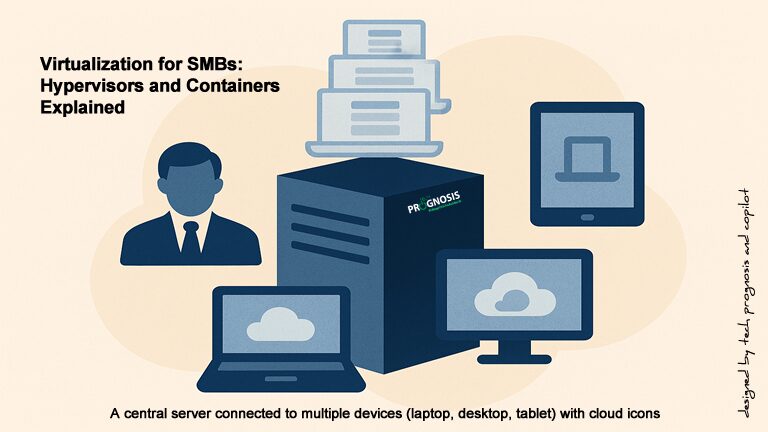
Illustration of a central server connected to multiple devices (laptop, desktop, tablet) with cloud icons, symbolizing virtualization and hybrid cloud integration for small businesses.

How Small Businesses Can Use Virtualization in 2026

Virtualization has moved from “promising” to practical and pervasive. In 2009, running six servers on 8 GB of RAM felt remarkable. Today, consolidation, hybrid cloud, containerization, and Desktop‑as‑a‑Service (DaaS) make modern small‑business IT more scalable, secure, and cost‑aware than ever. This guide shows how to choose—and succeed with—the right mix of virtual machines (VMs), containers, and cloud desktops for your business.

1) What “Virtualization” Means Today

Virtual machines (VMs) still anchor most business workloads. A hypervisor (like Hyper‑V, KVM, or VMware by Broadcom’s vSphere) runs multiple guest operating systems on one physical host, isolating workloads while boosting utilization. Linux’s KVM is built into the kernel, delivering near‑native performance for many workloads and supporting both x86 and Arm hosts. [kernel.org]

Read more

Share

True Cost of Neglecting IT (Information Technology) and Support

Illustration of essential IT investments concept with technology symbols and text of collaboration and communication, cloud computing and storage, cybersecurity, and secure remote work solutions as a remedy for organizations and businesses neglecting IT (Information Technology) and Support

Neglecting IT (Information Technology) and Support : The Make-Or-Break Factor Business Owners Overlook—Until It’s Too Late

A CIO’s Perspective on IT as a Growth Driver, Not Just a Cost

As the vCIO of a couple of businesses and organizations, I have seen firsthand how technology can be either a strategic enabler or a major roadblock. Too often, business owners focus on growth, sales, and customer experience while leaving IT decisions on the back burner—until something goes wrong.

For many business owners, IT is seen as a necessary expense rather than a strategic asset. But the reality is that your technology infrastructure directly impacts efficiency, security, and growth. Slow computer systems, dropped phone calls impacting sales, outdated software, or weak cybersecurity measures that leave an organization’s data vulnerable don’t just cause occasional frustration—they can create significant vulnerabilities that cost your business time, money, and reputation.

Here’s the hard truth: neglecting IT and support can cost your business more than you think—in lost productivity, security risks, and missed opportunities. The right technology isn’t just an operational necessity; it is a competitive advantage.

So, let me ask you: Is your IT helping your business grow, or is it quietly holding you back?

Read more

Share
Share
Share