
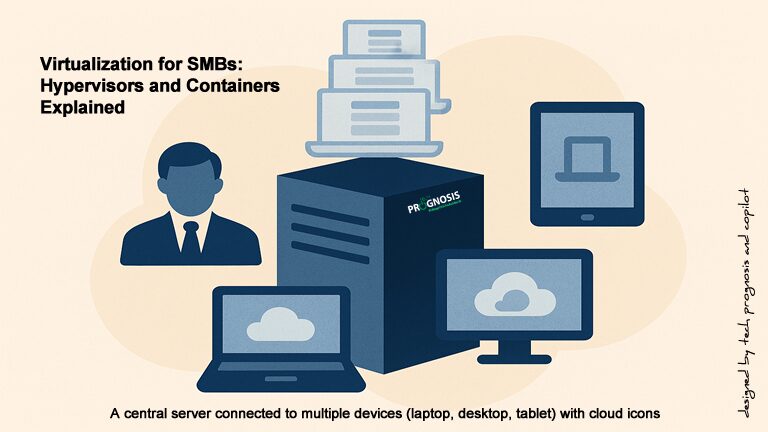
How Small Businesses Can Use Virtualization in 2026
Virtualization has moved from “promising” to practical and pervasive. In 2009, running six servers on 8 GB of RAM felt remarkable. Today, consolidation, hybrid cloud, containerization, and Desktop‑as‑a‑Service (DaaS) make modern small‑business IT more scalable, secure, and cost‑aware than ever. This guide shows how to choose—and succeed with—the right mix of virtual machines (VMs), containers, and cloud desktops for your business.
1) What “Virtualization” Means Today
Virtual machines (VMs) still anchor most business workloads. A hypervisor (like Hyper‑V, KVM, or VMware by Broadcom’s vSphere) runs multiple guest operating systems on one physical host, isolating workloads while boosting utilization. Linux’s KVM is built into the kernel, delivering near‑native performance for many workloads and supporting both x86 and Arm hosts. [kernel.org]


 Apple has thrown its hat into the cloud “gold rush” ring and all of a sudden, we have started hearing the old but boring cries of the death of Windows. A lot of noise is being made about Steve Jobs’ statement that “We’re going to demote the PC and the Mac to just be a device – just like an iPad, an iPhone or an iPod Touch. We’re going to move the hub of your digital life to the cloud”
 That there is a lot of hype in the technology industry about “the cloud” is pretty obvious these days. You will be hard pressed to read an article about technology (this one included) without some reference to the beauty, ease and affordability of cloud services.