
Generative AI in Risk and Compliance: How Texas Enterprises Are Navigating the New Frontier
The Generative AI revolution isn’t coming—it’s already transforming conference rooms from Round Rock to Richardson, and boardrooms from Austin to Arlington.
When Dell Technologies’ compliance team in Round Rock began experimenting with generative AI tools in early 2023, they discovered something remarkable: what started as a productivity enhancement quickly evolved into a fundamental reshaping of their entire risk landscape. This transformation isn’t unique to Dell—it’s happening across Texas enterprises, from Samsung’s semiconductor facilities in Austin to the financial institutions lining Dallas’s Main Street.
As someone who’s spent years helping organizations navigate the complex waters of governance, risk, and compliance (GRC), I’ve witnessed firsthand how generative AI is simultaneously creating unprecedented opportunities and introducing risks that keep chief compliance officers awake at night.
Let’s explore how this technology is reshaping enterprise risk profiles and where it can genuinely deliver value for your organization.
The New Risk Landscape: What’s Keeping Texas Executives Up at Night
Data Privacy and Security Concerns Take Center Stage in the age of Generative AI
The most pressing concern dominating enterprise agendas isn’t whether to adopt generative AI—it’s how to do so without compromising sensitive data. When a major healthcare system in Austin discovered that employees were inadvertently sharing patient information with ChatGPT to draft medical summaries, they faced a stark reality: the convenience of AI had created a potential HIPAA violation nightmare.
This scenario plays out daily across industries. Financial services firms in Dallas’s thriving fintech sector grapple with protecting customer financial data while leveraging AI for fraud detection. Manufacturing giants in Fort Worth worry about intellectual property leaking through AI interactions. These aren’t theoretical risks—they’re real challenges requiring immediate attention.
The Shadow Generative AI Phenomenon
Perhaps more concerning than official AI adoption is what we call “Shadow AI”—unauthorized use of generative AI tools by well-meaning employees. At a prominent energy company in Houston (just down Highway 290 from Round Rock), IT security discovered that over 40% of employees were using personal accounts on various AI platforms to complete work tasks, completely bypassing corporate security controls.
This underground AI usage creates blind spots in risk management. Organizations can’t protect against risks they don’t know exist, and when employees operate outside established guidelines, compliance becomes nearly impossible to maintain.
Model Generative AI Bias and Fairness Issues
Texas’s diverse workforce and customer base make AI bias particularly problematic. When a retail chain headquartered in Plano implemented an AI-powered hiring system, they discovered it was inadvertently discriminating against candidates from certain zip codes in South Dallas—a clear violation of equal employment opportunity regulations.
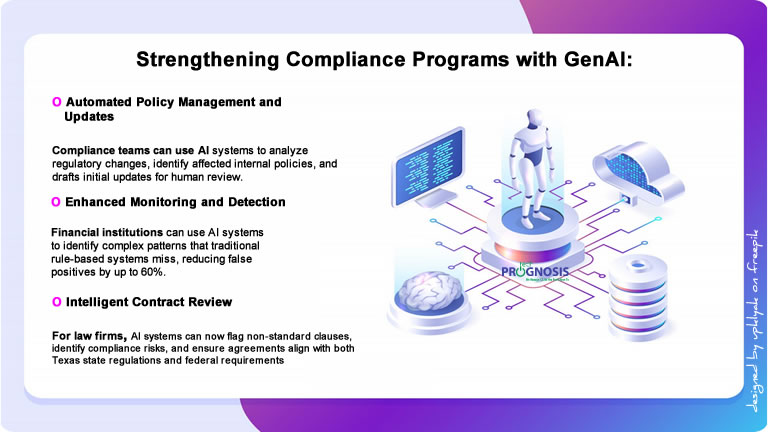
Strengthening Compliance Programs with GenAI: The Texas Success Stories
Despite these challenges, forward-thinking organizations are discovering powerful ways to leverage generative AI to strengthen their compliance programs.
Automated Policy Management and Updates
At Applied Materials in Austin, the compliance team reduced policy update cycles from months to weeks using generative AI. Their system analyzes regulatory changes, identifies affected internal policies, and drafts initial updates for human review. This approach has proven particularly valuable for keeping pace with Texas’s evolving data privacy regulations and federal compliance requirements.
Enhanced Monitoring and Detection
Financial institutions along Richardson’s Telecom Corridor are using generative AI to revolutionize transaction monitoring. These systems can identify complex patterns that traditional rule-based systems miss, reducing false positives by up to 60% while catching sophisticated money laundering schemes that would have previously gone undetected.
Intelligent Contract Review
Law firms and corporate legal departments from San Antonio to Cedar Park are transforming contract review processes. AI systems now flag non-standard clauses, identify compliance risks, and ensure agreements align with both Texas state regulations and federal requirements. What once took teams of paralegals weeks now happens in hours, with higher accuracy rates.
Areas Most Affected by Generative AI in Risk and Compliance: Today and Tomorrow
Current Impact Zones
Healthcare Compliance: Medical facilities throughout the Austin-Round Rock metropolitan area are using AI for HIPAA compliance monitoring, clinical documentation improvement, and automated audit preparation. However, they’re also grappling with ensuring AI-generated clinical notes meet regulatory standards.
Financial Services: Banks and credit unions from Georgetown to Buda are experiencing transformation in anti-money laundering (AML) compliance, know-your-customer (KYC) processes, and regulatory reporting. The challenge lies in explaining AI decisions to regulators who expect transparency.
Manufacturing and Supply Chain: Companies in Round Rock’s thriving tech manufacturing sector use AI for quality control documentation, safety compliance monitoring, and supply chain risk assessment. The semiconductor industry, particularly vital to Texas’s economy, faces unique challenges in protecting trade secrets while leveraging AI capabilities.
Near-Future Transformations
Within the next 18-24 months, we expect to see:
- Predictive Compliance: AI systems that anticipate regulatory violations before they occur
- Real-time Risk Scoring: Dynamic risk assessments that update continuously based on internal and external data
- Automated Incident Response: AI-driven systems that can contain and remediate certain compliance breaches without human intervention
The Texas Regulatory Landscape: Navigating Federal and State Requirements
Key Enforcement Trends
Texas Attorney General’s office has increased enforcement actions related to data privacy violations by 300% since 2022. Meanwhile, federal agencies are developing AI-specific regulations that will impact every Texas business using these technologies.
The Securities and Exchange Commission (SEC) recently fined a Dallas-based investment firm $1.5 million for inadequate AI governance—a warning shot that resonated throughout Texas’s financial sector. Similarly, the Federal Trade Commission (FTC) is actively investigating deceptive AI practices, with several Texas companies under scrutiny.
Common Compliance Challenges
Organizations across Texas face several regulatory hurdles:
- Texas Data Privacy and Security Act (TDPSA) compliance while using AI systems
- CCPA/CPRA requirements for companies serving California residents
- HIPAA regulations for healthcare AI applications
- SOX compliance for publicly traded companies using AI in financial reporting
- Industry-specific regulations (FINRA, NERC-CIP, FDA guidelines)
Security Controls for Generative AI: Learning from Texas’s Regulated Industries
Essential Controls for AI Governance
After witnessing a data breach at a major insurance company in Irving that exposed 100,000 customer records through an unsecured AI API, the importance of robust security controls becomes crystal clear.
Here are essential controls every organization should implement:
Access Management: Implement role-based access controls (RBAC) for all AI systems. A semiconductor manufacturer in North Austin learned this lesson when a contractor accidentally gained access to proprietary chip designs through an AI platform.
Data Classification and Handling: Establish clear data classification schemes. When a law firm in downtown Austin failed to properly classify client data, their AI system inadvertently included confidential information in training datasets—a costly mistake that resulted in client lawsuits and regulatory penalties.
Encryption and Data Protection: Ensure end-to-end encryption for all AI interactions. A healthcare provider in Temple avoided a potential disaster by encrypting all data flowing to and from their AI diagnostic assistant, preventing patient data exposure when the system was compromised.
Audit Logging and Monitoring: Maintain comprehensive logs of all AI interactions. This proved invaluable for a Round Rock-based e-commerce company when they needed to demonstrate compliance during a PCI-DSS audit.
Consequences of Poor Controls
The impact of inadequate security controls extends beyond regulatory fines:
- Reputation Damage: A San Antonio-based bank lost 15% of its customer base after an AI-related data breach
- Operational Disruption: A manufacturing plant in Lewisville faced three weeks of downtime after ransomware spread through an unsecured AI system
- Legal Liability: Multiple Texas companies face class-action lawsuits totaling over $50 million related to AI privacy violations
- Competitive Disadvantage: Organizations with poor AI governance lose talent and partnerships to more secure competitors
Best Practices and NIST CSF Compliance Tools
Implementing NIST Cybersecurity Framework for Generative AI
The NIST Cybersecurity Framework provides an excellent foundation for AI governance. Here’s how to adapt it for generative AI:
Identify: Map all AI assets and data flows. Document which systems process sensitive information and understand your AI supply chain.
Protect: Implement strong authentication, encryption, and access controls. Establish AI-specific security awareness training for all employees.
Detect: Deploy continuous monitoring for anomalous AI behavior. Set up alerts for unusual data access patterns or model outputs.
Respond: Develop AI-specific incident response procedures. Create playbooks for common scenarios like data leaks or model manipulation.
Recover: Plan for AI system recovery and ensure business continuity. Include procedures for model retraining and validation after incidents.
Recommended Tools for NIST CSF Evaluation
Several tools can help evaluate your NIST CSF compliance in the context of AI:
- ServiceNow Governance, Risk, and Compliance: Excellent for large enterprises needing integrated risk management
- Archer Integrated Risk Management: Popular among Texas financial institutions for its flexibility
- LogicGate Risk Cloud: User-friendly option for mid-market companies
- OneTrust Privacy & Security: Strong privacy focus, ideal for healthcare and retail
- Compliance.ai: Specifically designed for regulatory change management
- NIST’s own Cybersecurity Assessment Tool (CSAT): Free tool perfect for initial assessments
Generative AI in Risk and Compliance: Texas-Specific Best Practices
Based on successful implementations across Texas organizations:
- Start Small: Begin with low-risk use cases. A credit union in Pflugerville successfully piloted AI in customer service before expanding to fraud detection.
- Establish Clear Governance: Create an AI steering committee with representatives from IT, legal, compliance, and business units.
- Invest in Training: Ensure your team understands both AI capabilities and risks. Organizations in Austin’s “Silicon Hills” report that AI literacy training reduces incidents by 70%.
- Partner with Experts: Leverage local expertise from universities like UT Austin and consultancies specializing in AI governance.
- Document Everything: Maintain detailed records of AI decisions, model versions, and compliance measures.
What the Future Holds for Generative AI
The next five years will bring unprecedented changes to risk and compliance landscapes. We’re already seeing early indicators in Texas:
- Regulatory Harmonization: Texas is likely to adopt comprehensive AI legislation similar to the EU’s AI Act
- Industry-Specific AI Standards: Healthcare, finance, and energy sectors are developing detailed AI governance frameworks
- Automated Compliance-by-Design: Future AI systems will have compliance controls built into their architecture
- Increased Enforcement: Expect more frequent and severe penalties for AI-related violations
- Insurance Evolution: Cyber insurance policies will explicitly address AI risks, with premiums based on AI governance maturity
Organizations that act now to establish robust AI governance will find themselves at a significant advantage. Those that wait risk falling behind competitively while facing increased regulatory scrutiny.
Taking Action: Your Next Steps in Generative AI and IT Governance
The journey to effective AI governance doesn’t happen overnight, but every organization needs to start somewhere. Whether you’re a healthcare provider in Temple, a manufacturer in Grand Prairie, or a financial services firm in Richardson, the time to act is now.
The complexity of balancing innovation with compliance requires careful planning and expert guidance. That’s where strategic partnerships become invaluable. Understanding your unique risk profile, industry requirements, and organizational goals is the first step toward building a resilient AI governance framework.
Ready to transform your approach to AI risk and compliance? Let’s explore how your organization can harness the power of generative AI while maintaining robust governance. Schedule a complimentary 15-minute discovery call to discuss your specific challenges and opportunities. Together, we’ll identify the most impactful first steps for your AI governance journey.
Book Your Discovery Call Today →
References:
- National Institute of Standards and Technology (NIST). “AI Risk Management Framework.” 2023.
- Texas Department of Information Resources. “AI Guidelines for State Agencies.” 2023.
- Securities and Exchange Commission. “Cybersecurity Risk Management, Strategy, Governance, and Incident Disclosure.” 2023.
- Department of Health and Human Services. “Health Industry Cybersecurity Practices.” 2023.
- Federal Trade Commission. “Guidance on AI and Algorithms.” 2024.
About the Author
Daniel Ihonvbere, CISM, CISSP, Qualys is a Virtual Chief Information Security Officer (vCISO) with over a decade of experience helping small organizations and business navigate complex compliance and cybersecurity requirements. Specializing in HIPAA, NIST, TX-RAMP, TAC 202, and other risk-based frameworks, Daniel partners with businesses across Texas—particularly in Round Rock, Austin, and the greater Central Texas region—to build practical, defensible, and scalable security programs.
Connect on LinkedIn | www.techprognosis.com
