Generative AI in Risk and Compliance

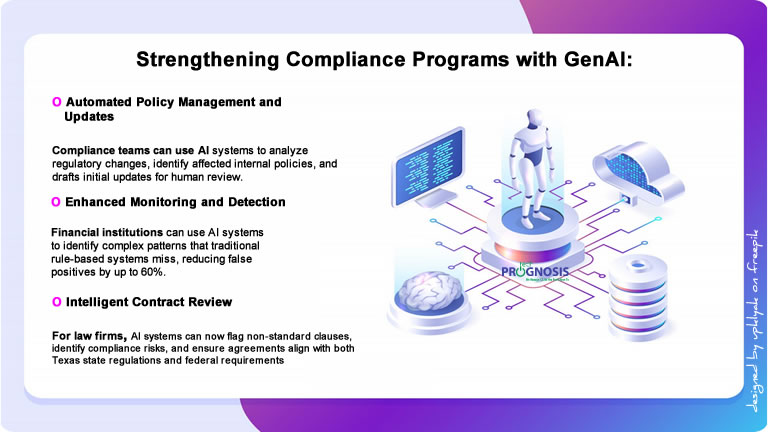
Generative AI concept showing humanoid with neural network, code on a computer monitor, and cloud computing icon.

Generative AI in Risk and Compliance: How Texas Enterprises Are Navigating the New Frontier

The Generative AI revolution isn’t coming—it’s already transforming conference rooms from Round Rock to Richardson, and boardrooms from Austin to Arlington.

When Dell Technologies’ compliance team in Round Rock began experimenting with generative AI tools in early 2023, they discovered something remarkable: what started as a productivity enhancement quickly evolved into a fundamental reshaping of their entire risk landscape. This transformation isn’t unique to Dell—it’s happening across Texas enterprises, from Samsung’s semiconductor facilities in Austin to the financial institutions lining Dallas’s Main Street.

As someone who’s spent years helping organizations navigate the complex waters of governance, risk, and compliance (GRC), I’ve witnessed firsthand how generative AI is simultaneously creating unprecedented opportunities and introducing risks that keep chief compliance officers awake at night.

Let’s explore how this technology is reshaping enterprise risk profiles and where it can genuinely deliver value for your organization.

Read more

Share

Risk Assessment Program: Real-World Scenarios & Smart Strategies

Simulation of people reviewing a risk assessment program showing a checklist dashboard on a laptop.

Why Round Rock Businesses Can’t Afford to Skip a Risk Assessment Program: Real-World Scenarios & Smart Strategies

Learn how Round Rock, Texas businesses can manage cybersecurity and operational risks using practical, real-world examples. Understand PII breaches, DDoS attacks, and software update failures — and how to build a proactive risk management program or plan under the NIST RMF.

Estimated Reading Time: 10 minutes (≈1,950 words)


Introduction

Round Rock and its neighboring communities — Georgetown, Cedar Park, Pflugerville, Hutto, and Taylor — are thriving tech hubs. With that growth comes a new level of responsibility: keeping data safe, systems reliable, and operations compliant.

As a Governance, Risk, and Compliance (GRC) specialist, I’ve seen how even small and mid-sized companies can suffer serious setbacks when they don’t treat risk assessment as a business priority. This post breaks down how to identify, categorize, and document risks — using three realistic examples your business might face.

Read more

Share

Ethical AI Governance Framework for Risk Assessment in Modern Banking

Ethical AI Governance Framework for risk assessment in modern banking concept with artificial intelligence humanoid with neural network and big data technology.

Ethical AI Governance Framework: A Practical Guide to AI Governance in Banking Risk Assessment

Picture this: You’re a risk officer at a major bank, and your AI system just flagged a small business loan application as high-risk. The applicant is a talented entrepreneur from an underserved community with a solid business plan but limited credit history. Your AI model, trained on decades of lending data, sees patterns that correlate with higher default rates. But here’s the catch – those patterns might reflect historical biases rather than true risk indicators. Perhaps, it is time to develop an ethical AI governance framework for Risk Assessment that ensures responsible AI use while maintaining innovation.

As artificial intelligence transforms how banks assess risk and make decisions, we’re witnessing a fundamental shift in the financial services landscape. AI promises faster decisions, better risk prediction, and improved customer experiences. Yet with this power comes unprecedented ethical challenges that keep chief risk officers awake at night. How do we harness AI’s potential while ensuring fairness, transparency, and accountability?

Welcome to the complex world of AI ethics in banking, where innovation meets responsibility at every turn.

Let’s dive into this critical conversation that’s reshaping modern banking. We will look at key ethical considerations when using AI for risk assessment in banking, and for each consideration we will provide a specific example of how it might manifest in practice.

Read more

Share

GRC Landscape: Navigating Governance, Risk and Compliance

Governance, Risk management, and Compliance or GRC isometric business concept with icons of server computers, people, electronic gadgets, magnifier, graphs, clock, coins, tablet computer, laptop, business presentation, negotiations, conference meeting etc.

GRC in Small and Medium-Sized Enterprises (SMEs): A Comprehensive Guide

In today’s dynamic business environment, governance, risk management, and compliance (GRC) have become essential components for small and medium-sized enterprises (SMEs). While often associated with large corporations, GRC frameworks are equally crucial for SMEs to ensure sustainable growth, mitigate risks, and maintain compliance with regulations. This guide will explore the importance of GRC in SMEs, provide practical examples, and present use cases to illustrate its application.

What is GRC?

Governance, Risk, and Compliance (GRC) is a framework that helps organizations achieve their objectives, address uncertainties, and act with integrity. Traditionally, GRC has been associated with large corporations. However, it is equally vital for Small and Medium-Sized Enterprises (SMEs) to embrace GRC to ensure sustainability and growth in an increasingly complex business environment.

These three pillars form an integrated approach to ensuring that an organization achieves its objectives, manages uncertainty, and acts with integrity.

Read more

Share

Data Pseudonymization in Cybersecurity: A Practical Guide

Image of data pseudonymization, or data protection technique concept with isometric laptop with lock on folder, shield and key, scrambled text, and protected login entry in background.

The Power of Data Pseudonymization in Cybersecurity: Protecting Personal Data with Practical Examples

Data breaches and cyber threats are becoming increasingly common, and as a result, safeguarding personal data has become paramount for individuals and organizations alike. With increasing cyber threats and stringent data protection regulations, innovative solutions like pseudonymization are gaining traction. But what exactly do we mean by replacing sensitive data values with artificial identifiers, and how does it bolster cybersecurity?

This blog post will delve into what pseudonymization is, why it matters, and how it can be applied in various sectors. We’ll also discuss practical use cases to help you understand its significance in real-world scenarios.

Read more

Share

Regulatory Frameworks: A Guide for Non-Technical Readers

Image of legal advice isometric showing books, a legal shield, a gavel, "legal" stamp, hourglass, justice scale, document, as a reference to regulatory frameworks and compliance.

Navigating Regulatory Frameworks: Ensuring Compliance Across Sectors

Understanding regulatory frameworks is crucial for any business. Whether you’re in healthcare, finance, technology, or any other sector, knowing the rules that govern your industry can make the difference between success and costly penalties.

In today’s complex world, businesses operate within a labyrinth of rules and regulations designed to protect consumers, employees, and the environment. Whether you run a small business or a large corporation, understanding and adhering to these regulatory frameworks is essential.

In this blog post, we’ll break down what regulatory frameworks are, provide examples from specific sectors, discuss common challenges organizations face, and offer some best practices to ensure compliance. This guide is designed to be easy to read and understand, even if you’re not a legal or regulatory expert.

Read more

Share
Share
Share