Generative AI in Risk and Compliance

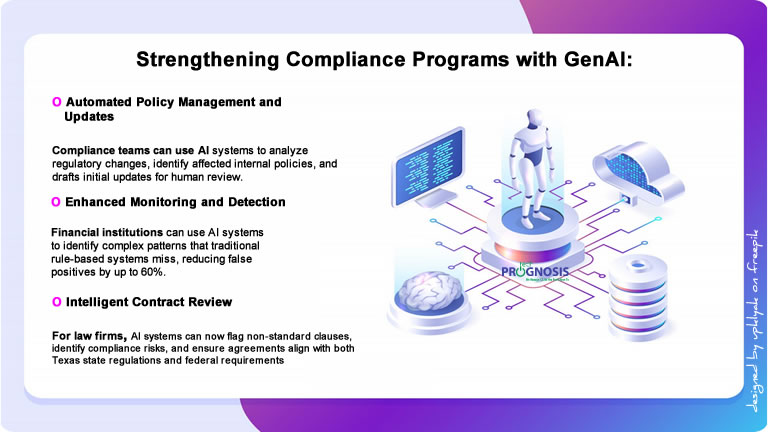
Generative AI concept showing humanoid with neural network, code on a computer monitor, and cloud computing icon.

Generative AI in Risk and Compliance: How Texas Enterprises Are Navigating the New Frontier

The Generative AI revolution isn’t coming—it’s already transforming conference rooms from Round Rock to Richardson, and boardrooms from Austin to Arlington.

When Dell Technologies’ compliance team in Round Rock began experimenting with generative AI tools in early 2023, they discovered something remarkable: what started as a productivity enhancement quickly evolved into a fundamental reshaping of their entire risk landscape. This transformation isn’t unique to Dell—it’s happening across Texas enterprises, from Samsung’s semiconductor facilities in Austin to the financial institutions lining Dallas’s Main Street.

As someone who’s spent years helping organizations navigate the complex waters of governance, risk, and compliance (GRC), I’ve witnessed firsthand how generative AI is simultaneously creating unprecedented opportunities and introducing risks that keep chief compliance officers awake at night.

Let’s explore how this technology is reshaping enterprise risk profiles and where it can genuinely deliver value for your organization.

Read more

Share

Risk Authorization Decisions in the NIST Risk Management Framework

Cybersecurity risk authorization decisions isometric concept showing businessmen shaking hands, a huge tablet with signatures, a secure padlock, and blockchain technology.

Why Your Business Can’t Afford to Ignore Cybersecurity Risk Authorization Decisions: A Round Rock Business Leader’s Guide to the NIST Risk Management Framework

How Central Texas organizations can protect sensitive data and avoid million-dollar mistakes through proper security risk authorization decisions


If your Round Rock, Austin, or Cedar Park business handles sensitive financial data, healthcare records, or customer information, there’s a critical decision-making process that could make or break your organization’s future. It’s called the cyber risk authorization decision within the NIST Risk Management Framework (RMF), and understanding it could save your company from devastating breaches, regulatory fines, and reputational damage.

Let me share a story that illustrates why this matters to every business leader from Georgetown to San Marcos.

Read more

Share

Compensating Security Controls for Texas Businesses

Informative isometric simulation of compensating security controls showing icons for surveillance camera, data privacy, and security system

When Your Cloud Security Falls Short: A Practical Guide to Compensating Security Controls for Texas Businesses

How Round Rock and Austin-Area Companies Can Bridge Security Gaps with Compensating Security Controls Without Breaking the Budget


If you’re running a business in Round Rock, Austin, or anywhere in Central Texas’s booming tech corridor, you’re likely using cloud services for at least part of your operations. Maybe you’re a healthcare provider in Cedar Park storing patient records, a financial services firm in Georgetown processing transactions, or a tech startup in Pflugerville building the next big thing.

Here’s something that might keep you up at night: what happens when your cloud provider’s security features don’t quite meet your industry’s requirements?

Let me share a story about “Adam,” a security analyst at a Austin-area financial services company, whose experience might sound familiar to many of you.

Read more

Share

Risk Assessment Program: Real-World Scenarios & Smart Strategies

Simulation of people reviewing a risk assessment program showing a checklist dashboard on a laptop.

Why Round Rock Businesses Can’t Afford to Skip a Risk Assessment Program: Real-World Scenarios & Smart Strategies

Learn how Round Rock, Texas businesses can manage cybersecurity and operational risks using practical, real-world examples. Understand PII breaches, DDoS attacks, and software update failures — and how to build a proactive risk management program or plan under the NIST RMF.

Estimated Reading Time: 10 minutes (≈1,950 words)


Introduction

Round Rock and its neighboring communities — Georgetown, Cedar Park, Pflugerville, Hutto, and Taylor — are thriving tech hubs. With that growth comes a new level of responsibility: keeping data safe, systems reliable, and operations compliant.

As a Governance, Risk, and Compliance (GRC) specialist, I’ve seen how even small and mid-sized companies can suffer serious setbacks when they don’t treat risk assessment as a business priority. This post breaks down how to identify, categorize, and document risks — using three realistic examples your business might face.

Read more

Share

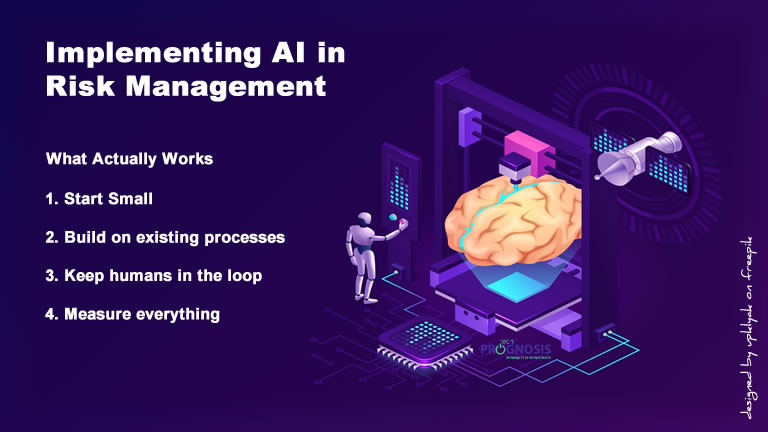
AI Implementation in Financial Risk Management: A Practical Guide

Technology isometric with ai robot, brain and text simulating AI implementation processes.

Implementing AI in Financial Risk Management: A Practical Guide for Mid-Size Banks

In my 15 years of working with financial institutions on governance and risk initiatives, I’ve never seen as much excitement – and anxiety – as I do now around AI implementation. Let’s cut through the hype and talk about what really works.

Read more

Share

Cybersecurity Crisis Management: Building Resilient Responses

Simulation of stressed executive instructing employees in office about cybersecurity crisis management.

Cybersecurity Crisis Management: Building Resilient Responses Across Manufacturing, Healthcare, and Finance

When it comes to cybersecurity, it’s not a question of if an incident will occur—it’s when. Whether you’re in manufacturing, healthcare, or finance, cyber threats don’t just disrupt business—they can harm people’s safety, compromise sensitive information, or destabilize markets.

This is why Cybersecurity Crisis Management has become one of the most vital disciplines in modern governance, risk, and compliance (GRC). At its heart, crisis management is about more than just reacting to an incident. It’s about preparing, escalating, containing, and learning from disruptions in a structured way—so your organization can bounce back stronger than before.

In this article, we’ll take a deep dive into the principles of cybersecurity crisis management, explore escalation matrices in detail (with step-by-step guidance for manufacturing, healthcare, and finance), walk through playbook examples, discuss common challenges, and outline how metrics can drive post-incident improvements.

We’ll also highlight some trusted tools and share best practices to help you build resilience in your organization.

Read more

Share
Share
Share