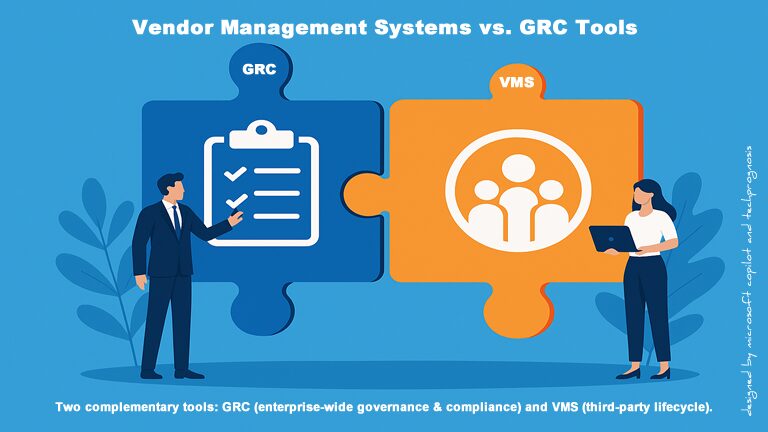
Vendor Management Systems vs. GRC Tools: Key Differences Explained

Key differences between GRC tools, and vendor management systems in terms of scope, integration, core functionality and outcomes.

Vendor Management Systems vs. GRC Tools: Understanding the Key Differences and How They Can Benefit Your Organization


In today’s fast-paced business environment, managing risk and ensuring compliance are critical. As organizations increasingly rely on third-party vendors, it’s more important than ever to have the right tools to assess and monitor vendor risk, alongside maintaining overall governance and compliance. But here’s the catch: while the terms GRC tools and Vendor Management Systems (VMS) are often used interchangeably, they serve very different purposes.

So, why does this matter?

If your organization is looking to streamline vendor management or strengthen your risk and compliance processes, it’s crucial to understand when to use GRC tools and when to turn to a Vendor Management System (VMS). Both can help manage risk, but they do so in distinct ways.

GRC platforms govern risk across the entire organization, while Vendor Management System tools specialize in managing the lifecycle of third‑party vendors.

In this article, we’ll explore the key differences and discuss how to make the right choice for your business, or organization.

Read more

Share

Generative AI in Risk and Compliance

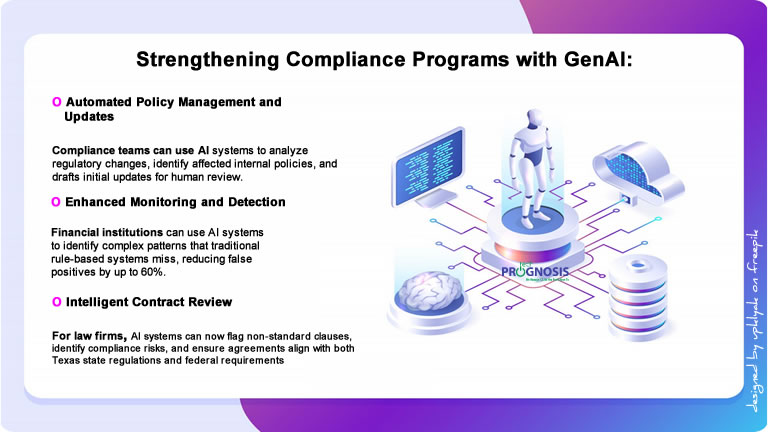
Generative AI concept showing humanoid with neural network, code on a computer monitor, and cloud computing icon.

Generative AI in Risk and Compliance: How Texas Enterprises Are Navigating the New Frontier

The Generative AI revolution isn’t coming—it’s already transforming conference rooms from Round Rock to Richardson, and boardrooms from Austin to Arlington.

When Dell Technologies’ compliance team in Round Rock began experimenting with generative AI tools in early 2023, they discovered something remarkable: what started as a productivity enhancement quickly evolved into a fundamental reshaping of their entire risk landscape. This transformation isn’t unique to Dell—it’s happening across Texas enterprises, from Samsung’s semiconductor facilities in Austin to the financial institutions lining Dallas’s Main Street.

As someone who’s spent years helping organizations navigate the complex waters of governance, risk, and compliance (GRC), I’ve witnessed firsthand how generative AI is simultaneously creating unprecedented opportunities and introducing risks that keep chief compliance officers awake at night.

Let’s explore how this technology is reshaping enterprise risk profiles and where it can genuinely deliver value for your organization.

Read more

Share

Access Control and the NIST Cybersecurity Framework

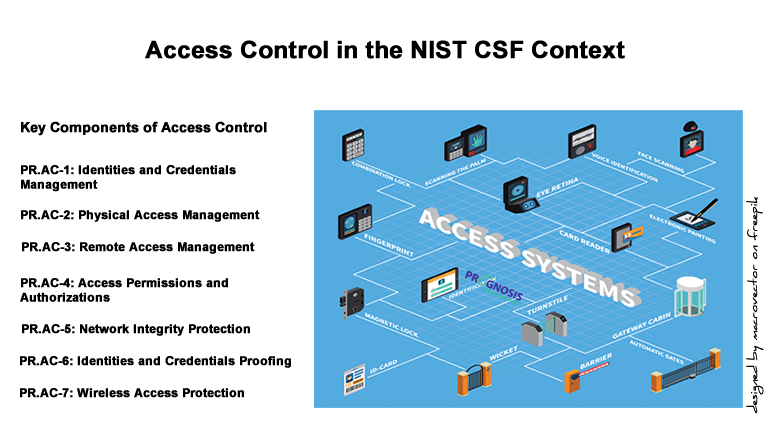
Access control systems isometric flowchart showing security systems using biometric verification, face and voice recognition, accessibility lock, security barriers etc.

Protecting Your Austin Business: A Deep Dive into Access Control and the NIST Cybersecurity Framework

If you’ve ever used a key card to enter your office building or typed a password into your laptop, you’ve experienced access control in action. But behind these everyday interactions lies a sophisticated security discipline that can make or break your organization’s cybersecurity posture—especially here in Austin, where our thriving tech scene and diverse business landscape make us an attractive target for cybercriminals.

As someone who’s spent years helping Texas businesses strengthen their security foundations, I’ve seen firsthand how proper access control can prevent devastating breaches, while poor implementation can lead to catastrophic consequences. Today, let’s explore access control through the lens of the NIST Cybersecurity Framework (CSF) and discuss how Austin organizations can protect their most valuable assets.

What is Access Control in the NIST CSF Context?

The National Institute of Standards and Technology (NIST) Cybersecurity Framework organizes cybersecurity activities into five core functions: Identify, Protect, Detect, Respond, and Recover. Access control falls squarely within the Protect Function, which focuses on developing and implementing appropriate safeguards to ensure delivery of critical services.

Specifically, access control is addressed in the Access Control (PR.AC) category of the Protect function. The NIST CSF defines this as managing access to assets and associated facilities to ensure that only authorized users, processes, or devices can access them—and only in a manner appropriate to their authorization level.

Think of access control as the digital and physical gatekeeper of your organization. It’s the system of policies, procedures, and technologies that determines who can enter your premises, what data they can view, which systems they can use, and what actions they can perform.

In Austin’s competitive business environment, where companies from healthcare startups to financial services firms handle sensitive information daily, robust access control isn’t just good practice—it’s essential for survival.

Read more

Share

AI Implementation in Financial Risk Management: A Practical Guide

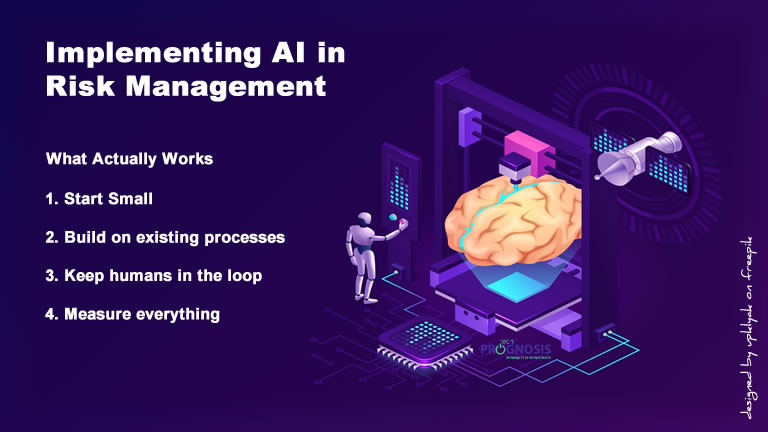
Technology isometric with ai robot, brain and text simulating AI implementation processes.

Implementing AI in Financial Risk Management: A Practical Guide for Mid-Size Banks

In my 15 years of working with financial institutions on governance and risk initiatives, I’ve never seen as much excitement – and anxiety – as I do now around AI implementation. Let’s cut through the hype and talk about what really works.

Read more

Share

Data Lifecycle Implementation and Records Management

Infographic showing texts of the six stages of data lifecycle in data lifecycle implementation and records management

Data Lifecycle Implementation and Records Management: A Comprehensive Guide

In today’s data-driven world, effective data lifecycle management and records management are crucial for organizations of all sizes. Organizations collect and store vast amounts of information. Managing this data efficiently is crucial to ensuring that it is both useful and compliant with regulations. This is where data lifecycle implementation and records management come into play. Understanding these concepts can seem daunting, but with the right approach, any organization can implement effective strategies to manage their data.

This comprehensive guide will delve into the concepts of data lifecycle implementation, records management, retention, and remediation. We’ll also explore common challenges faced by organizations, best practices to overcome these challenges, and recommend popular tools to streamline your data management processes.

Read more

Share

ISO 9001 Clause 9.2: A Comprehensive Guide to Internal Audits

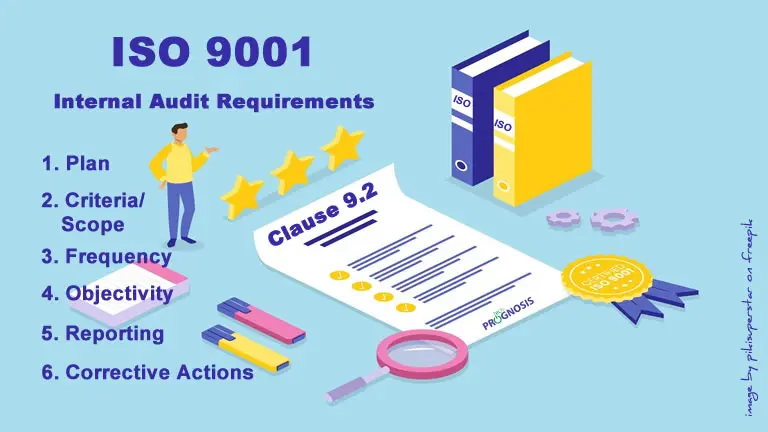
Image of isometric concept of ISO 9001 Clause 2 with ISO 9001 certification badge, a magnifying glass, book binders and a text of the requirements.

When it comes to maintaining a robust Quality Management System (QMS), ISO 9001 serves as the gold standard. Among its many requirements, ISO 9001 Clause 9.2, which deals with internal audits, stands out as a key element. For many organizations, however, the concept of internal audits can feel overwhelming, especially for those unfamiliar with quality management processes.

In this blog, we’ll break down ISO 9001 Clause 9.2 in a way that’s easy to understand. We’ll explore what internal audits are, why they’re essential, and how you can implement them effectively within your organization. Whether you’re a seasoned quality professional or new to the world of ISO standards, this guide will provide practical insights, examples, and actionable steps to help you meet the requirements with confidence.

What is ISO 9001 Clause 9.2?

Clause 9.2 of the ISO 9001 standard focuses on the internal audit process. Internal audits are systematic, independent evaluations of your QMS to determine whether your processes align with the requirements of ISO 9001 and whether they are effectively implemented and maintained.

The purpose of internal audits is to ensure that your organization consistently delivers quality products or services by identifying areas of non-conformance and opportunities for improvement. These audits are not just a compliance requirement but a strategic tool for enhancing your organization’s performance.

Read more

Share
Share
Share