
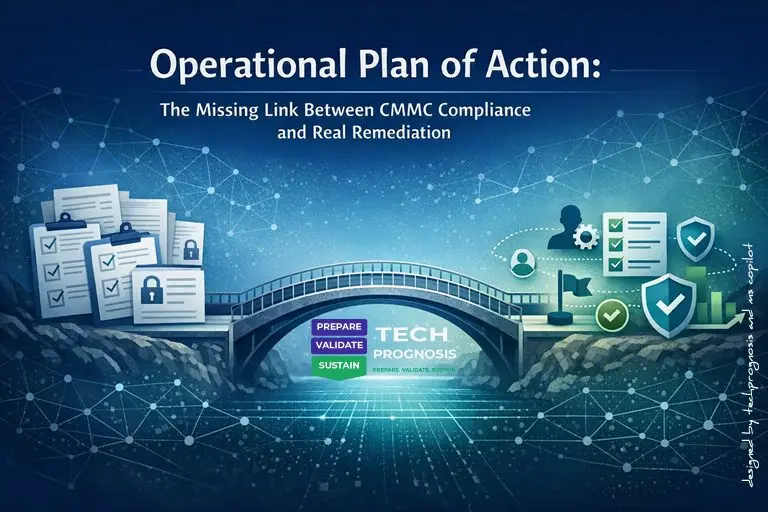
Operational Plan of Action in CMMC Compliance

Cybersecurity compliance bridge connecting CMMC documentation to remediation ownership, validation, and risk reduction with the text “Operational Plan of Action”.

Operational Plan of Action: The Missing Link Between CMMC Compliance and Real Remediation

Many DIB contractors understand the System Security Plan (SSP) and assessment Plan Of Action & Milestones (POA&M), but the Operational Plan of Action is where CMMC readiness becomes real remediation. This article explains what it is, why it matters, and how to use it as an ongoing cybersecurity management process.

In CMMC readiness conversations, the System Security Plan often gets most of the attention. The POA&M also receives plenty of discussion, especially because of the rules around conditional status and post-assessment remediation. But one requirement deserves more attention across the Defense Industrial Base: the Operational Plan of Action.

At first glance, it may sound like another compliance artifact. In practice, it asks a much more operational question: when your organization discovers a cybersecurity deficiency or vulnerability, how do you make sure it actually gets fixed?

That question matters because CMMC readiness should not stop at documentation. It should create a repeatable way to identify weaknesses, assign responsibility, drive remediation, validate completion, and sustain improvement over time.

Read more

Share

Plan of Action and Milestones (POA&Ms) in the NIST RMF

Isometric composition simulating a Plan of Action and Milestones (POA&M) strategy session with editable text and little human characters with plans and calendars.

How Businesses in Round Rock Can Strengthen Cybersecurity with Plan of Action and Milestones POA&Ms, Risk Registers, and NIST RMF

In today’s hyper-connected world, cybersecurity isn’t just an IT issue, it’s a core business risk. For businesses across Round Rock, Texas, and neighboring areas like Georgetown, Cedar Park, and Pflugerville, the question is no longer if cybersecurity threats will strike, but when.

The good news? With the right risk management approach, you can prepare, respond, and continuously improve.

This article explores how small-to-midsize organizations can use key tools from the NIST Risk Management Framework (RMF)—specifically Plan of Action and Milestones (POA&Ms) and Risk Registers, to effectively manage security control weaknesses, reduce risk, and maintain a strong security posture.

You’ll also follow a relatable real-world scenario with Peter, an IT manager navigating a system assessment.

Read more

Share
Share
Share