CMMC Level 2 Readiness: The Need for Strong IT Audits

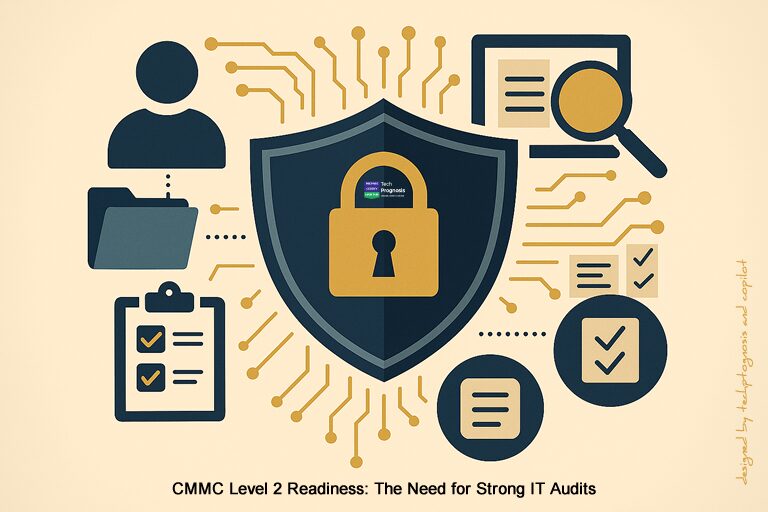
Abstract cybersecurity audit illustration showing a shield with padlock surrounded by checklists, documents, and review icons, representing CMMC Level 2 readiness and evidence‑based defense compliance

CMMC Level 2 Readiness: Why Strong IT Audits Are the Difference Between Compliance and Contract Loss

For defense contractors, CMMC Level 2 is no longer a theoretical requirement—it’s a gatekeeper. As the Department of Defense moves away from self‑attestation toward evidence‑based assessments, organizations handling Controlled Unclassified Information (CUI) must now prove their cybersecurity maturity.

At the core of that proof is one often‑misunderstood capability: the IT audit function.

In our work helping organizations prepare for and pass CMMC Level 2 assessments, we consistently see the same pattern. Companies that treat audits as a last‑minute compliance exercise struggle. Companies that integrate internal and external audit disciplines into their CMMC strategy succeed—and stay compliant long after certification.

This article explains how IT audits directly support CMMC Level 2 readiness, why both internal and external auditors matter, and how audit‑driven programs build real cybersecurity resilience.

Read more

Share

Cyber Resilience for CMMC Contractors: Why It Matters and How to Build It

A flat, minimalist illustration showing a manufacturing environment with robotic arms, workers in safety vests, and a central shield symbol split between a cracked surface and a circuit‑board design, representing cyber threats and resilience. Minimalist aircraft, a satellite dish, and a green security checkmark appear in the background.

Cyber Resilience for CMMC Contractors: Why It Matters and How to Build It

Cyber resilience is the capability to anticipate, withstand, recover from, and adapt to adverse cyber conditions—so that your mission‑essential manufacturing operations continue even when an attack succeeds. Resilience complements CMMC’s confidentiality‑focused controls (based on NIST SP 800‑171r3) by emphasizing continuity, restoration, and adaptation across IT and OT.

Audience: Defense Industrial Base (DIB) manufacturers and suppliers that handle FCI/CUI and are preparing for (or maintaining) CMMC compliance.


Why Cyber Resilience Now (Especially in the DIB)

  • The DIB remains a prime target for espionage and ransomware, and the Department of Defense (DoD) created CMMC to raise the floor on contractor protections for FCI/CUI.
  • NIST’s Cybersecurity Framework (CSF) 2.0 underscores governance and recoverability as integral to enterprise risk management—useful language for your board, program managers, and auditors.
  • Ransomware and OT/ICS impacts propagate from IT to plant networks; resilient manufacturers isolate critical processes, segment IT/OT, and test offline backups to maintain production.

Bottom line: CMMC helps protect sensitive data; resilience keeps your line running and deliveries on time.

Read more

Share

DFARS 252.204 7012 Explained: What Primes and Subs Must Do Before Accepting CUI

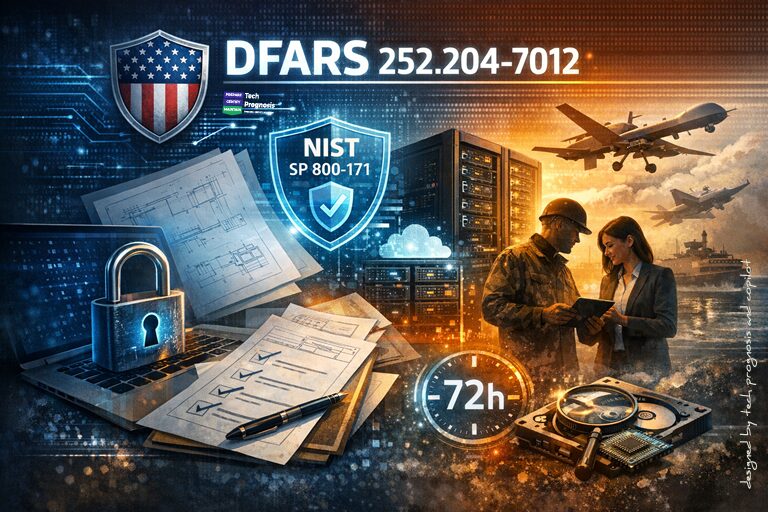
Illustration showing DFARS 252.204 7012 concepts with simple icons: a U.S. shield, a drone and naval vessel, a lock over documents, a NIST SP 800 171 badge, and a 72 hour incident reporting stopwatch.

DFARS 252.204‑7012 Explained (2026 Update): What Primes and Subs Must Do Before Accepting CUI

Bottom line: before a contractor accepts Controlled Unclassified Information (CUI) from DoD or a prime, DFARS 252.204‑7012 imposes concrete security, reporting, and cloud-handling duties—on both primes and subs—that must be in place first, not “as you go.” Non‑compliance risks contractual violations, bid ineligibility as CMMC phases in, and even False Claims Act exposure.

What DFARS 252.204‑7012 Actually Requires

DFARS 252.204‑7012 requires contractors to:

(1) Provide adequate security for Covered Defense Information (CDI/CUI);

(2) Implement NIST SP 800‑171;

(3) Report cyber incidents within 72 hours;

(4) Submit malware to DC3 if discovered;

(5) Preserve images/logs/data for forensic review;

(6) Flow down the entire clause to applicable subcontractors; and

(7) Use FedRAMP Moderate‑equivalent cloud services when CUI touches the cloud.

CDI/CUI defined. DFARS cross‑references the CUI Registry and includes Controlled Technical Information (CTI) and other protected categories provided by DoD or generated in performance and not intended for public release.

Read more

Share

CUI vs. FCI: What Every DoD Contractor Must Get Right Before Chasing CMMC

Minimalist illustration showing CUI vs FCI folders, a balanced scale labeled Level 1 and Level 2, and CMMC compliance icons referencing FAR 52.204 21 and DFARS 7012.

Why this article on CUI vs. FCI matters

If you’re a prime, a sub, or an overwhelmed SMB in the Defense Industrial Base (DIB), your CMMC journey starts with one decision: What data are we protecting – Federal Contract Information (FCI), Controlled Unclassified Information (CUI), or both? Get this wrong and everything downstream – scope, controls, budget, tools, even your chances at award – will be off. The good news: you can make this call with clear, objective criteria grounded in FAR 52.204‑21 (FCI) and 32 CFR Part 2002 (CUI), along with DoD and NIST guidance.


Quick CUI vs. FCI definitions (plain English)

  • FCI (Federal Contract Information)
    Information not intended for public release that the Government provides to you or that you generate under a Federal contract to deliver a product or service. If it’s on a public website or simple payment data, it’s not FCI. Think SOWs, deliverable drafts, CO emails, project plans. FCI invokes FAR 52.204‑21 and its 15 basic safeguards.
  • CUI (Controlled Unclassified Information)
    Unclassified information that Federal law/regulation/policy requires or permits safeguarding or limited dissemination. It is created or possessed by the Government, or by you for/on behalf of the Government. CUI is standardized under the government‑wide CUI Program and cataloged in the CUI Registry; DoD also maintains a DoD‑specific registry. In DoD contracts, CUI generally triggers DFARS 252.204‑7012 and NIST SP 800‑171 implementation.

Practical rule of thumb: If it’s just contract‑related but not public, it’s probably FCI. If a law/regulation/policy says it needs protection (e.g., export control, Controlled Technical Information (CTI), Personally Identifiable Information (PII) tied to a DoD purpose), it’s CUI – check the registry category and your contract.

Read more

Share

Defense Supply Chain and CMMC: Practical Steps for Vendor Security

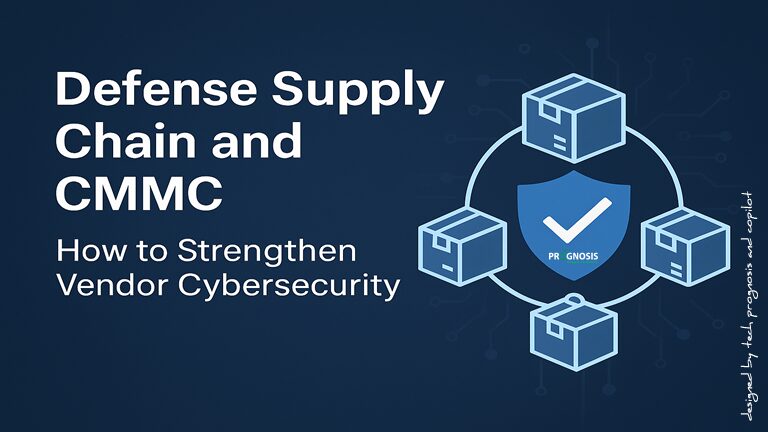
Illustration of secure defense supply chain with shield and interconnected boxes representing vendors

CMMC 2.0 and Defense Supply Chain Attacks: Practical Steps to Build Resilience Across Your Vendor Ecosystem

Supply chain attacks keep rising because attackers go where trust and access already exist—third-party vendors, managed service providers, and software suppliers. If you handle Federal Contract Information (FCI) or Controlled Unclassified Information (CUI), your security posture is only as strong as your partners’. CMMC 2.0 responds to this reality by placing verifiable expectations on every tier that touches sensitive DoD data. In this post, we’ll break down the threat, connect it to CMMC’s objectives, and share a practical roadmap you can start using today—grounded in inclusive, plain language and real-world scenarios.

Why the Defense Supply Chain Is a Prime Target

  • The attack surface is huge. Organizations share data with hundreds of vendors, yet few have mature processes to evaluate and improve vendor cybersecurity posture. In 2023, 15% of breaches involved a defense supply chain compromise, and 98% of companies had at least one vendor that experienced a breach. This is a perfect storm of exposure and limited oversight.
  • High-profile cases illustrate the risk. The SolarWinds Orion compromise showed how malicious code in a trusted update can ripple across government and commercial networks. Likewise, the 2023 third-party breach linked to Infosys McCamish Systems affected more than 57,000 Bank of America-related entities, underscoring how downstream vendors can become a gateway for attackers.

Inclusive takeaway: regardless of your organization’s size, role, or location within the Defense Industrial Base (DIB), defense supply chain risk touches everyone who processes, stores, or transmits FCI/CUI.

Read more

Share

CMMC Audit Guide: How to Detect Hidden or Forgotten Systems

Simulation of a CMMC audit showing a cybersecurity auditor reviewing network map and CMMC scoping guide to detect hidden systems during compliance assessment.

Detecting Concealed, Forgotten, or “Conveniently Omitted” Systems During a CMMC Audit

Hidden assets—forgotten servers, unregistered devices, and unmonitored cloud instances—can derail a CMMC assessment. This practical guide helps you spot them early, align your scope with DoD rules, and prepare for a CMMC audit like a pro.

Why hidden systems matter for a CMMC Audit

In CMMC Level 2, your environment must meet the NIST SP 800‑171 requirements for systems that process, store, or transmit CUI—and certain systems that provide security services to those systems. If your scope misses assets, your controls won’t cover the real environment, which leads to findings. The DoD’s Final CMMC Rule formalizes verification, introduces annual affirmations of ongoing compliance, and ties certification status to contract award and performance—so accuracy isn’t optional. [cmmcaudit.org]

Read more

Share
Share
Share