OCTAVE Allegro: A Comprehensive Guide to Cybersecurity Risk Assessment

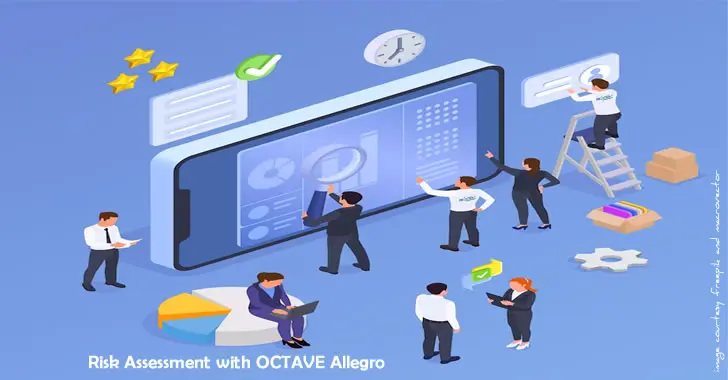
Image of people working in a simulated OCTAVE Allegro risk assessment environment showing a man in a dark suit holding a magnifying glass, and a woman working on a laptop.

Introduction

The Operationally Critical Threat, Asset, and Vulnerability Evaluation (OCTAVE) Allegro methodology is an effective approach to address the challenges organizations face in today’s fast-paced business landscape. Businesses increasingly face a multitude of risks that can disrupt operations, damage reputation, and lead to significant financial losses. If you add to that the ever-increasing number of cyber threats, organizations must be proactive in identifying and mitigating potential risks.

OCTAVE Allegro offers a robust and adaptable approach for organizations to assess and mitigate cybersecurity risks.

In this article, we will delve into the origins, methodologies, and components of OCTAVE Allegro, and discuss why organizations should consider adopting it for their cybersecurity risk assessment needs. We will also provide clear implementation steps to make the process understandable and achievable for organizations of all sizes.

Section 1: The Origin of OCTAVE Allegro

OCTAVE Allegro is an evolution of the original OCTAVE methodology, which was developed at the Software Engineering Institute (SEI) at Carnegie Mellon University. The SEI introduced OCTAVE in the late 1990s as a comprehensive approach to managing information security risks.

Read more

Share

NIST Cybersecurity Framework (CSF) is a Crucial Tool for Cybersecurity

Image showing business data analytics, platform charts and diagram with text of the five functions of the NIST Cybersecurity Framework: Identify, Protect, Detect, Respond and Recover.

Understanding the NIST Cybersecurity Framework (CSF)

The NIST Cybersecurity Framework (CSF) is a crucial tool in today’s cybersecurity environment, providing organizations with a structured and flexible approach to managing and improving their cybersecurity efforts. It was developed by the National Institute of Standards and Technology (NIST) in response to the increasing cyber threats that organizations face, and to help them navigate these challenges.

In this article, we will discuss why the NIST CSF matters, delve into its implementation tiers, and provide guidance on how organizations can use this framework to protect their infrastructure.

Read more

Share

Achieving Comprehensive GRC with the OCTAVE Methodology


Image of a cyber-security flowchart with hacking activity data-protection icons.

The OCTAVE methodology is a risk management threat model that can be used to implement GRC (governance, risk, and compliance) in an organization. It is a flexible and adaptable methodology that can be tailored to the specific needs of any organization.

The business landscape today is rapidly changing, and cybersecurity threats are becoming increasingly complex. Ensuring that an organization operates efficiently while managing risks and complying with regulations is essential for success.

This is where Governance, Risk, and Compliance (GRC) comes into play.

GRC is a holistic approach that enables organizations to navigate the complex web of regulations, risks, and internal policies effectively.

One highly regarded method for implementing GRC is the OCTAVE (Operationally Critical Threat, Asset, and Vulnerability Evaluation) methodology.

In this article, we’ll explore how organizations can use the OCTAVE methodology to build a robust GRC framework.

Read more

Share

Aligning GRC Excellence: CIS Controls Risk Assessment Method and COBIT 2019 Framework

Image of people simulating a risk assessment business meeting, and analysis for management.

Introduction

The digital landscape today is fast-paced and interconnected, and has presented organizations with an ever-growing array of cybersecurity threats and compliance challenges. To navigate this complex terrain effectively, they often turn to comprehensive frameworks that provide guidance for Governance, Risk Management, and Compliance (GRC). Two of the most prominent frameworks in this realm are the CIS Controls Risk Assessment Method and the COBIT 2019 Framework.

In this article, we will explore the key components of the CIS Controls Risk Assessment Method and lay out a compelling argument for how it aligns with and complements the COBIT 2019 Framework, creating a powerful synergy for organizations seeking GRC excellence.

Read more

Share
Share
Share