
DFARS 252.204 7012 Explained: What Primes and Subs Must Do Before Accepting CUI

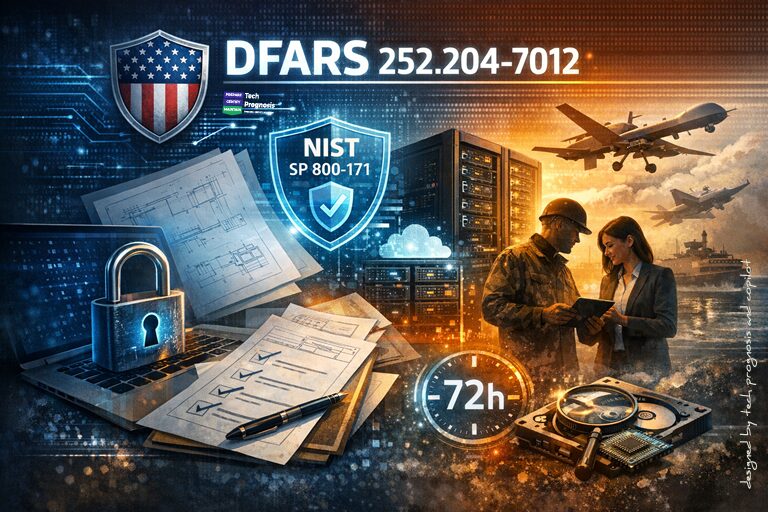
Illustration showing DFARS 252.204 7012 concepts with simple icons: a U.S. shield, a drone and naval vessel, a lock over documents, a NIST SP 800 171 badge, and a 72 hour incident reporting stopwatch.

DFARS 252.204‑7012 Explained (2026 Update): What Primes and Subs Must Do Before Accepting CUI

Bottom line: before a contractor accepts Controlled Unclassified Information (CUI) from DoD or a prime, DFARS 252.204‑7012 imposes concrete security, reporting, and cloud-handling duties—on both primes and subs—that must be in place first, not “as you go.” Non‑compliance risks contractual violations, bid ineligibility as CMMC phases in, and even False Claims Act exposure.

What DFARS 252.204‑7012 Actually Requires

DFARS 252.204‑7012 requires contractors to:

(1) Provide adequate security for Covered Defense Information (CDI/CUI);

(2) Implement NIST SP 800‑171;

(3) Report cyber incidents within 72 hours;

(4) Submit malware to DC3 if discovered;

(5) Preserve images/logs/data for forensic review;

(6) Flow down the entire clause to applicable subcontractors; and

(7) Use FedRAMP Moderate‑equivalent cloud services when CUI touches the cloud.

CDI/CUI defined. DFARS cross‑references the CUI Registry and includes Controlled Technical Information (CTI) and other protected categories provided by DoD or generated in performance and not intended for public release.

Read more

Share

Defense Supply Chain and CMMC: Practical Steps for Vendor Security

Illustration of secure defense supply chain with shield and interconnected boxes representing vendors

CMMC 2.0 and Defense Supply Chain Attacks: Practical Steps to Build Resilience Across Your Vendor Ecosystem

Supply chain attacks keep rising because attackers go where trust and access already exist—third-party vendors, managed service providers, and software suppliers. If you handle Federal Contract Information (FCI) or Controlled Unclassified Information (CUI), your security posture is only as strong as your partners’. CMMC 2.0 responds to this reality by placing verifiable expectations on every tier that touches sensitive DoD data. In this post, we’ll break down the threat, connect it to CMMC’s objectives, and share a practical roadmap you can start using today—grounded in inclusive, plain language and real-world scenarios.

Why the Defense Supply Chain Is a Prime Target

  • The attack surface is huge. Organizations share data with hundreds of vendors, yet few have mature processes to evaluate and improve vendor cybersecurity posture. In 2023, 15% of breaches involved a defense supply chain compromise, and 98% of companies had at least one vendor that experienced a breach. This is a perfect storm of exposure and limited oversight.
  • High-profile cases illustrate the risk. The SolarWinds Orion compromise showed how malicious code in a trusted update can ripple across government and commercial networks. Likewise, the 2023 third-party breach linked to Infosys McCamish Systems affected more than 57,000 Bank of America-related entities, underscoring how downstream vendors can become a gateway for attackers.

Inclusive takeaway: regardless of your organization’s size, role, or location within the Defense Industrial Base (DIB), defense supply chain risk touches everyone who processes, stores, or transmits FCI/CUI.

Read more

Share

Securing The Global Supply Chain: A Blueprint for A Robust Third-Party Risk Management

Image of a supply chain flow from raw materials to customer with the words "Supply Chain Management" written in big letters.

Enhancing Security and Risk Management in a Complex Supply Chain Organization

In today’s dynamic business landscape, global supply chain organizations face an array of challenges that demand proactive risk management. This is particularly relevant for supply chain companies dealing with a vast array of almost obsolete hardware and diverse operating systems. Additionally, the absence of formal information security policies, plans, and specialized staff further complicates the situation.

In this article, we explore the pressing need for bolstering security and risk management in complex supply chain organizations and delve into how the integration of three vital risk management frameworks – ISO 31000, NIST CSF, and COBIT 2019 – can bring about a transformative impact.

Challenges of the Modern Supply Chain

Complex supply chain organizations often grapple with a multitude of issues:

Read more

Share
Share
Share