
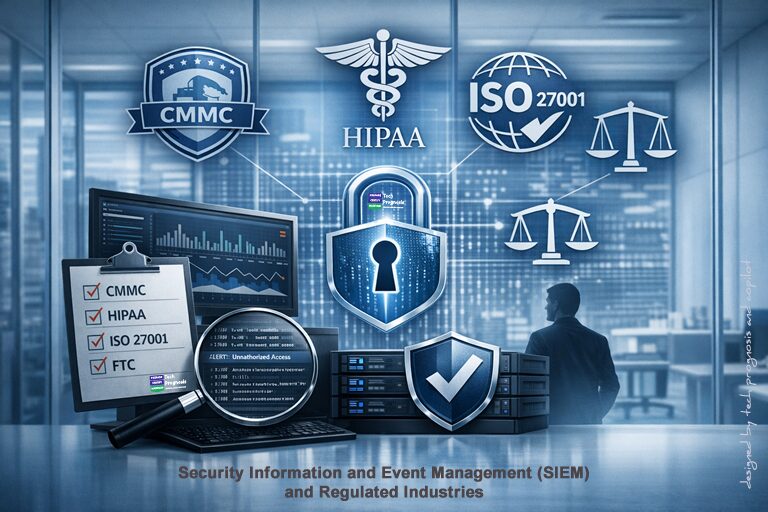
Security Information and Event Management (SIEM) and Regulated Industries

A digital illustration showing cybersecurity, Security Information and Event Management (SIEM) and compliance concepts, including a glowing lock at the center, surrounded by icons for CMMC, HIPAA, ISO 27001, and FTC related compliance, with dashboards, servers, checklists, and security symbols representing monitoring, auditing, and regulatory alignment.

Understanding SIEM in 2026: Limitations—and How to Build a Compliant, Outcome‑Driven Detection Program

Executive summary. Security Information and Event Management (SIEM) remains central to modern detection and response, but the playing field has evolved: cloud‑first estates, identity‑centric attacks, and new or strengthened rules (CMMC, HIPAA Security Rule enforcement practices, FTC Safeguards updates, ISO/IEC 27001:2022, and NIST CSF 2.0) raise the bar for logging, monitoring, and evidence. SIEM alone isn’t enough; you’ll need smart log source prioritization, detection engineering mapped to frameworks like MITRE ATT&CK, and automation you can trust (SOAR), all tuned to produce defensible evidence for audits and assessments.


What is Security Information and Event Management (SIEM) today (and what it isn’t)

A SIEM centrally collects and analyzes logs and events across systems, networks, applications, identities, and cloud services to help analysts detect, investigate, and report incidents. It’s often paired with Security Orchestration, Automation, and Response or SOAR to orchestrate and automate response actions.

SOAR (security orchestration, automation, and response) provides playbooks and automation for triage and remediation; it does not replace analytic rigor or governance.

Governments and industry recently published pragmatic guidance for implementing SIEM/SOAR, highlighting benefits (visibility, faster response) and pitfalls (data normalization, coverage, resource intensity).

Where SIEM fits in frameworks: NIST CSF 2.0 explicitly expects continuous monitoring and event logging outcomes (e.g., PR.PS‑04 requires that log records are generated and made available for continuous monitoring)—functions typically enabled by SIEM + SOAR.

Read more

Share

Defense Supply Chain and CMMC: Practical Steps for Vendor Security

Illustration of secure defense supply chain with shield and interconnected boxes representing vendors

CMMC 2.0 and Defense Supply Chain Attacks: Practical Steps to Build Resilience Across Your Vendor Ecosystem

Supply chain attacks keep rising because attackers go where trust and access already exist—third-party vendors, managed service providers, and software suppliers. If you handle Federal Contract Information (FCI) or Controlled Unclassified Information (CUI), your security posture is only as strong as your partners’. CMMC 2.0 responds to this reality by placing verifiable expectations on every tier that touches sensitive DoD data. In this post, we’ll break down the threat, connect it to CMMC’s objectives, and share a practical roadmap you can start using today—grounded in inclusive, plain language and real-world scenarios.

Why the Defense Supply Chain Is a Prime Target

  • The attack surface is huge. Organizations share data with hundreds of vendors, yet few have mature processes to evaluate and improve vendor cybersecurity posture. In 2023, 15% of breaches involved a defense supply chain compromise, and 98% of companies had at least one vendor that experienced a breach. This is a perfect storm of exposure and limited oversight.
  • High-profile cases illustrate the risk. The SolarWinds Orion compromise showed how malicious code in a trusted update can ripple across government and commercial networks. Likewise, the 2023 third-party breach linked to Infosys McCamish Systems affected more than 57,000 Bank of America-related entities, underscoring how downstream vendors can become a gateway for attackers.

Inclusive takeaway: regardless of your organization’s size, role, or location within the Defense Industrial Base (DIB), defense supply chain risk touches everyone who processes, stores, or transmits FCI/CUI.

Read more

Share
Share
Share