Access Control and the NIST Cybersecurity Framework

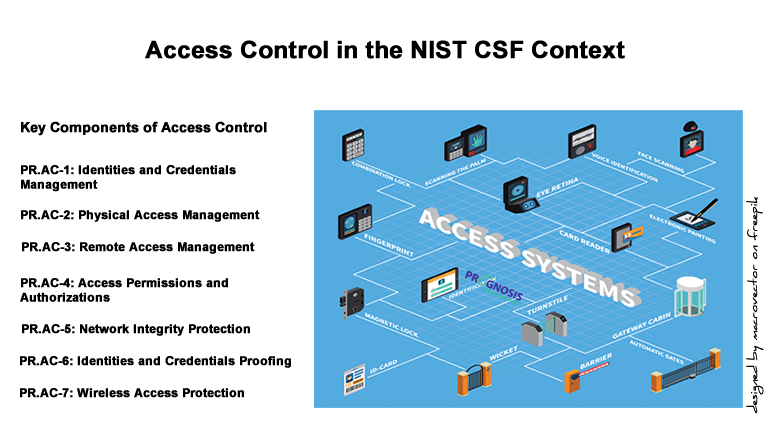
Access control systems isometric flowchart showing security systems using biometric verification, face and voice recognition, accessibility lock, security barriers etc.

Protecting Your Austin Business: A Deep Dive into Access Control and the NIST Cybersecurity Framework

If you’ve ever used a key card to enter your office building or typed a password into your laptop, you’ve experienced access control in action. But behind these everyday interactions lies a sophisticated security discipline that can make or break your organization’s cybersecurity posture—especially here in Austin, where our thriving tech scene and diverse business landscape make us an attractive target for cybercriminals.

As someone who’s spent years helping Texas businesses strengthen their security foundations, I’ve seen firsthand how proper access control can prevent devastating breaches, while poor implementation can lead to catastrophic consequences. Today, let’s explore access control through the lens of the NIST Cybersecurity Framework (CSF) and discuss how Austin organizations can protect their most valuable assets.

What is Access Control in the NIST CSF Context?

The National Institute of Standards and Technology (NIST) Cybersecurity Framework organizes cybersecurity activities into five core functions: Identify, Protect, Detect, Respond, and Recover. Access control falls squarely within the Protect Function, which focuses on developing and implementing appropriate safeguards to ensure delivery of critical services.

Specifically, access control is addressed in the Access Control (PR.AC) category of the Protect function. The NIST CSF defines this as managing access to assets and associated facilities to ensure that only authorized users, processes, or devices can access them—and only in a manner appropriate to their authorization level.

Think of access control as the digital and physical gatekeeper of your organization. It’s the system of policies, procedures, and technologies that determines who can enter your premises, what data they can view, which systems they can use, and what actions they can perform.

In Austin’s competitive business environment, where companies from healthcare startups to financial services firms handle sensitive information daily, robust access control isn’t just good practice—it’s essential for survival.

Read more

Share

Protect Function of the NIST Cybersecurity Framework: A Practical Guide

Infographic concept with a six-point point list of what the Protect function of the NIST Cybersecurity Framework covers like access control, awareness training, data security.

The NIST Cybersecurity Framework Protect Function: A Practical Guide for Small Businesses in Austin, Texas

Cybersecurity often feels overwhelming for small businesses. With headlines about major breaches and new regulations, it’s easy to think that strong cybersecurity is something only large corporations can afford. But the truth is, businesses of every size—whether you’re running a coffee shop in East Austin, a dental clinic in South Lamar, or a boutique retail store downtown—have critical systems, data, and people to protect.

That’s where the Protect Function of the NIST Cybersecurity Framework (CSF) comes in. While the framework sounds technical, it’s essentially a guide to help organizations reduce risk by protecting what matters most. In this article, we’ll break down the Protect Function in simple terms, explore how Austin businesses can apply it, and highlight practical steps you can take today.


What Is the Protect Function?

The NIST CSF has five core functions: Identify, Protect, Detect, Respond, and Recover. The Protect function focuses on proactive measures—safeguarding your people, assets, systems, and data before something goes wrong.

Think of it as putting locks on your doors, training your staff, and installing smoke detectors before there’s a fire. Protection doesn’t eliminate all risks, but it makes you less vulnerable and better prepared.

Read more

Share

Privacy Risk Management in Cybersecurity: A Comprehensive Guide

Isometric illustration showing a 3d laptop, fingerprint, security shield, credit card, data privacy, 3d lock, and text of the key components of privacy risk management in cybersecurity.

Effective privacy risk management is crucial for protecting personal data and maintaining compliance with privacy laws. By conducting regular privacy assessments, implementing tracker scanning, managing user consent, and handling subject rights requests diligently, organizations can mitigate privacy risks and build trust with their users. Embracing best practices and leveraging privacy management tools further enhance these efforts.

This blog post delves into the key concepts of privacy risk management, including privacy assessments, tracker scanning, consent management, and subject rights requests. We’ll also explore common challenges organizations face, offer best practices, and recommend popular tools to help manage privacy risks effectively.

Introduction to Privacy Risk Management

In today’s fast-moving technology and increasingly digital landscape, the protection of personal data is not just a regulatory requirement but also a critical factor in maintaining customer trust. Privacy risk management involves identifying, assessing, and mitigating risks associated with the handling of personal information. It ensures that organizations comply with privacy laws and regulations while safeguarding individual privacy rights.

Read more

Share

Data Pseudonymization in Cybersecurity: A Practical Guide

Image of data pseudonymization, or data protection technique concept with isometric laptop with lock on folder, shield and key, scrambled text, and protected login entry in background.

The Power of Data Pseudonymization in Cybersecurity: Protecting Personal Data with Practical Examples

Data breaches and cyber threats are becoming increasingly common, and as a result, safeguarding personal data has become paramount for individuals and organizations alike. With increasing cyber threats and stringent data protection regulations, innovative solutions like pseudonymization are gaining traction. But what exactly do we mean by replacing sensitive data values with artificial identifiers, and how does it bolster cybersecurity?

This blog post will delve into what pseudonymization is, why it matters, and how it can be applied in various sectors. We’ll also discuss practical use cases to help you understand its significance in real-world scenarios.

Read more

Share

GDPR Accountability Principles: A Practical Guide

Image of the Euopean Union's data protection law concept with text of the GDPR Accountability Principles

Understanding Accountability Principles under the EU GDPR: A Practical Guide with Sector-Specific Insights

It is safe to argue that today, data has become one of the most valuable assets for organizations. With the rise of data collection, processing, and sharing, the European Union’s General Data Protection Regulation (GDPR) has put accountability at the forefront of data protection practices. But what does accountability under the GDPR really mean for your organization, and how can you ensure compliance while fostering a culture of responsibility and ownership over data?

This article breaks down the GDPR’s accountability principles, provides sector-specific examples, and offers practical advice to help you navigate this complex terrain. Whether you work in healthcare, finance, retail, or any other industry, understanding and implementing these principles can help protect your organization and build trust with your customers.

Read more

Share

Amazon Macie: A Guide to Securing Sensitive Data in the Cloud

Image of V Model software development isometric composition with gear, icons, code screens, and computer workstations as a simulation of how Amazon Macie uses machine learning and pattern matching to discover and protect sensitive data in AWS.

Securing Sensitive Data in the Cloud: A Comprehensive Guide to Amazon Macie

Data security and privacy are more important than ever. With the increasing amount of sensitive information stored in the cloud, organizations face growing challenges in safeguarding their data. As a service designed to enhance data security and privacy, Amazon Macie helps organizations discover, monitor, and protect sensitive data stored in Amazon S3 (Simple Storage Service).

In this article, we’ll explore how Amazon Macie can help your organization stay compliant and secure, highlight common challenges in data protection, and offer best practices and popular tools to enhance your data security strategy.

Read more

Share
Share
Share