Overengineering Solutions: A Call for Practicality in MSP Services

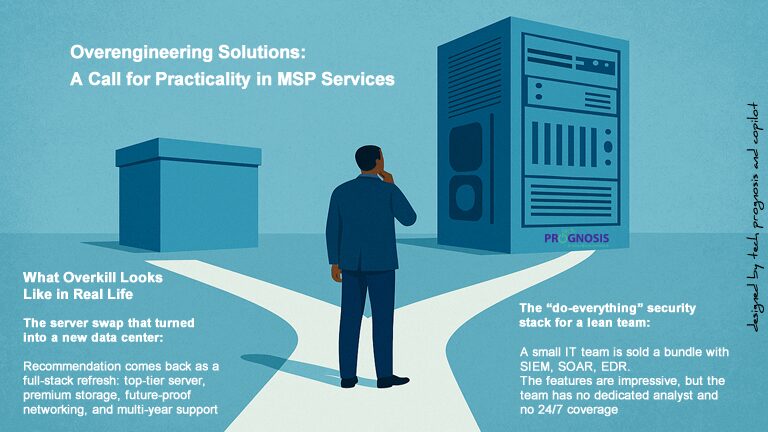
Illustration of a business professional standing at a crossroads, deciding between a simple box and a large server tower, symbolizing overengineering versus practical solutions.

Too many managed service providers (MSPs) still prescribe solutions that are bigger, pricier, and more complex than what clients actually need. Overengineering solutions not only wastes budget—it also slows teams down, erodes trust, and makes day‑to‑day operations harder. The fix is simple, but it takes discipline: start with the business problem, apply a risk‑based lens, right‑size the solution, and co‑design with the people who will live with it.

This post shares real‑world examples, root causes, and a practical framework you can use today.

Why This Question on Overengineering Solutions Still Matters

In a world of nonstop product launches, aggressive vendor marketing, and a constant drumbeat of “more features, more protection,” it’s easy to equate complexity with quality. But for many organizations—especially small and mid‑size businesses—large, layered solutions can be the wrong fit. They can consume scarce budgets, demand skills that the team doesn’t have, and introduce new points of failure.

Right‑sizing solutions is not about cutting corners. It’s about delivering outcomes that match the organization’s goals, resources, and risk tolerance. It’s about respect: the kind that honors each client’s constraints and aspirations. And it’s about trust—because teams remember when you take care to recommend what works, not simply what sells.

Read more

Share

Defense Supply Chain and CMMC: Practical Steps for Vendor Security

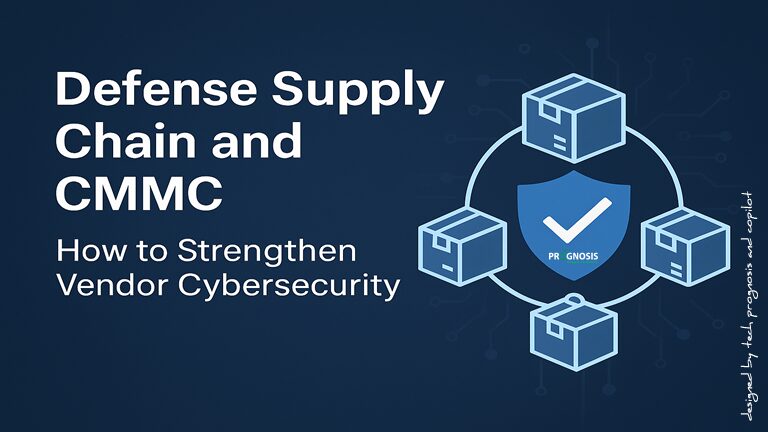
Illustration of secure defense supply chain with shield and interconnected boxes representing vendors

CMMC 2.0 and Defense Supply Chain Attacks: Practical Steps to Build Resilience Across Your Vendor Ecosystem

Supply chain attacks keep rising because attackers go where trust and access already exist—third-party vendors, managed service providers, and software suppliers. If you handle Federal Contract Information (FCI) or Controlled Unclassified Information (CUI), your security posture is only as strong as your partners’. CMMC 2.0 responds to this reality by placing verifiable expectations on every tier that touches sensitive DoD data. In this post, we’ll break down the threat, connect it to CMMC’s objectives, and share a practical roadmap you can start using today—grounded in inclusive, plain language and real-world scenarios.

Why the Defense Supply Chain Is a Prime Target

  • The attack surface is huge. Organizations share data with hundreds of vendors, yet few have mature processes to evaluate and improve vendor cybersecurity posture. In 2023, 15% of breaches involved a defense supply chain compromise, and 98% of companies had at least one vendor that experienced a breach. This is a perfect storm of exposure and limited oversight.
  • High-profile cases illustrate the risk. The SolarWinds Orion compromise showed how malicious code in a trusted update can ripple across government and commercial networks. Likewise, the 2023 third-party breach linked to Infosys McCamish Systems affected more than 57,000 Bank of America-related entities, underscoring how downstream vendors can become a gateway for attackers.

Inclusive takeaway: regardless of your organization’s size, role, or location within the Defense Industrial Base (DIB), defense supply chain risk touches everyone who processes, stores, or transmits FCI/CUI.

Read more

Share

CMMC Audit Guide: How to Detect Hidden or Forgotten Systems

Simulation of a CMMC audit showing a cybersecurity auditor reviewing network map and CMMC scoping guide to detect hidden systems during compliance assessment.

Detecting Concealed, Forgotten, or “Conveniently Omitted” Systems During a CMMC Audit

Hidden assets—forgotten servers, unregistered devices, and unmonitored cloud instances—can derail a CMMC assessment. This practical guide helps you spot them early, align your scope with DoD rules, and prepare for a CMMC audit like a pro.

Why hidden systems matter for a CMMC Audit

In CMMC Level 2, your environment must meet the NIST SP 800‑171 requirements for systems that process, store, or transmit CUI—and certain systems that provide security services to those systems. If your scope misses assets, your controls won’t cover the real environment, which leads to findings. The DoD’s Final CMMC Rule formalizes verification, introduces annual affirmations of ongoing compliance, and ties certification status to contract award and performance—so accuracy isn’t optional. [cmmcaudit.org]

Read more

Share

CMMC Controls MSSPs Should Already Have (But Might Not)

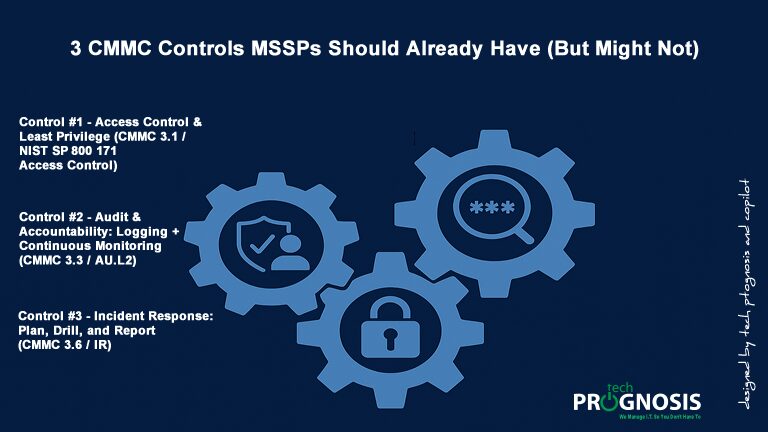
Three interlocking gears on a dark blue background, each containing security icons: a shield with a user silhouette, a magnifying glass with password symbols, and a padlock. Above the gears, bold white text reads ‘3 CMMC Controls MSSPs Should Already Have (But Might Not)’.

3 CMMC Controls MSSPs Should Already Have (But Might Not) — Plus Real‑World Case Studies

Hey there, MSSP heroes! Let’s cut to the chase: If you’re prepping for a CMMC audit, you’re already ahead of the game. But here’s the kicker—many MSSPs (just like you!) might be missing a few key CMMC controls staring them right in the face.

CMMC isn’t just about checking boxes—it’s about proving you’re trustworthy enough to protect sensitive government data. And while you’ve likely got solid security practices in place, CMMC’s specific requirements can trip you up if you’re not paying attention.

As a CISM & CISSP‑holding MSSP myself, I know how overwhelming the CMMC landscape can feel. There are so many controls! But here’s the good news: You probably already have the foundation for several critical CMMC controls… you just might not realize it!

In this post, we’ll uncover three essential CMMC controls that every MSSP should have in their toolbox — yet many overlook. I’ll break each one down with real‑world examples, a simple analogy, and actionable tips. Let’s turn “uh‑oh” into “I’ve got this!”

Read more

Share
Share
Share