
Vendor Management Systems vs. GRC Tools: Key Differences Explained

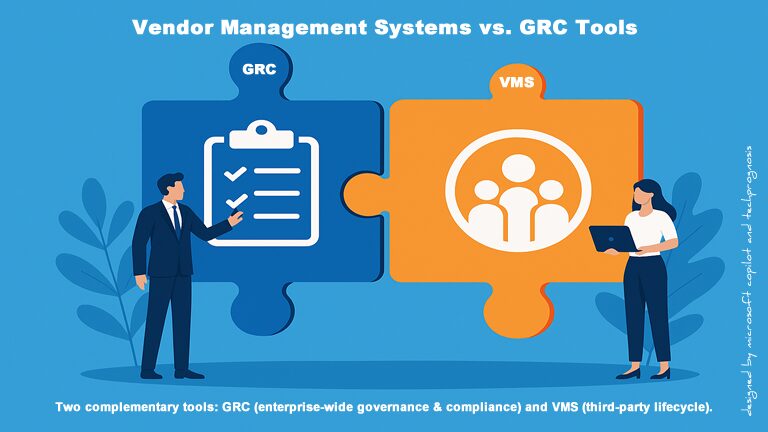
Key differences between GRC tools, and vendor management systems in terms of scope, integration, core functionality and outcomes.

Vendor Management Systems vs. GRC Tools: Understanding the Key Differences and How They Can Benefit Your Organization


In today’s fast-paced business environment, managing risk and ensuring compliance are critical. As organizations increasingly rely on third-party vendors, it’s more important than ever to have the right tools to assess and monitor vendor risk, alongside maintaining overall governance and compliance. But here’s the catch: while the terms GRC tools and Vendor Management Systems (VMS) are often used interchangeably, they serve very different purposes.

So, why does this matter?

If your organization is looking to streamline vendor management or strengthen your risk and compliance processes, it’s crucial to understand when to use GRC tools and when to turn to a Vendor Management System (VMS). Both can help manage risk, but they do so in distinct ways.

GRC platforms govern risk across the entire organization, while Vendor Management System tools specialize in managing the lifecycle of third‑party vendors.

In this article, we’ll explore the key differences and discuss how to make the right choice for your business, or organization.

Read more

Share

Business Impact Analysis: Principles, Methodologies, Challenges, and Best Practices

Male and female looking at a simulated Business Impact Analysis (BIA) dashboard with a huge magnifying glass.

The Complete Guide to Business Impact Analysis (BIA): Principles, Methodologies, Challenges, and Best Practices

Let’s talk about something that might sound a bit dry at first – Business Impact Analysis, or BIA for short. But trust me, as someone who’s spent years in the trenches of Governance, Risk, and Compliance (GRC), I can tell you, this is anything but boring. In fact, it’s the superhero cape your organization needs to navigate the unexpected.

Imagine a sudden power outage, a supply chain disruption, or even a cyberattack. What happens next? Do you scramble in the dark, hoping things will magically sort themselves out? Or do you have a plan, a roadmap that guides you through the chaos? That roadmap is built on the foundation of a solid BIA.

BIA helps businesses identify critical functions, assess the potential impact of disruptions, and establish strategies to minimize the effects of disruptions on these functions. This guide dives deep into the concept and principles of BIA, highlighting its role in various sectors, methodologies, challenges, and best practices.

Read more

Share

Information Security Risk Assessment: Best Practices for SMBs

Image of information security risk assessment concept with speedometer and people and graph chart analysis data information.

Understanding Information Security Risk Assessment: A Guide for Small and Medium-Sized Businesses

Today, protecting your business from cyber threats is more crucial than ever. Cybersecurity breaches can lead to significant financial losses, reputational damage, and even legal consequences. For small and medium-sized businesses (SMBs), the stakes are particularly high since they often lack the extensive resources of larger enterprises. This is where information security risk assessment comes into play. By understanding and implementing effective risk assessments, SMBs can safeguard their operations and ensure long-term success.

This comprehensive guide will walk you through the basics of information security risk assessment, using business-specific examples to illustrate key points. We’ll also share best practices that are practical and actionable, ensuring that your business can protect its valuable data without requiring deep technical knowledge.

Read more

Share
Share
Share