Modern Recovery Planning: A Central Texas Business Guide

Business professional walking through flooded Central Texas street during severe storm, holding umbrella and briefcase. A case for why modern recovery planning is essential.

When Disaster Strikes: A Central Texas Business Guide to Modern Recovery Planning

How Round Rock, Austin, and Central Texas Businesses Can Plan Modern Recovery by Building Resilience Using the NIST Cybersecurity Framework and Cloud Technologies


Executive Summary

Central Texas businesses face frequent disruptions—from severe winter storms and flash floods to cyber incidents. A modern recovery strategy combines Business Continuity Planning (BCP) and Disaster Recovery Planning (DRP) within the NIST Cybersecurity Framework’s Recover function to minimize downtime and protect revenue. Cloud approaches (e.g., “pilot light” on AWS/Azure) now deliver near–enterprise‑grade recovery at a fraction of the traditional cost.

Quick next step:
Schedule your free 15‑minute discovery call to discuss your recovery objectives (RTO/RPO) and build a right‑sized cloud‑enabled plan for your Round Rock, Austin, or broader Central Texas operations.

Read more

Share

Continuity Planning: Unexpected Disasters Your IT Provider Should Be Planning For

Simulation of risk management consultants looking at a diagram illustration of a business continuity planning dashboard.

Continuity Planning: The Unexpected Disaster Your IT Provider Should Be Planning For

Power outages, cyberattacks, hardware failures and natural disasters rarely arrive with a warning, and when they hit, the impact on small businesses can be devastating. Many assume that having a backup is enough, but the truth is, restoring a file isn’t the same as staying operational. If you can’t access systems, support remote work or keep your team and clients in the loop, even a short disruption can turn into a long-term setback. A reliable IT partner should prepare you for these moments – not just with backups, but with a complete plan to keep your business running no matter what.

Read more

Share

Business Impact Analysis: Principles, Methodologies, Challenges, and Best Practices

Male and female looking at a simulated Business Impact Analysis (BIA) dashboard with a huge magnifying glass.

The Complete Guide to Business Impact Analysis (BIA): Principles, Methodologies, Challenges, and Best Practices

Let’s talk about something that might sound a bit dry at first – Business Impact Analysis, or BIA for short. But trust me, as someone who’s spent years in the trenches of Governance, Risk, and Compliance (GRC), I can tell you, this is anything but boring. In fact, it’s the superhero cape your organization needs to navigate the unexpected.

Imagine a sudden power outage, a supply chain disruption, or even a cyberattack. What happens next? Do you scramble in the dark, hoping things will magically sort themselves out? Or do you have a plan, a roadmap that guides you through the chaos? That roadmap is built on the foundation of a solid BIA.

BIA helps businesses identify critical functions, assess the potential impact of disruptions, and establish strategies to minimize the effects of disruptions on these functions. This guide dives deep into the concept and principles of BIA, highlighting its role in various sectors, methodologies, challenges, and best practices.

Read more

Share

IT Preparedness: Six Risk-Based Questions Every Nonprofit Leader Must Ask


Circular diagram infographic showing text of six risk-based questions non-profit leaders must ask about information technology or IT preparedness before their IT expert leaves the organization.

Six Risk-Based Questions Every Nonprofit Leader Must Ask About IT Preparedness Before Their IT Expert Leaves

Nonprofit organizations rely heavily on their in-house IT experts to keep operations running smoothly. But have you ever thought about what happens if that expert suddenly quits? It’s not just an inconvenience—it could be a disaster. Here are six critical questions to help you identify your IT preparedness, identify potential risks and protect your nonprofit.

When your nonprofit’s in-house IT expert suddenly leaves, the organization might face serious challenges—from downtime to security risks. To avoid disruption, leaders must take a proactive approach to understanding and documenting their IT environment. These six questions can help nonprofits of any size safeguard their operations.

Read more

Share

Information Asset Security and Control: Tailored Strategies for SMBs

Isometric image of information asset security and control simulation showing a laptop with a security shield in front of it, a stack of storage devices with a locked padlock on top, an encryption key and a folder with a password prompt in front.

Information Asset Security and Control: Best Practices for Small and Medium-Sized Businesses

Information is one of the most valuable assets a business can possess in today’s fast-paced digital world. From customer data to financial records, the information that companies handle is crucial to their operations and success. However, with the rise in cyber threats, information asset security and control has become more critical than ever.

This comprehensive guide will delve into the essentials of information asset security and control, offering practical advice tailored for small and medium-sized businesses (SMBs). We’ll cover the importance of securing information assets, explore common threats, and provide best practices to safeguard your business.

Understanding Information Asset Security

What Are Information Assets?

Information assets include any data, digital files, and knowledge that hold value to your business. These can be customer records, financial information, proprietary software, marketing strategies, and even employee details. For SMBs, the security of these assets is paramount to avoid financial loss, reputational damage, and legal repercussions.

Read more

Share

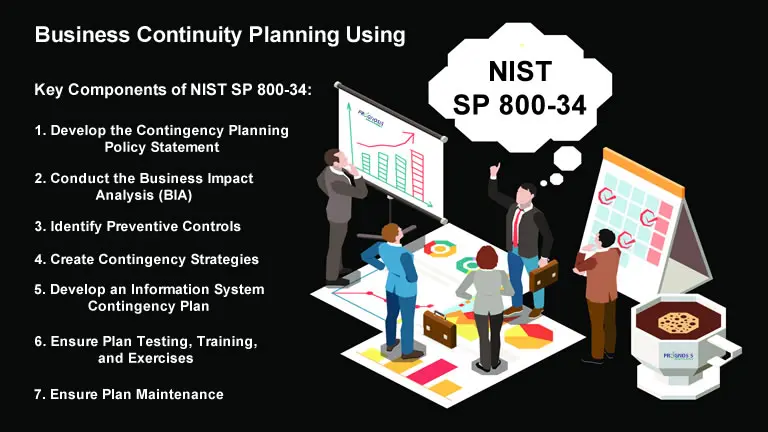
Business Continuity Planning Using NIST SP 800-34

Concept illustration of business continuity planning showing group of workers, NIST SP 800-34 thought bubbles, calendar, planning boards, and texts of the key components of the NIST SP 800-34 Framework: Develop the Contingency Planning Policy Statement, Conduct the Business Impact Analysis (BIA), Identify Preventive Controls, Create Contingency Strategies, Develop an Information System Contingency Plan, Ensure Plan Testing, Training, and Exercises, and Ensure Plan Maintenance.

Mastering Business Continuity Planning: A Guide Using NIST SP 800-34

In today’s fast-paced and interconnected world, businesses face an array of potential disruptions—from natural disasters and cyber-attacks to pandemics and supply chain failures. Ensuring that your organization can continue operations during and after such events is crucial. This is where Business Continuity Planning (BCP) comes in.

By using the National Institute of Standards and Technology’s (NIST) Special Publication (SP) 800-34 as our frame of reference, this comprehensive guide will delve into the principles of BCP as outlined in NIST SP 800-34, explore sector-specific examples, address common challenges, and present best practices to help your organization stay resilient.

Read more

Share
Share
Share