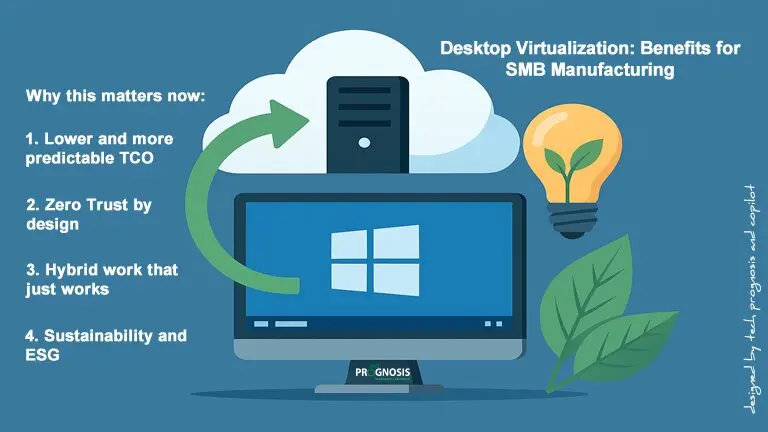
Desktop Virtualization: Benefits for SMB Manufacturing

Illustration of desktop virtualization concept showing a computer screen with Windows logo, cloud server, green arrow, light bulb, and leaves symbolizing sustainability.

The Future of Work is Here: How Modern Desktop Virtualization Empowers Your Team (and Your Bottom Line)

Imagine this: Your manufacturing team needs to access critical CAD software from the shop floor, the home office, and a client site—all in the same week. Or your accounting firm just onboarded five seasonal auditors who need secure access to sensitive financial data without waiting weeks for new laptops. Sound familiar? Modern desktop virtualization can empower your team (and your bottom line).

Desktop virtualization makes these scenarios not just possible, but simple. And the best part? It’s no longer reserved for enterprise giants with massive IT budgets. Today’s solutions are designed with small and mid-sized businesses in mind.

Let’s explore how modern desktop virtualization can transform the way your organization works—without the tech headaches.


What Is Desktop Virtualization, Anyway?

Think of desktop virtualization as running your computer “in the cloud” instead of on a physical machine sitting under your desk. Your team members can access their familiar Windows desktop, applications, and files from almost any device—whether that’s a laptop at home, a tablet on a job site, or a thin client terminal on the manufacturing floor.

Read more

Share

Access Control and the NIST Cybersecurity Framework

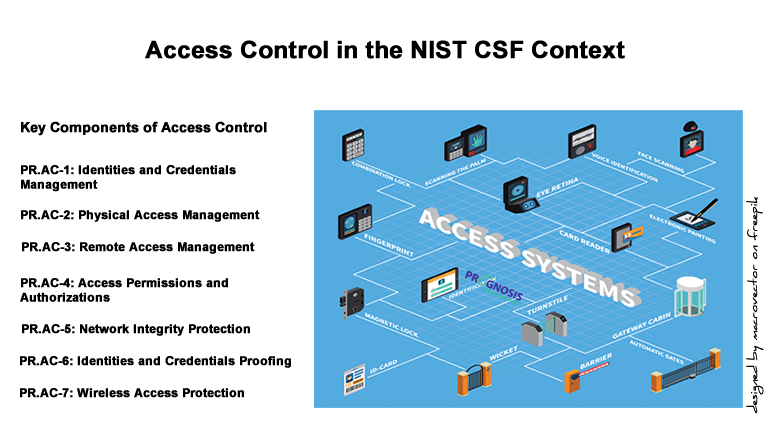
Access control systems isometric flowchart showing security systems using biometric verification, face and voice recognition, accessibility lock, security barriers etc.

Protecting Your Austin Business: A Deep Dive into Access Control and the NIST Cybersecurity Framework

If you’ve ever used a key card to enter your office building or typed a password into your laptop, you’ve experienced access control in action. But behind these everyday interactions lies a sophisticated security discipline that can make or break your organization’s cybersecurity posture—especially here in Austin, where our thriving tech scene and diverse business landscape make us an attractive target for cybercriminals.

As someone who’s spent years helping Texas businesses strengthen their security foundations, I’ve seen firsthand how proper access control can prevent devastating breaches, while poor implementation can lead to catastrophic consequences. Today, let’s explore access control through the lens of the NIST Cybersecurity Framework (CSF) and discuss how Austin organizations can protect their most valuable assets.

What is Access Control in the NIST CSF Context?

The National Institute of Standards and Technology (NIST) Cybersecurity Framework organizes cybersecurity activities into five core functions: Identify, Protect, Detect, Respond, and Recover. Access control falls squarely within the Protect Function, which focuses on developing and implementing appropriate safeguards to ensure delivery of critical services.

Specifically, access control is addressed in the Access Control (PR.AC) category of the Protect function. The NIST CSF defines this as managing access to assets and associated facilities to ensure that only authorized users, processes, or devices can access them—and only in a manner appropriate to their authorization level.

Think of access control as the digital and physical gatekeeper of your organization. It’s the system of policies, procedures, and technologies that determines who can enter your premises, what data they can view, which systems they can use, and what actions they can perform.

In Austin’s competitive business environment, where companies from healthcare startups to financial services firms handle sensitive information daily, robust access control isn’t just good practice—it’s essential for survival.

Read more

Share

Zero Trust: A Modern Approach to Cybersecurity with NIST SP 800-207

Data protection framework on a laptop simulating the zero trust assumption that threats can exist both inside and outside the network, and continuously verifying the identity and integrity of every user and device trying to access resources.

Cybersecurity is a top priority for organizations across all sectors. As cyber threats evolve, traditional security models are becoming less effective, prompting the need for more robust frameworks. One such framework is Zero Trust or ZT, which fundamentally shifts how organizations approach security. NIST SP 800-207 provides a comprehensive guide to implementing ZT.

This article will explore what Zero Trust is, delve into NIST SP 800-207, provide examples from various sectors, examine common challenges, and offer best practices for implementation.

Read more

Share
Share
Share