Internet of Things: Essential Security Requirements, Challenges, and Best Practices

Internet of things isometric infographic poster showing smart technology, security system, isometric phone, wearable technology etc.

Securing the Internet of Things: Essential Requirements, Challenges, and Best Practices

The Internet of Things (IoT) is transforming industries and daily lives by connecting devices, sensors, and systems to the internet, enabling unprecedented levels of data collection, analysis, and automation. From smart homes and healthcare to manufacturing and transportation, IoT is driving innovation and efficiency. However, the widespread adoption of IoT also introduces significant security challenges that organizations must address to protect sensitive data and ensure the integrity and reliability of their systems.

In this blog, we’ll explore the security requirements for IoT, examine challenges across different sectors, and offer best practices to help organizations secure their IoT deployments. We’ll also provide examples from specific industries to illustrate these concepts in action.

Understanding Internet of Things Security

What is Internet of Things?

IoT refers to the network of physical objects embedded with sensors, software, and other technologies to connect and exchange data with other devices and systems over the internet. Examples include smart thermostats, wearable fitness trackers, industrial sensors, and connected vehicles.

Read more

Share

Understanding GDPR: A Comprehensive Guide with Sector-Specific Examples

Image of laptop computer with a padlock and stars concept of GDPR, along with text outlining the key principles of GDPR.

GDPR: A Comprehensive Guide with Sector-Specific Examples

Introduction

The General Data Protection Regulation (GDPR) is a critical piece of legislation that reshaped the landscape of data privacy and security for organizations operating within the European Union (EU) and those dealing with EU citizens’ data. Since its implementation on May 25, 2018, GDPR has set a high standard for data protection, influencing laws worldwide.

In this article, we’ll explore the essentials of GDPR, examine specific examples from various sectors, discuss common challenges organizations face, and provide best practices for compliance. Whether you’re a business owner, a data privacy enthusiast, or simply curious about GDPR, this guide will offer valuable insights.

What is GDPR?

GDPR is a regulation in EU law on data protection and privacy for all individuals within the EU and the European Economic Area (EEA). It also addresses the export of personal data outside the EU and EEA areas. The primary aim of GDPR is to give control to individuals over their personal data and simplify the regulatory environment for international business by unifying the regulation within the EU.

Read more

Share

Information Security Risk Assessment: Best Practices for SMBs

Image of information security risk assessment concept with speedometer and people and graph chart analysis data information.

Understanding Information Security Risk Assessment: A Guide for Small and Medium-Sized Businesses

Today, protecting your business from cyber threats is more crucial than ever. Cybersecurity breaches can lead to significant financial losses, reputational damage, and even legal consequences. For small and medium-sized businesses (SMBs), the stakes are particularly high since they often lack the extensive resources of larger enterprises. This is where information security risk assessment comes into play. By understanding and implementing effective risk assessments, SMBs can safeguard their operations and ensure long-term success.

This comprehensive guide will walk you through the basics of information security risk assessment, using business-specific examples to illustrate key points. We’ll also share best practices that are practical and actionable, ensuring that your business can protect its valuable data without requiring deep technical knowledge.

Read more

Share

Information Systems Acquisition, Development, and Implementation

Image of isometric composition simulating information systems acquisition, development, and implementation showing IT professionals with system admin symbols

A Comprehensive Guide to Information Systems Acquisition, Development, and Implementation

Information systems (IS) are the backbone of successful organizations. They streamline operations, enhance decision-making, and improve customer satisfaction. However, acquiring, developing, and implementing these systems can be a daunting task.

This guide will walk you through the process, using examples from various sectors, addressing common challenges, and offering best practices to ensure a smooth journey.

Whether you’re a small business owner or part of a large enterprise, this comprehensive guide will help you understand the intricacies involved and offer best practices to ensure successful information systems projects.

Introduction to Information Systems

Information systems (IS) are integrated sets of components designed to collect, store, and process data, providing information, knowledge, and digital products. They play a pivotal role in managing operations, interacting with customers and suppliers, and competing in the marketplace. In essence, they form the backbone of modern organizations, driving efficiency and innovation.

Read more

Share

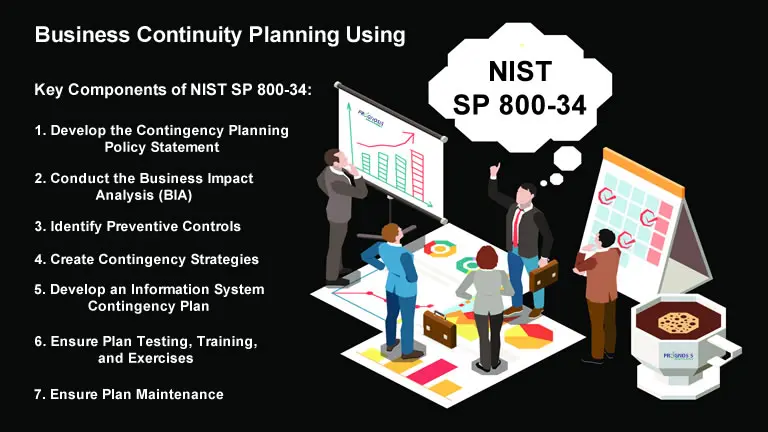
Business Continuity Planning Using NIST SP 800-34

Concept illustration of business continuity planning showing group of workers, NIST SP 800-34 thought bubbles, calendar, planning boards, and texts of the key components of the NIST SP 800-34 Framework: Develop the Contingency Planning Policy Statement, Conduct the Business Impact Analysis (BIA), Identify Preventive Controls, Create Contingency Strategies, Develop an Information System Contingency Plan, Ensure Plan Testing, Training, and Exercises, and Ensure Plan Maintenance.

Mastering Business Continuity Planning: A Guide Using NIST SP 800-34

In today’s fast-paced and interconnected world, businesses face an array of potential disruptions—from natural disasters and cyber-attacks to pandemics and supply chain failures. Ensuring that your organization can continue operations during and after such events is crucial. This is where Business Continuity Planning (BCP) comes in.

By using the National Institute of Standards and Technology’s (NIST) Special Publication (SP) 800-34 as our frame of reference, this comprehensive guide will delve into the principles of BCP as outlined in NIST SP 800-34, explore sector-specific examples, address common challenges, and present best practices to help your organization stay resilient.

Read more

Share

IT Governance: Key Focus Areas and Best Practices for Businesses

Isometric IT Governance concept with magnifier, graphs, clock, coins, tablet computer, laptop, business presentation, negotiations, and conference meeting illustration.

Understanding IT Governance: Key Focus Areas and Best Practices for Businesses

In today’s digital age, information technology (IT) is a critical component of business success. However, managing and aligning IT with business goals can be a complex task. This is where IT governance comes into play. IT governance ensures that IT resources and systems support business objectives, manage risks effectively, and deliver value. In this article, we will explore the key focus areas of IT governance and provide practical examples and best practices for businesses.

What is IT Governance?

IT governance is a framework that ensures IT investments support business goals, manage risks, and deliver value. It involves a set of processes, policies, and structures that help organizations manage and control their IT operations. Effective IT governance aligns IT strategy with business strategy, optimizes resources, and ensures compliance with regulations.

Read more

Share
Share
Share