Cybersecurity Crisis Management: Building Resilient Responses

Simulation of stressed executive instructing employees in office about cybersecurity crisis management.

Cybersecurity Crisis Management: Building Resilient Responses Across Manufacturing, Healthcare, and Finance

When it comes to cybersecurity, it’s not a question of if an incident will occur—it’s when. Whether you’re in manufacturing, healthcare, or finance, cyber threats don’t just disrupt business—they can harm people’s safety, compromise sensitive information, or destabilize markets.

This is why Cybersecurity Crisis Management has become one of the most vital disciplines in modern governance, risk, and compliance (GRC). At its heart, crisis management is about more than just reacting to an incident. It’s about preparing, escalating, containing, and learning from disruptions in a structured way—so your organization can bounce back stronger than before.

In this article, we’ll take a deep dive into the principles of cybersecurity crisis management, explore escalation matrices in detail (with step-by-step guidance for manufacturing, healthcare, and finance), walk through playbook examples, discuss common challenges, and outline how metrics can drive post-incident improvements.

We’ll also highlight some trusted tools and share best practices to help you build resilience in your organization.

Read more

Share

Texas Cybersecurity Framework: Fortifying Your Texas Digital Fortress

Half-circle Infographic with text flyouts of the five functions of the Texas Cybersecurity Framework - Identify, Protect, Detect, Respond, and Recover.

Texas Cybersecurity Framework: A Deep Dive into Fortifying Your Texas Digital Fortress

As a GRC (Governance, Risk, and Compliance) expert, I’ve had the privilege of guiding many organizations through the sometimes-dusty trails of cybersecurity. And when it comes to securing digital assets right here in the Lone Star State, one framework consistently stands tall: the Texas Cybersecurity Framework (TCF).

Now, cybersecurity might sound like complicated tech-speak, but at its heart, it’s about protecting what matters most – your data, your operations, and the trust of your customers. Think of the TCF as a well-laid-out blueprint for building a strong and resilient digital fortress. It provides a clear roadmap to help organizations, both big and small, navigate the ever-evolving landscape of cyber threats.

In this deep dive, we’ll unpack the TCF in plain language, exploring its origins, how it’s structured, some of its key components, the hurdles organizations often face, and practical ways to get started. So, grab your virtual Stetson, and let’s get to it!

Read more

Share

True Cost of Neglecting IT (Information Technology) and Support

Illustration of essential IT investments concept with technology symbols and text of collaboration and communication, cloud computing and storage, cybersecurity, and secure remote work solutions as a remedy for organizations and businesses neglecting IT (Information Technology) and Support

Neglecting IT (Information Technology) and Support : The Make-Or-Break Factor Business Owners Overlook—Until It’s Too Late

A CIO’s Perspective on IT as a Growth Driver, Not Just a Cost

As the vCIO of a couple of businesses and organizations, I have seen firsthand how technology can be either a strategic enabler or a major roadblock. Too often, business owners focus on growth, sales, and customer experience while leaving IT decisions on the back burner—until something goes wrong.

For many business owners, IT is seen as a necessary expense rather than a strategic asset. But the reality is that your technology infrastructure directly impacts efficiency, security, and growth. Slow computer systems, dropped phone calls impacting sales, outdated software, or weak cybersecurity measures that leave an organization’s data vulnerable don’t just cause occasional frustration—they can create significant vulnerabilities that cost your business time, money, and reputation.

Here’s the hard truth: neglecting IT and support can cost your business more than you think—in lost productivity, security risks, and missed opportunities. The right technology isn’t just an operational necessity; it is a competitive advantage.

So, let me ask you: Is your IT helping your business grow, or is it quietly holding you back?

Read more

Share

PCI Compliance Questionnaires: A Deep Dive

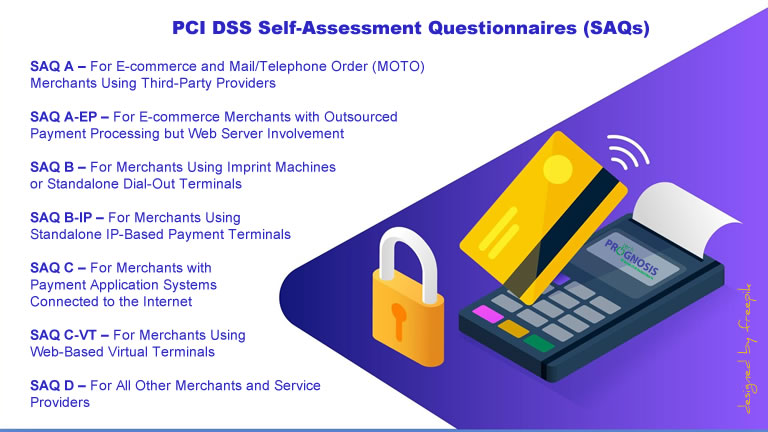
Credit card security isometric illustration showing a padlock, a credit card and a Point-of-Sale card reader, with text of types of PCI compliance questionnaires

A Deep Dive into PCI Compliance Questionnaires: Understanding the Differences and Overcoming Challenges

Payment security is critical in today’s digital economy, and the Payment Card Industry Data Security Standard (PCI DSS) plays a vital role in protecting payment card data from breaches and fraud. However, achieving PCI compliance can feel overwhelming, especially when organizations must determine the correct Self-Assessment Questionnaire (SAQ) or PCI compliance questionnaires to complete.

This article will provide a detailed breakdown of the different PCI DSS SAQs, the challenges businesses face in completing them, and best practices to streamline compliance. We’ll also explore risk appetite statements, clarify the roles of Qualified Security Assessors (QSAs) and Approved Scanning Vendors (ASVs), and conclude with a call to action for expert PCI compliance guidance.

Read more

Share

Zero Trust: A Modern Approach to Cybersecurity with NIST SP 800-207

Data protection framework on a laptop simulating the zero trust assumption that threats can exist both inside and outside the network, and continuously verifying the identity and integrity of every user and device trying to access resources.

Cybersecurity is a top priority for organizations across all sectors. As cyber threats evolve, traditional security models are becoming less effective, prompting the need for more robust frameworks. One such framework is Zero Trust or ZT, which fundamentally shifts how organizations approach security. NIST SP 800-207 provides a comprehensive guide to implementing ZT.

This article will explore what Zero Trust is, delve into NIST SP 800-207, provide examples from various sectors, examine common challenges, and offer best practices for implementation.

Read more

Share

Risk and Information Systems Control: Navigating IT Risks with Confidence


Risk and information systems control banner with isometric man and risk meter on gears with concept of the tools organizations use to manage risks associated with their information systems.Risk management and information systems control are essential in today’s digital age. As businesses increasingly rely on robust information systems to drive efficiency, foster innovation, and gain a competitive edge, the potential risks associated with cyber threats, data breaches, and system failures have grown exponentially. There is an equally critical responsibility facing organizations: managing the risks associated with these systems.

But what exactly does “Risk and Information Systems Control” mean, and why is it crucial for every organization?

Risk and Information Systems Control (RISC) is a framework that helps organizations safeguard their assets, comply with regulations, and build resilient operations.

This blog dives into the fundamentals, challenges, and best practices to help businesses protect their most valuable asset: information.

Read more

Share
Share
Share