Business Impact Analysis: Principles, Methodologies, Challenges, and Best Practices

Male and female looking at a simulated Business Impact Analysis (BIA) dashboard with a huge magnifying glass.

The Complete Guide to Business Impact Analysis (BIA): Principles, Methodologies, Challenges, and Best Practices

Let’s talk about something that might sound a bit dry at first – Business Impact Analysis, or BIA for short. But trust me, as someone who’s spent years in the trenches of Governance, Risk, and Compliance (GRC), I can tell you, this is anything but boring. In fact, it’s the superhero cape your organization needs to navigate the unexpected.

Imagine a sudden power outage, a supply chain disruption, or even a cyberattack. What happens next? Do you scramble in the dark, hoping things will magically sort themselves out? Or do you have a plan, a roadmap that guides you through the chaos? That roadmap is built on the foundation of a solid BIA.

BIA helps businesses identify critical functions, assess the potential impact of disruptions, and establish strategies to minimize the effects of disruptions on these functions. This guide dives deep into the concept and principles of BIA, highlighting its role in various sectors, methodologies, challenges, and best practices.

Read more

Share

IT Preparedness: Six Risk-Based Questions Every Nonprofit Leader Must Ask


Circular diagram infographic showing text of six risk-based questions non-profit leaders must ask about information technology or IT preparedness before their IT expert leaves the organization.

Six Risk-Based Questions Every Nonprofit Leader Must Ask About IT Preparedness Before Their IT Expert Leaves

Nonprofit organizations rely heavily on their in-house IT experts to keep operations running smoothly. But have you ever thought about what happens if that expert suddenly quits? It’s not just an inconvenience—it could be a disaster. Here are six critical questions to help you identify your IT preparedness, identify potential risks and protect your nonprofit.

When your nonprofit’s in-house IT expert suddenly leaves, the organization might face serious challenges—from downtime to security risks. To avoid disruption, leaders must take a proactive approach to understanding and documenting their IT environment. These six questions can help nonprofits of any size safeguard their operations.

Read more

Share

Natural Disasters and Malicious Activities: How to Protect Your Business and Yourself

Simulation of malicious activities after natural disasters like phishing and a cybercriminal stealing password.

In the wake of natural disasters, people and organizations are often focused on recovery, safety, and rebuilding. Unfortunately, cybercriminals see these times of crisis as prime opportunities to exploit vulnerabilities. Whether through phishing emails, malware attacks, or fraudulent schemes, malicious actors strike when defenses are down and emotions are high. Understanding how to avoid falling victim to these cyber threats is essential for both individuals and businesses as they recover from disasters.

In this article, we’ll explore the common cyber risks that arise after natural disasters, how to recognize them, and practical steps you can take to protect yourself and your business. We’ll also highlight some valuable resources available to help you stay safe online during these challenging times.

Read more

Share

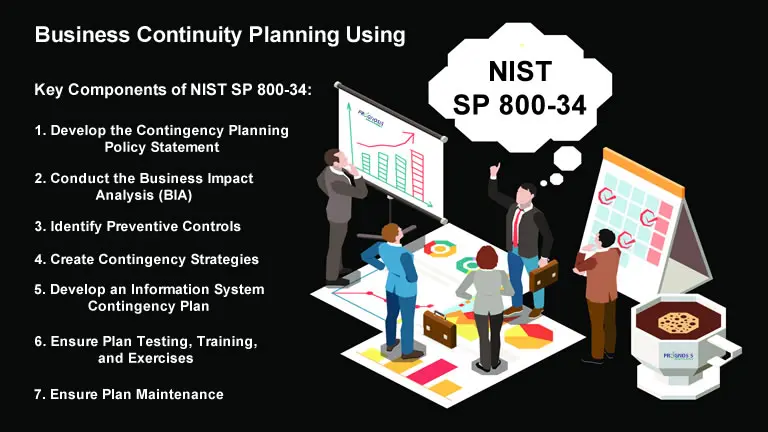
Business Continuity Planning Using NIST SP 800-34

Concept illustration of business continuity planning showing group of workers, NIST SP 800-34 thought bubbles, calendar, planning boards, and texts of the key components of the NIST SP 800-34 Framework: Develop the Contingency Planning Policy Statement, Conduct the Business Impact Analysis (BIA), Identify Preventive Controls, Create Contingency Strategies, Develop an Information System Contingency Plan, Ensure Plan Testing, Training, and Exercises, and Ensure Plan Maintenance.

Mastering Business Continuity Planning: A Guide Using NIST SP 800-34

In today’s fast-paced and interconnected world, businesses face an array of potential disruptions—from natural disasters and cyber-attacks to pandemics and supply chain failures. Ensuring that your organization can continue operations during and after such events is crucial. This is where Business Continuity Planning (BCP) comes in.

By using the National Institute of Standards and Technology’s (NIST) Special Publication (SP) 800-34 as our frame of reference, this comprehensive guide will delve into the principles of BCP as outlined in NIST SP 800-34, explore sector-specific examples, address common challenges, and present best practices to help your organization stay resilient.

Read more

Share

Online Tracking & Spying is No Joke!

You’ve heard about it and read tons of articles about it, but until you actually experience it, you do not realize how unnerving online spying can be. As a Computer Security Consultant, I spend a lot of time on the internet reading, researching and writing. Naturally, I subscribe to a lot of content providers for white-papers, research reports etc.

Recently, I started noticing a trend that did not initially ring an alarm bell.

Read more

Share
Share
Share