Modern Recovery Planning: A Central Texas Business Guide

Business professional walking through flooded Central Texas street during severe storm, holding umbrella and briefcase. A case for why modern recovery planning is essential.

When Disaster Strikes: A Central Texas Business Guide to Modern Recovery Planning

How Round Rock, Austin, and Central Texas Businesses Can Plan Modern Recovery by Building Resilience Using the NIST Cybersecurity Framework and Cloud Technologies


Executive Summary

Central Texas businesses face frequent disruptions—from severe winter storms and flash floods to cyber incidents. A modern recovery strategy combines Business Continuity Planning (BCP) and Disaster Recovery Planning (DRP) within the NIST Cybersecurity Framework’s Recover function to minimize downtime and protect revenue. Cloud approaches (e.g., “pilot light” on AWS/Azure) now deliver near–enterprise‑grade recovery at a fraction of the traditional cost.

Quick next step:
Schedule your free 15‑minute discovery call to discuss your recovery objectives (RTO/RPO) and build a right‑sized cloud‑enabled plan for your Round Rock, Austin, or broader Central Texas operations.

Read more

Share

Defense Supply Chain and CMMC: Practical Steps for Vendor Security

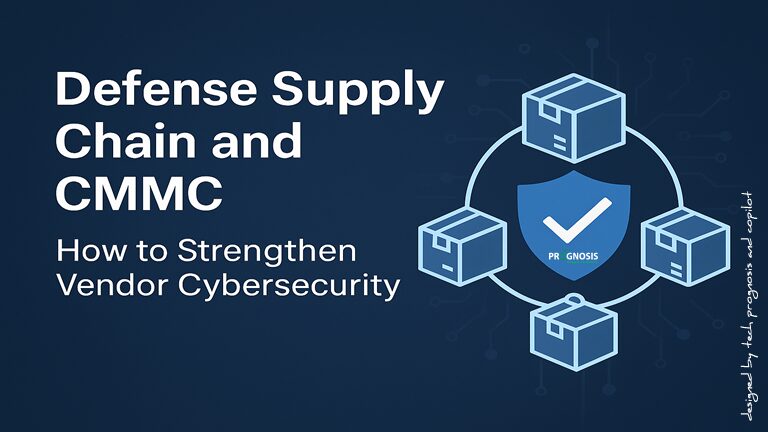
Illustration of secure defense supply chain with shield and interconnected boxes representing vendors

CMMC 2.0 and Defense Supply Chain Attacks: Practical Steps to Build Resilience Across Your Vendor Ecosystem

Supply chain attacks keep rising because attackers go where trust and access already exist—third-party vendors, managed service providers, and software suppliers. If you handle Federal Contract Information (FCI) or Controlled Unclassified Information (CUI), your security posture is only as strong as your partners’. CMMC 2.0 responds to this reality by placing verifiable expectations on every tier that touches sensitive DoD data. In this post, we’ll break down the threat, connect it to CMMC’s objectives, and share a practical roadmap you can start using today—grounded in inclusive, plain language and real-world scenarios.

Why the Defense Supply Chain Is a Prime Target

  • The attack surface is huge. Organizations share data with hundreds of vendors, yet few have mature processes to evaluate and improve vendor cybersecurity posture. In 2023, 15% of breaches involved a defense supply chain compromise, and 98% of companies had at least one vendor that experienced a breach. This is a perfect storm of exposure and limited oversight.
  • High-profile cases illustrate the risk. The SolarWinds Orion compromise showed how malicious code in a trusted update can ripple across government and commercial networks. Likewise, the 2023 third-party breach linked to Infosys McCamish Systems affected more than 57,000 Bank of America-related entities, underscoring how downstream vendors can become a gateway for attackers.

Inclusive takeaway: regardless of your organization’s size, role, or location within the Defense Industrial Base (DIB), defense supply chain risk touches everyone who processes, stores, or transmits FCI/CUI.

Read more

Share

CMMC Controls MSSPs Should Already Have (But Might Not)

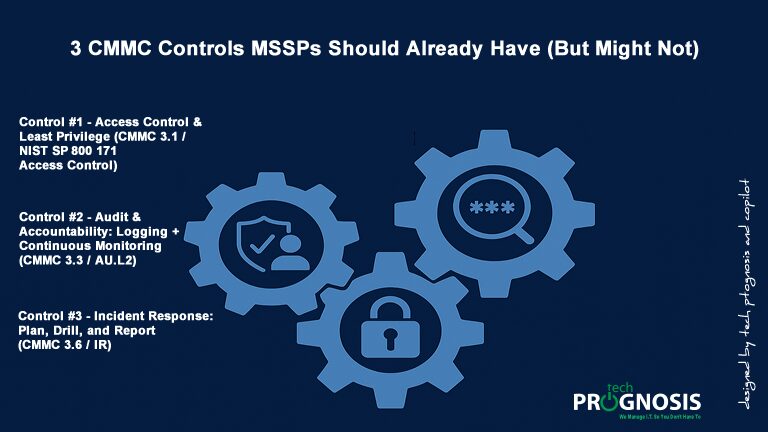
Three interlocking gears on a dark blue background, each containing security icons: a shield with a user silhouette, a magnifying glass with password symbols, and a padlock. Above the gears, bold white text reads ‘3 CMMC Controls MSSPs Should Already Have (But Might Not)’.

3 CMMC Controls MSSPs Should Already Have (But Might Not) — Plus Real‑World Case Studies

Hey there, MSSP heroes! Let’s cut to the chase: If you’re prepping for a CMMC audit, you’re already ahead of the game. But here’s the kicker—many MSSPs (just like you!) might be missing a few key CMMC controls staring them right in the face.

CMMC isn’t just about checking boxes—it’s about proving you’re trustworthy enough to protect sensitive government data. And while you’ve likely got solid security practices in place, CMMC’s specific requirements can trip you up if you’re not paying attention.

As a CISM & CISSP‑holding MSSP myself, I know how overwhelming the CMMC landscape can feel. There are so many controls! But here’s the good news: You probably already have the foundation for several critical CMMC controls… you just might not realize it!

In this post, we’ll uncover three essential CMMC controls that every MSSP should have in their toolbox — yet many overlook. I’ll break each one down with real‑world examples, a simple analogy, and actionable tips. Let’s turn “uh‑oh” into “I’ve got this!”

Read more

Share

Security Testing for Critical Systems: How Businesses in Round Rock Can Protect Sensitive Data

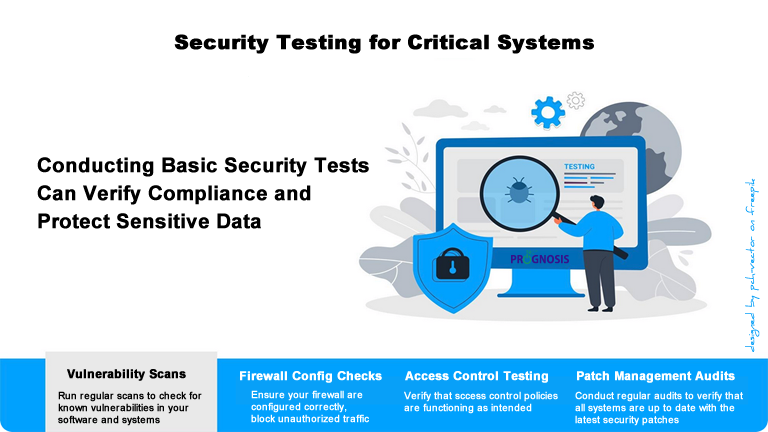
Simulation of security testing for critical systems showing a security shield, and a man in a blue shirt holding a magnifying glass over a software bug.

A Comprehensive Guide to Security Testing for Critical Systems: How Businesses in Round Rock Can Protect Sensitive Data

In today’s digital age, cybersecurity is not just a technical concern—it’s a critical aspect of protecting your business’s future. As businesses in Round Rock, Texas, and surrounding cities grow increasingly dependent on technology, securing sensitive data and critical systems has become more important than ever. Whether you’re in healthcare, finance, or retail, data protection should be a top priority.

This comprehensive guide will walk you through the essentials of security testing and security assessments, focusing on how businesses can safeguard their most critical systems, particularly those holding sensitive information.

From understanding the differences between security testing and security assessments, to how you can incorporate best practices into your own operations, this blog is a valuable resource for business owners, managers, and IT leaders looking to ensure that their cybersecurity measures are up to par.

Let’s dive into how effective security testing and risk assessments can make a difference in your organization’s security posture.

Read more

Share

Vendor Management Systems vs. GRC Tools: Key Differences Explained

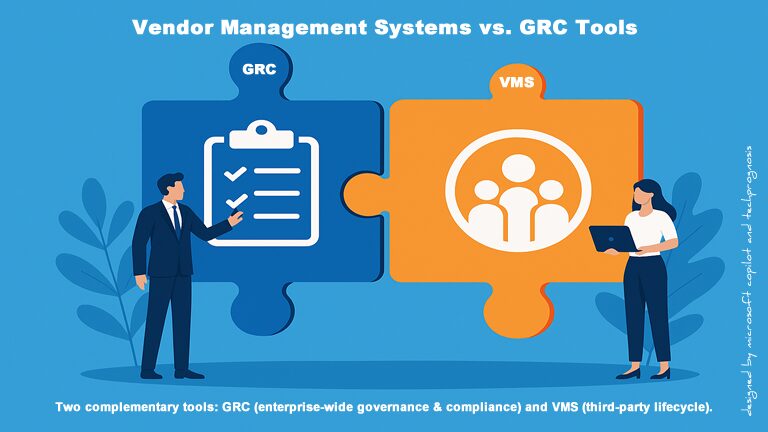
Key differences between GRC tools, and vendor management systems in terms of scope, integration, core functionality and outcomes.

Vendor Management Systems vs. GRC Tools: Understanding the Key Differences and How They Can Benefit Your Organization


In today’s fast-paced business environment, managing risk and ensuring compliance are critical. As organizations increasingly rely on third-party vendors, it’s more important than ever to have the right tools to assess and monitor vendor risk, alongside maintaining overall governance and compliance. But here’s the catch: while the terms GRC tools and Vendor Management Systems (VMS) are often used interchangeably, they serve very different purposes.

So, why does this matter?

If your organization is looking to streamline vendor management or strengthen your risk and compliance processes, it’s crucial to understand when to use GRC tools and when to turn to a Vendor Management System (VMS). Both can help manage risk, but they do so in distinct ways.

GRC platforms govern risk across the entire organization, while Vendor Management System tools specialize in managing the lifecycle of third‑party vendors.

In this article, we’ll explore the key differences and discuss how to make the right choice for your business, or organization.

Read more

Share

Generative AI in Risk and Compliance

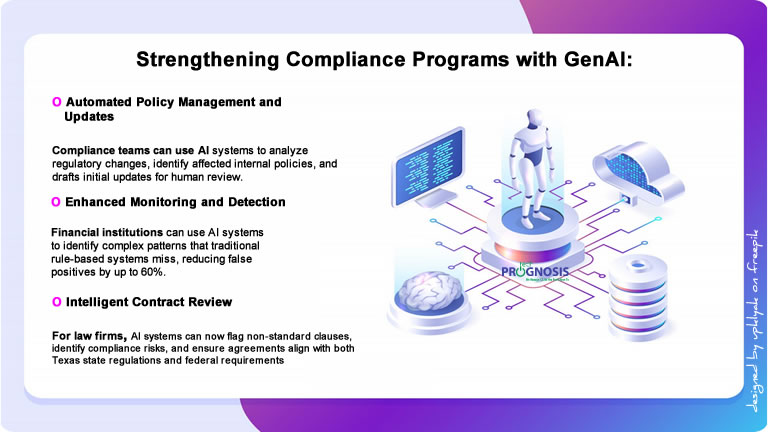
Generative AI concept showing humanoid with neural network, code on a computer monitor, and cloud computing icon.

Generative AI in Risk and Compliance: How Texas Enterprises Are Navigating the New Frontier

The Generative AI revolution isn’t coming—it’s already transforming conference rooms from Round Rock to Richardson, and boardrooms from Austin to Arlington.

When Dell Technologies’ compliance team in Round Rock began experimenting with generative AI tools in early 2023, they discovered something remarkable: what started as a productivity enhancement quickly evolved into a fundamental reshaping of their entire risk landscape. This transformation isn’t unique to Dell—it’s happening across Texas enterprises, from Samsung’s semiconductor facilities in Austin to the financial institutions lining Dallas’s Main Street.

As someone who’s spent years helping organizations navigate the complex waters of governance, risk, and compliance (GRC), I’ve witnessed firsthand how generative AI is simultaneously creating unprecedented opportunities and introducing risks that keep chief compliance officers awake at night.

Let’s explore how this technology is reshaping enterprise risk profiles and where it can genuinely deliver value for your organization.

Read more

Share
Share
Share